Are nuclear power plants REALLY cheaper than natural energy?
 Creating a Solar Belt in East Japan: The Energy Future, Japan Focus , Son Masayoshi with an introduction by Andrew DeWit, 19 Sept 11 “……… Are nuclear power plants actually cheap while natural energy is expensive? From the standpoint of practical, economical logic, solar power and natural energy are expensive. I had always believed that nuclear power was the most inexpensive way of producing power, at 5-6 yen per kilowatt-hour; therefore we have to use nuclear power and construct new plants. I am sure that many people thought the same.

But is this really true? According to figures listed on an application for approval of the nuclear power plant installation, its unit cost is 15-20 yen. This is the actual data; the pre-accident cost.
So then what happens if we add the cost of the accident? TEPCO obviously should pay this, but any cost beyond its capacity will fall to the government; in other words, tax. If we include the full cost of the accident, nuclear power may in fact be the most expensive form of energy.
As this example illustrates, the true cost of nuclear power should include local subsidies, nuclear waste processing costs and accident coverage. We need to reevaluate the legitimacy of “5-6 yen,” which was the initial hook, but now seems somewhat off.
Moreover, 15 yen was a figure derived from commodity prices 30 years ago, so I wonder what the figure per kilowatt-hour (kWh) would be for a new nuclear power plant today. The number 3 reactor at Olkiluoto Nuclear Power Plant in Finland was slated for an initial construction budget of 350 billion yen, but the work was continually delayed as safety standards continued to rise, and has already cost 1.5 trillion yen despite still having no schedule for completion. Accounting only for capital investment and without fuel or operating costs, the plant already costs 14 yen/kWh, and fuel and operating costs would add to this. The world no longer makes new nuclear power plants because the truth is, as this case shows, they come at a huge cost.
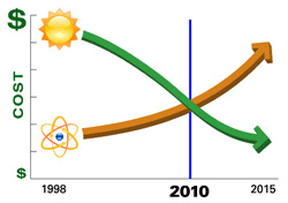
A graph shows some surprising data. Power production costs for solar and nuclear energy in the U.S. crossed over each other last year, in 2010. I, like many others, had thought that natural energy was ideal but expensive, that solar power would not work in the rain or at night, and nuclear energy could mass-produce and was inexpensive. But a crossover of the two actually occurred last year, with all the rain and night concerns accounted for and looking only at production cost during operation. Looking at this case makes us think that we must shift our energy policy toward realizing a society in which every citizen can feel safe……
Looking at trends of the next 10 and 20 years brings an expectation that fossil fuel prices will rise. On the other hand, costs are declining for natural energy, owing to effects of mass production and technological innovation as seen in the U.S. It is time for our government to draw up a grand vision.
The average monthly electricity bill of a common household is about 8,000 yen, and if we account for the 40 yen for 20 years purchase price in this, the bill temporarily rises by about 500 yen. But this buys us safety and assurance. Fossil fuel prices will continue to rise, and nuclear power plants will further involve accident costs. There is no need for us to resort to more dangerous and expensive options……
The sun will rise again
Solar, solar thermal, wind, geothermal, biomass, oceanic energy and other blessings of nature can be used for thousands of years without contaminating the Earth. These are forms of energy that coexist with nature without destroying it. I have one suggestion to make concerning a vision on recovering from the quake. It is known that land salinized by the tsunami cannot be cultivated for the next decade. How much money would it take to “recover” such farmland and create taller embankments? What future do we see there? Can the government instead take the lead in creating an “East Japan Solar Belt” as an area for producing new energy for the future?
Ports of the past could gain new life as ports of solar and wind energy. Such a recovery project would create huge job opportunities for the region’s people, and Japanese manufacturers already have the number-one solar technology in the world. Instead of exporting it, we should use it domestically to create the world’s largest Solar Belt.
In this way, the sun of 21st century Japan would rise again rather than continuing to set. And with safety and assurance, people could live on this land for many thousands of years. I believe that our nation can come up with such a hopeful vision….
Translated from “Higashi-nihon ni sora-a beruto chitai wo: Taiyo no minato, kaze no minato de nihon ha yomigaeru,” Sekai, June 2011, pp. 44–51, by Son Masayoshi. Japan Echo Web No. 7 August-September 2011
SON Masayoshi
Chairman & CEO, SOFTBANK Corp. Representative Director & President, Yahoo Japan Corporation. Born 1957 in Saga Prefecture. Graduated from the Economics Department of the University of California, Berkeley. Founded SOFTBANK Corp. Japan in 1981. Established the Broadband Association in 2003 and assumed the role of Representative Chairman.
No comments yet.
1 This month

of the week – Australians for War Powers Reform (AWPR)
To see nuclear-related stories in greater depth and intensity
 Antinuclear
Leave a comment