Australia’s Clean Energy Finance Corporation a chance to turbocharge renewable energy
 Next generation of clean energy technology is within Australia’s grasp, SMH, Kane Thornton October 5, 2011 “…….The Clean Energy Finance Corporation (CEFC) pledged under the federal government’s carbon price package will use $10 billion of carbon price revenue from big polluters as loans for new, clean energy technologies. It will be overseen by an independent board of finance professionals.
Last year, renewable energy provided about 8.6 per cent of Australia’s electricity. We are headed for 20 per cent by 2020 under the bipartisan Renewable Energy Target. A recent review by the Productivity Commission found that most of Australia’s trading partners have introduced some kind of target for renewable energy. The debate on a carbon price continues, but the energy target is currently Australia’s largest climate change policy, set to lead to the reduction of about 380 million tonnes of carbon emissions by the end of the decade. Like the IT industry in the late 1990s, some incredibly bright minds across the world have turned their attention to developing new technologies that can produce clean, renewable electricity…..lobally there are plenty of examples where the investment is indeed paying off. Figures from Bloomberg New Energy Finance show that $US243 billion ($A252 billion) was invested in clean energy last year, as the sector continues to outstrip traditional energy. Some of the world’s biggest players are seeing the value in clean energy investments, including Google, GE, the US military, Samsung and engineering giant Siemens. GE’s Ecomagination program made more than $80 billion for the company over the past five years by combining good business and sustainability.
Clean energy is a massive opportunity for Australia. There will be the occasional setback, but this is an opportunity we should be seizing with both hands rather than looking for reasons to sit on them. http://www.smh.com.au/business/next-generation-of-clean-energy-technology-is-within-australias-grasp-20111004-1l77n.html#ixzz1a25GMjO9
Uranium mining – Global X Uranium ETF is down over 60% this year!
 Over the last month, these companies have lost between 25 and 29 percent, and they have lost between 57 and 84 percent so far this year. These significant losses proliferate uranium miners and producers, as can be seen from the Global X Uranium ETF (URA), which tracks the Solactive Uranium Index and is down over 60% so far this year…..
 An Abysmal Month For Uranium Producers Extends Their 2011 Pain, Seeking Alpha 4 Oct 11, The uranium industry is not what it used to be, nor are the share values of the uranium producers. This may well go down as the worst year for uranium in the modern era, even though several nuclear power experts continue to claim that uranium use is sensible and safe.
This first quarter of 2011 started off with Japanese nuclear concerns following the destruction caused by the earthquake and tsunami that hit the nation, and uranium prices entered a tailspin shortly thereafter. In the wake of tsunami, Germany opted to discontinue nuclear power plant development and reveal plans to eventually eliminate nuclear power as an energy source.
It also appears likely that Japan may be hesitant to build more nuclear power plants in the near future. For many years, Japan and Germany have been significant users of nuclear power. This perceived vacuum to demand weakened the price of uranium. It also weakened the shares of those companies that produce and/or provide uranium…..
In the third quarter, which just ended last week, uranium and its producers continued to drop along with the broader market, only mostly to a broader extent as the investment was deemed more and more speculative. Most uranium producers ended the third quarter at their 2011 lows.
Below are the 1-month, 3-month, 6-month, and 2011-to-date performance rates for several companies that mine and/or provide uranium for energy production: Continue reading
In USA renewable energy now beating nuclear power
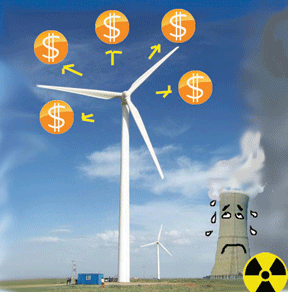
 U.S. Energy Information Administration (EIA) data shows U.S. production of renewable energy greater than nuclear power, PennEnergy, Washington D.C., October 3, 2011 — According to the most recent issue of the “Monthly Energy Review” by the U.S. Energy Information Administration, with data through June 30, 2011, renewable energy has passed another milestone as domestic production is now greater than that of nuclear power and continues to close in on oil.
During the first half of 2011, renewable energy sources (biomass & biofuels, geothermal, solar, water, wind) provided 4.687 quadrillion BTUs of energy or 12.25 percent of U.S. energy production.
By comparison, renewables accounted for 11.05 percent of domestic production during the first half of 2010 and 10.50 percent during the first half of 2009. (On the consumption side, which includes oil and other energy imports, renewable sources accounted for 9.45 percent of total U.S. energy use.)
Energy production from renewable energy sources in 2011 was 17.91 percent more than that from nuclear power, which provided 3.975 quadrillion BTUs and has been declining in recent years. Energy from renewable sources is now equal to 79.83 percent of that from domestic crude oil production, with the gap closing rapidly. Continue reading
1 This month

of the week – Australians for War Powers Reform (AWPR)
To see nuclear-related stories in greater depth and intensity
 Antinuclear