A mixed “blessing” for Australia in radiation cleanup breakthrough
 It is comforting that Queensland’s Professor Zhu tells us that radiation cleanup will still be needed, even if the world abandons nuclear power. In that case, it is good that Australia might provide other parts of the world with a technology to help in this.
On the other hand, Professor Zhu tells us “we have the technology to do the cleaning up for the world.” This is far from comforting, especially when we realise that the Australian Nuclear Science and Technology Organisation is involved. ANSTO is well known as a promoter of nuclear technology. There are some in Australia, like John White, Ron Walker and Robert Champion de Crespigny, and others – who would just love to make several $billion out of importing foreign nuclear wastes into Australia.
This new “radiation absorbent’ might be just the technology they want? – Christina Macpherson
 Breakthrough to help clean up contaminated water, Brisbane Time s, 2 Nov 11 Brisbane scientists have helped developed an intelligent absorbent, which they hope will solve the problem of how to clean up water contaminated with radioactive waste. The research team believes the technology will benefit industries rangingfrom mining to medicine, plus assist in clean-up efforts after nuclear disasters.
One gram of the absorbent can “effectively purify at least one tonne of polluted water”, according to Professor Huai-Yong Zhu from Queensland University of Technology Chemistry. The absorbent, developed in collaboration with the Australian Nuclear Science and Technology Organisation and Pennsylvania State University in the United States, effectively locks in the dangerous radioactive material and extracts it from the water.
It uses titanate nanofibre and nanotube technology. Professor Zhu said the technology would run the contaminated water through fine nanotubes and fibres, trapping radioactive ions.
The absorbent could then be safely disposed without the risk of leakage, even if the material became wet. “This saves large amounts of dangerous water needing to be stored somewhere and also prevents the risk of contaminated products leaking into the soil,” Professor Zhu said……Even if we decide that nuclear energy is not the way we want to go, we will still need to clean-up what’s been produced so far and store it safely.
“Australia is one of the largest producers of titania that are the raw materials used for fabricating the absorbents of titanate nanofibres and nanotubes. Now with the knowledge to produce the absorbents, we have the technology to do the cleaning up for the world.”
Christina Macpherson It all might be rather fanciful anyway. If you go to “comments” on this item, you will see a comment from a radiation expert, who throws cold water on the whole proposal, anyway, and wonders why, if it’s so great “why this breakthrough is not on the front page of the IAEA “?
Japanese mothers confront government on nuclear radiation, and demand nuclear shutdown
The women are calling for two things. First, they want to protect children living in highly contaminated areas by giving them the officially sanctioned ‘right to evacuate.’ This would include government compensation and support that would enable children and their families to relocate on a voluntary basis.
Secondly, they want to close down all nuclear power plants in Japan. “Fukushima women feel very strongly that there is no safe nuclear power,” “This is the lesson to be learned from Fukushima.”
The women have asked for a response from the state by Nov. 11—exactly eight months after the deadly quake.
 Fukushima Women Demand Better Protection for Children Exposed to Radiation, TIME.com , November 3, 2011 Lucy Birmingham. About 100 women from Fukushima, Japan, have started a week-long sit-in at a government office in Tokyo to demand greater protection for children affected by radiation. “Many children and their families are trapped in Fukushima because they can’t afford to move,” explains Ayako Oga, 38, a housewife living in the prefecture and one of the sit-in organizers. “The government has set the accepted radiation exposure rate too high.” Japan’s standard rate for exposure to radiation is 1 millisievert per year. For Fukushima residents alone the accepted exposure rate is up to 20 millisieverts per year. The International Commission on Radiological Protection considers this rate the top level and says it should not be exceeded over the long term.
National and prefectural governments have determined that until the 20 millisieverts level they are not obligated to offer financial support to residents, certain businesses or schools wanting to relocate outside the irradiated areas. At the heart of the debate is the question of who has a ‘right to evacuate.’ “At Chernobyl, the right to evacuate, which means government support, was given from 1 to 5 millisieverts. In Japan it’s 20,” Continue reading
Aboriginal culture may yet save Australia for European pastoralists, Aborigines and environmentalists
 Honour invasion warriors’, Canberra Times, BY BREANNA TUCKER, 04 Nov, 2011 “…………..Professor Flannery pointed out that Australia would do well to take lessons from its elders.
He said technology had made the world smaller, and communication and building strong links had become the key to successful business. But far from being covered in dust in the history books, Aboriginal people had pioneered the structure in which such relationships needed to be build.
”Aborigines were the only people who, without the assistance of any transport, forged a community of knowledge and interconnectedness that spanned an entire continent,” Professor Flannery said. ”If you look at the records, people from the Kimberley knew the names of people living in the Great Australian Bight.
”They did not trade in physical goods, they traded in intellectual property, in songs and knowledge. The maintenance of that connectedness is an echo of the world we’re now moving into because knowledge is everything in the modern world.”
Professor Flannery ended by reflecting on Australian politics, in which he said Aboriginal people and Australians were perhaps more aligned than they realised. Where the nation was once divided between European pastoralists, Aborigines and environmentalists, the interests of all three groups were now merging.
”There is a thirst out there for a new sort of partnership, reflecting a new reality and that reality is that Europeans on the land, Aboriginal people and environmentalists now have a very strong common thread.
”But unless we acknowledge and really come to terms with our past, we won’t be able to fully take the benefits of the diverse place Australia has become.” http://www.canberratimes.com.au/news/local/news/general/honour-invasion-warriors/2346731.aspx
With 30% drop in uranium price, AREVA stops uranium mine project

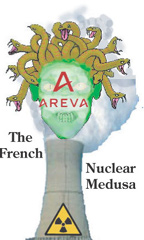 Areva suspends uranium mine project, SMH ,November 3, 2011 – French nuclear giant Areva says it is suspending a mining project in the Central African Republic for “a year or two” because of a drop in uranium prices since the Fukushima disaster. Work on developing the Bakouma mine, which is estimated to hold about 32,000 tonnes of uranium, has been suspended until the market value of the commodity rises again, an Areva spokesman said on Wednesday……
The price of uranium subsequently dropped by about 30 per cent, at a time when Areva was hoping for a global nuclear power renaissance. On Wednesday the price of a pound (450 grams) of uranium was at $US52 ($A50.49), down from $US68 in March before the accident…..
Areva began development works at the mine under a deal signed in 2007 and to date has spent 106 million euros on developing the site. The 2007 deal ended friction between Areva and the country’s authorities, who had handed mining rights to British-Canadian firm UraMin in 2006.
Areva bought out UraMin in July 2007 to the displeasure of the government, which said the “irregular” sale showed “disregard for the rights and interests” of the Central African people….. Areva is expected to present a plan next month on a rethink of its corporate strategies in the wake of the Japanese disaster.http://news.smh.com.au/breaking-news-business/areva-suspends-uranium-mine-project-20111103-1mw4h.html
1 This month

of the week – Australians for War Powers Reform (AWPR)
To see nuclear-related stories in greater depth and intensity
 Antinuclear