Shareholders grill BHP about environmental risks of planned new mega uranium mine at Olympic Dam

 BHP Billiton AGM asked about mining radiation risk , ABC News, 17
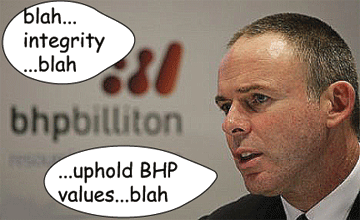 Nov 11 The environmental credentials of the planned Olympic Dam mine expansion in outback South Australia have been questioned by some shareholders at BHP Billiton’s annual general meeting in Melbourne.
Dr Jenny Grounds from the Medical Association for the Prevention of War has questioned the BHP Billiton board about monitoring radiation exposure levels for Olympic Dam workers. She has also raised the issue of disposal of radioactive tailings by the company “with its open cut mine and the surface tailings piles and the potential for dispersion by dust storms and groundwater retention.”….
Water demands The board also was asked about water demands for the proposed expansion. A desalination plant will be built on upper Spencer Gulf near Whyalla to supply water for the huge mining expansion. Anne Kennedy from the Great Artesian Basin Protection Group says it will produce a surplus of 80 million litres of water daily.
She asked if it would replace water now being drawn from the basin. “To allocate half of that surplus would enable [the company] to return that same quantity of water to the Great Artesian Basin,” she told the meeting…. http://www.abc.net.au/news/2011-11-17/bhp-billiton-agm-environment-olympic-dam/3677110?section=sa
Questions: nuclear submarines for Darwin? Greens, China, Indonesia – all want answers
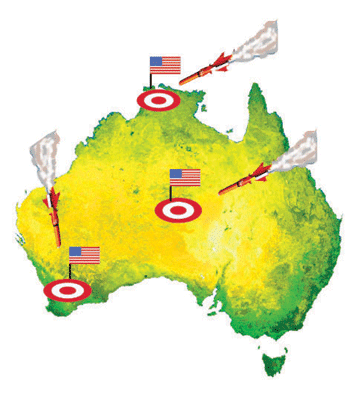 We need more details of US build-up: Brown, SMH, 17 Nov 11, Australian Greens leader Bob Brown fears nuclear submarines could be stationed off the coast of Australia as part of a US military build-up in the Top End……
The expansion of the existing collaboration between the Australian Defence Force and the US Marine Corps and US Air Force will allow America to enhance its presence in the Asia-Pacific region
Senator Brown wants to see more details of the deal, announced jointly by Prime Minister Julia Gillard and US President Barack Obama on Wednesday. He also wants a parliamentary debate on the deal. “I object to Australian people and parliament not knowing what the details are,” Senator Brown told ABC radio on Thursday. Continue reading
Darwin U.S. military base opens the way for cluster munitions and nuclear-powered vessels
 probability cluster munitions will be stockpiled in Darwin since there are known plans for the US to base a number of B-52 bombers historically used to deploy cluster bombs. It is already known that nuclear weapons will not be permitted onto Australian territory, but a number of the US’ naval fleet are nuclear-powered vessels which will be allowed…….
Both acts would result in Australia violating the spirit and intent of the Convention—to eliminate cluster munitions and the harm they cause for all time. And both are likely to occur as a result of the US base in Darwin.
Theorising Darwin: US may stockpile and transit cluster munitions Crikey, November 17, 2011 , by NAJ Taylor, A US military ‘base’ in Darwin will necessitate foreign weapons systems and armaments being stockpiled, retained and transited on and in Australian territory (spun as a “rotational deployment” – for China? I’ll use base until I know better).
Whilst long-standing and committed allies, Australia and the United States hold different positions on many matters relating to both arms control and humanitarian law. One recent normative development where the US and Australia’s views have diverged is the ban on cluster bombs, Continue reading
Uranium mining opposed by Minister in Bangalore, India
| Minister opposes uranium mining | |
| Deccan Herald, Bangalore, Nov 16, DHNS: | |
| Yadgir district in-charge minister Raju Gouda on Wednesday said he would appeal to Chief Minister D V Sadananda Gowda to cancel the permission granted to the Uranium Corporation of India Limited (UCIL) to take up uranium mining in Gogi village of Yadgir district. | |
| Addressing the media, Gouda said he would take a delegation to meet the chief minister on Thursday, and submit a memo- randum urging the government to drop the project as it would pose serious health hazards to the people of the region.
The minister said the project was not only hazardous to human beings but would also adversely impact the environment and the wildlife, and fertile land in the radius of over 100 km in and around the project would turn barren. The government has agreed to allot about 102 hectares of land to UCIL for taking up mining activities in Gogi, where rich deposits of Uranium have been found. UCIL had already dug up a 273-metre deep tunnel. The effluents generated are being discharged into a nearby water body, which was a water source for the people. Both humans and cattle have been taking ill after consuming this water, he said. .. |
|
Renewable energy going ahead in Australia, attractive to investors
 Winds of change for new energy investment, SMH 17 Nov 11 CANBERRA: Australia’s gradual shift away from coal and towards cleaner energy has begun, government figures released yesterday showed, with nearly half of new energy investment being in wind, hydro and solar projects. The Bureau of Resources and Energy Economics reported that new wind farms alone made up 41 per cent of the new energy investment either begun or committed in the year to October……
The director of emissions and environment at Westpac, Emma Herd, said the passage of the carbon pricing legislation would help investors make long-term decisions about energy projects. ”Renewable energy will become more attractive as the carbon price improves the economics of deploying renewable energy,” she said. ”In the short to medium term, we also expect gas to be a transitional energy source and expect more gas-fired electricity generation projects to be developed.”
The Clean Energy Council policy manager, Tim Sonnreich, said: ”Plenty of people still have the view that renewable energy is a very small percentage of our energy mix. ‘But in South Australia it’s already 20 per cent and that will be the model for the country by the end of the decade.”: http://www.smh.com.au/environment/winds-of-change-for-new-energy-investment-20111116-1njds.html#ixzz1e01bdjUy
Australian Capital Territory will have solar feed in tariff for both small and commercial systems
Small scale solar power in Canberra is also still being supported through a 1:1feed in tariff. Solar households in Canberra and the A.C.T are rewarded for any surplus electricity generated by their systems; which is purchased by ActewAGL Retail at the customer’s electricity tariff rate.
 Big Solar To Benefit From Feed In Tariffs In Canberra, by Energy Matters, 17 Nov 11 The ACT Labor Government will today table legislation in the Territory’s Legislative Assembly to support development of large scale solar power facilities in Canberra. Minister for Environment and Sustainable Development Simon Corbell says the Electricity Feed In (Large Scale Renewable Energy Generation) Bill 2011 is the first time a feed in tariff for commercial scale solar power has been proposed by an Australian government.
“The Bill establishes the framework for a feed in tariff ‘reverse auction’ to award support for at least two large scale solar generation plants capable of powering 7000 Canberra homes. This reverse auction process will require companies to provide a detailed proposal to the ACT Government about how they can provide the greatest amount of renewable energy at the lowest cost to Canberrans.” Continue reading
India’s government backs down on Nuclear Liability Law, enabling USA to sell nuclear reactors
Ahead of PM-Obama meeting, India notifies nuclear liability rules |

 Govt notifies Rules: N-supplier liability to be ‘limited in time’, Indian Express, 17 Nov 11 The foreign suppliers of nuclear material to Indian nuclear power plants would not be held liable for accidents caused by defective or faulty equipment supplied by them if the accident takes place after a guarantee period specified by them.
According to the Rules of the Civil Liability for Nuclear Damages Act, which was made public today, suppliers of nuclear material would be allowed to specify a ‘product liability period’ beyond which they would not be held liable for any accident.
The operator of the nuclear power plant concerned would therefore have no ‘right of recourse’ against the suppliers after this period is over.
“The provision for right of recourse… shall be for the duration of initial licence issued under the Atomic Energy (Radiation Protection) Rules, 2004, or the product liability period, whichever is longer,” the Rules say. All licences issued under the Atomic Energy (Radiation Protection) Rules, 2004, are valid for an initial period of five years.
The Civil Liability for Nuclear Damages Act, commonly known as the Nuclear Liability Act, was passed by Parliament in August last year after much debate.
The notification of the rules paves the way for its operationalisation…. Continue reading
Pro nuclear union pushing to lift NSW’s ban on uranium mining, Lithgow not keen
Council airs uranium mining fears ABC News, 16 Nov 11, The Lithgow City Council says it would have concerns about any open-cut mining proposals that might come from a uranium discovery.
The Australian Workers Union has suggested deposits of the material could be found in the Lithgow area, if a ban on exploration was lifted.
Lithgow Mayor Neville Castle says despite wide exploration for other metals, he has never heard of it being found in the region.”Well as far as I’m aware there’s been no identified deposits of uranium and we’ve had obviously a lot of geologists,” he said….. http://www.abc.net.au/news/2011-11-16/council-airs-uranium-deposit-fears/3674062
India uranium sales would increase nuclear war risk
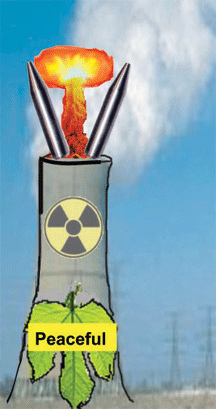
 India uranium sales would increase nuclear war risk The Medical Association for Prevention of War (MAPW) today called on the Government and the ALP to lead the world towards the abolition of nuclear weapons, rather than risking nuclear weapons proliferation by selling Australian uranium to nuclear-armed India. MAPW Vice-President Dr Margaret Beavis said:
“We cannot guarantee the “peaceful use” of uranium sold to India. Let’s remember that India made its nuclear weapons in the first place, by violating its pledge to use Canadian nuclear technology for peaceful purposes. India is currently involved in a nuclear arms race with Pakistan. A nuclear war between these countries would be a human and environmental disaster.”
“India does not have enough domestic uranium for both its weapons and energy programs. Australian uranium used in power generation frees up Indian uranium to make weapons, as senior Indian officials have publicly stated. Any “safeguards” aiming to ensure civilian use, even if they could be enforced, therefore have little meaning.
“We have treaties banning chemical weapons, biological weapons and landmines. The nuclear Non-Proliferation Treaty, a global nuclear non-proliferation and disarmament regime must be supported and strengthened, rather than undermined”.
The Medical Association for Prevention of War opposes the export of uranium on a number of grounds, including the risk of nuclear weapons proliferation; health and environmental risks of nuclear power production as illustrated recently in the Fukushima disaster; and the serious and growing unsolved problem of safe nuclear waste disposal.
1 This month

of the week – Australians for War Powers Reform (AWPR)
To see nuclear-related stories in greater depth and intensity
 Antinuclear