Rapidly falling costs for rooftop solar PV mean that Australia is poised for a solar boom
 a significant threat to the energy incumbents, particularly in the coal and gas industries, because it would reduce opportunities for new deployment and eat into their earnings because of the impact of solar and other short run marginal cost technologies in the so-called merit order effect (more on that tomorrow). It would also come as a shock to the government,
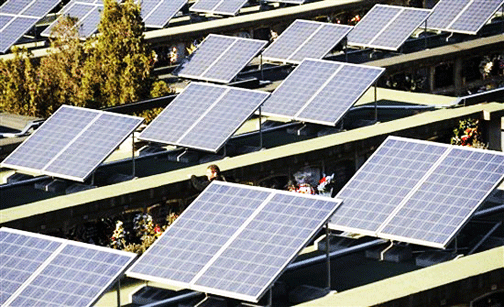
Suntech calls an Australian solar boom, Climate Spectator, Giles Parkinson, 17 Nov 11 Suntech, the world’s largest solar manufacturing company, has produced stunning forecasts for the solar PV industry in Australia – saying it could supply 5 per cent of the nation’s power demand by the end of this decade, reaching the target three decades ahead of the federal government’s most recent forecast.
Stefan Jarnason, the technical director of Suntech Australia, says solar PV capacity in Australia could reach 10 gigawatts by 2020, when it would be growing at a phenomenal 2GW a year. He bases these forecasts on rapidly declining costs, which mean electricity from rooftop PV that is already cheaper than coal-fired energy delivered by energy retailers in some parts of the country, will reach parity for commercial users around 2015, and parity for utility-scale developments towards the end of the decade.
It’s just a forecast, but it represents a growing realisation within and without the industry that in a very few years the rollout of solar PV will be dictated less by the scale of financial incentives – because it might not need much – but by the scale of regulatory protection for the current energy suppliers, because they might need all the help they can get.
Jarnason predicts installation of rooftop PV will slump sharply to around 250MW in 2012 because of the dramatic changes in government incentives over the last six to 12 months, but will grow at 20 per cent per year as more consumers use it as a hedge against rising electricity prices. Again, this will depend more on the removal of regulatory barriers than on government financial support.
He predicts commercial-scale solar PV will be around 40MW in 2012 and grow at 40 per cent a year, while utility-scale solar will grow at 20-60MW per year, before experiencing massive growth from around 2018, as solar costs come down, and hidden subsidies are removed from fossil fuels. “Until the government is able to remove hidden subsidies, growth in utility-scale will remain slow – when we hit grid parity there will be a boom,” he told a seminar on “The Future of Solar,” hosted by the Grattan Institute and the University of Melbourne last night. By the end of the decade, he says, the combination of solar PV and solar thermal with storage will be able to deliver base-load power.
Such a scenario would appear to be a significant threat to the energy incumbents, particularly in the coal and gas industries, because it would reduce opportunities for new deployment and eat into their earnings because of the impact of solar and other short run marginal cost technologies in the so-called merit order effect (more on that tomorrow). It would also come as a shock to the government, which forecasts just 5 per cent solar by 2050 in scenarios painted in its Clean Energy Future package. The long-awaited Energy White Paper, which will be delivered in the next month or so and will become the blueprint of the country’s energy planning over the next decade, will also be unlikely to have such a bullish forecast, seeing that none of the 23-person panel advising the government is a specialist in solar technology.
Indeed, Jarnason says the main impediments to the industry are not cost but regulatory barriers, with politicians seemingly unaware of the technology’s potential. “Unfortunately, politicians view solar PV, and probably to an extent all renewable energy, as a political exercise than an energy generation exercise,” he said….
http://www.climatespectator.com.au/commentary/suntech-calls-australian-solar-boom
No comments yet.
1 This month

of the week – Australians for War Powers Reform (AWPR)
To see nuclear-related stories in greater depth and intensity
 Antinuclear
Leave a comment