Energy farming an additional industry for rural Australia
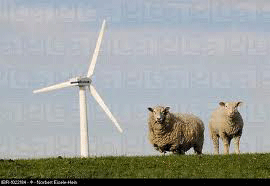 In Australia for many of us, isolation and lack of population limits such pursuits. Not so with renewable energy. It holds distinct advantages over traditional farming. It can be locally generated and locally used. We won’t face the market share and price squeezes that overseas competitors foist on us in other commodities.
I encourage state and federal politicians and bodies such as the National Farmers’ Federation and affiliated state representatives to lobby for renewable energy at ministerial level. After all it is a primary industry, no different to beef, sheep and viticulture.
Future in renewable energy, Weekly Times, 24 Nov 11 RENEWABLE energy is everybody’s concern, writes ROB NICHOLS Whether you believe the science on climate change or not, few would deny that a cleaner environment fuelled by renewable energy sources is a desirable goal. Far from threatening farming, this switch offers farmers and rural communities incredible opportunities.
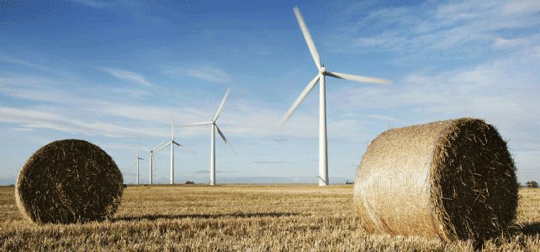
And these are big opportunities, as big as the opportunities afforded by fossil-fuel discoveries which have delivered spectacular fortunes to the world’s energy giants. After all, society’s insatiable desire for easier living and energy continues. Farmers have the resources – sun, wind, crops for biomass etc – plus the space to provide that energy.
Those resources can help us spread our financial risk, but we need to be quick. If we sit back and undervalue them, city and overseas investors will tap and rob our resources and export the financial gains away from our localities into the pockets of others. Failure to take control now will mean our businesses and communities will wither away and become irrelevant. Continue reading
Germany showing the way towards a distributed, decentralised energy future
 And will the rest of Europe follow? The poll-leading Socialists in France, after all, are talking of halving the country’s nuclear capacity. “Most of the world will follow this way, but it will be slow,” Dudenhauser says. “Everyone expected blackouts after the nuclear shutdown, but it didn’t happen. But it would not be manageable if everyone goes Germany’s way in the next two years.”
 Size not a factor in German power play , Climate Spectator, Giles
  Parkinson, 24 Nov 11 It seems strange that the world’s most cautious and best performing economy should be acting as some sort of crash test dummy for the world’s clean energy future. But this is exactly the position that Germany finds itself in following its commitment earlier this year to abandon nuclear energy and to push towards its vision of a fully renewable power supply by 2050.
And if this is the future, then companies that have based their models around the principal of centralised power stations may find little cause for comfort. But it is presenting enormous opportunities for those focused on the concept of distributed generation, particularly fuel cells – at least that’s the take of Roman Dudenhausen, the CEO and co-founder of German energy consultants ConEnergy, and a recently appointed director to the board of Australia’s Ceramic Fuels Cells. Continue reading
Australian company SILEX’s laser uranium enrichment technology – risks of nuclear weapons proliferation
 many of the good things GE is using to make a case about Silex—less use of resources and electricity and increased efficiency—are actually negatives that make it easier for rogue states to hide clandestine plants…..methods for the production and use of nuclear materials that would be more difficult to detect,” the report states
New Uranium Enrichment Technology Alarms Aviation Week, By Kristin Majcher Washington 23 Nov 11 General Electric says it has successfully tested a faster, cheaper way to produce nuclear reactor fuel, and is planning to commercialize the technology by building a facility in Wilmington, N.C. While the prospect of saving resources to generate energy at a lower price sounds like a breakthrough, scientists are concerned that the top-secret method of enrichment that GE is using will indirectly elevate proliferation risks around the world, thus inspiring rogue states to develop their own laser enrichment facilities for nuclear
weapons.
The enrichment technology is the Separation of Isotopes by Laser Excitation (Silex). It was developed by Silex of Australia in 1992. The technology company USEC funded early research on Silex, but abandoned it in favor of focusing on centrifuge enrichment. In 2006, GE signed an exclusive agreement to commercialize and license the technology and spearhead further research and development. Continue reading
International Energy Agency reports renewable energy becoming cost competitive
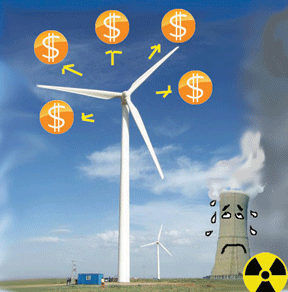 Renewable energy becoming cost competitive, IEA says, By Henning Gloystein, LONDON Nov 23, (Reuters) –Renewable energy technology is becoming increasingly cost competitive and growth rates are in line to meet levels required of a sustainable energy future, the International Energy Agency (IEA) said in a report on Wednesday.
The report also said subsidies in green energy technologies that were not yet competitive are justified in order to give an incentive to investing into technologies with clear environmental and energy security benefits.
The renewable electricity sector has grown rapidly in the past five years and now provides nearly 20 percent of the world’s power generation, the IEA said during the presentation of the report titled Deploying Renewables 2011.
The IEA’s report disagreed with claims that renewable energy technologies are only viable through costly subsidies and not able to produce energy reliably to meet demand. “A portfolio of renewable energy (RE) technologies is becoming cost-competitive in an increasingly broad range of circumstances, in some cases providing investment opportunities without the need for specific economic support,” the IEA said, and added that “cost reductions in critical technologies, such as wind and solar, are set to continue.”
“The portfolio of RE technologies, which includes established hydro power, geothermal and bioenergy technologies is now, therefore, cost-competitive in an increasingly broad range of circumstances, providing investment opportunities without the need for specific economic support.”
But the IEA also defended subsidies in renewable energy technology as a necessary means to create a clean and independent energy supply system. In the past, the IEA has been criticized by environmental groups for underplaying the role of renewable energy technologies in favor of nuclear and fossil-fuels….. http://www.reuters.com/article/2011/11/23/us-energy-iea-renewables-idUSTRE7AM0OV20111123
Big energy purchase deal for New South Wales wind farm
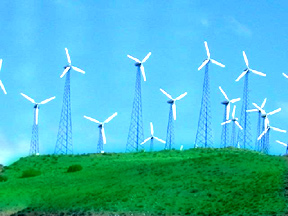 Origin Energy Buying Electricity From Gunning Wind Farm by Energy Matters, 24 Nov 11 Origin Energy has expanded its renewable energy portfolio, entering into a long-term power purchase agreement to buy electricity from Acciona’s Gunning Wind Farm.
Under the deal, Origin will initially purchase federal government issued Large-Scale Renewable Energy Certificates (LSREC) from Acciona for a period of two years, beginning January 2012. From January 1st 2014, the agreement allows Origin to buy both the LSRECs and the power generated by the wind farm for a further eight years; with an option to extend. Continue reading
Radiation health effects from rare earths plant – a warning for Australian company Lynas
 Industrial health expert T Jayabalan told FMT that he lived in Bukit Merah for three years during the 1980s, “collecting data” on the residents there. According to him, Lai Kwan and Cheah were only two of the many people he studied before presenting his findings to Malaysian courts. “Birth defects still exist,” he said, “and the number of miscarriages is incredibly high. Even if a foetus survives, it can still be born with leukemia and brain damage.”
“I’ve seen it happen with my own eyes. I’ve seen the suffering of these people. The only good thing about Lynas is that it hasn’t happened yet.”
 (includes VIDEO) Inside the world of a radiation victim, Free Malaysia Today Patrick Lee, November 24, 2011 VIDEO Tan Chui Mui’s short documentary is also about a mother’s undying love. Cheah was born in 1983, a year after Lai Kwan worked as a bricklayer at the Mitsubishi rare earth plant in Bukit Merah, Perak.
Cheah has multiple congenital defects, including a hole in the heart. He is also mentally deficient and virtually blind. And Lai Kwan is beside her son nearly every hour of her life, as portrayed in a short film entitled “Lai Kwan’s Love”…..
she tells the camera that she had no idea that the rare earth plant where she worked was handling toxic materials. Continue reading
1 This month

of the week – Australians for War Powers Reform (AWPR)
To see nuclear-related stories in greater depth and intensity
 Antinuclear