Energy farming an additional industry for rural Australia
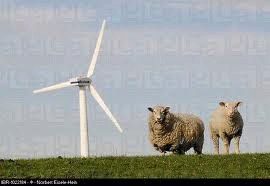 In Australia for many of us, isolation and lack of population limits such pursuits. Not so with renewable energy. It holds distinct advantages over traditional farming. It can be locally generated and locally used. We won’t face the market share and price squeezes that overseas competitors foist on us in other commodities.
I encourage state and federal politicians and bodies such as the National Farmers’ Federation and affiliated state representatives to lobby for renewable energy at ministerial level. After all it is a primary industry, no different to beef, sheep and viticulture.
Future in renewable energy, Weekly Times, 24 Nov 11 RENEWABLE energy is everybody’s concern, writes ROB NICHOLS Whether you believe the science on climate change or not, few would deny that a cleaner environment fuelled by renewable energy sources is a desirable goal. Far from threatening farming, this switch offers farmers and rural communities incredible opportunities.
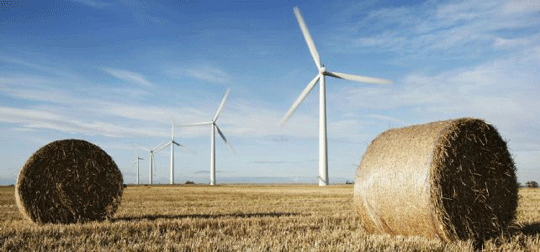
And these are big opportunities, as big as the opportunities afforded by fossil-fuel discoveries which have delivered spectacular fortunes to the world’s energy giants. After all, society’s insatiable desire for easier living and energy continues. Farmers have the resources – sun, wind, crops for biomass etc – plus the space to provide that energy.
Those resources can help us spread our financial risk, but we need to be quick. If we sit back and undervalue them, city and overseas investors will tap and rob our resources and export the financial gains away from our localities into the pockets of others. Failure to take control now will mean our businesses and communities will wither away and become irrelevant.
A Nuffield Scholarship has given me the chance to travel overseas to study and compare renewable energy technologies. What I’ve seen is that farms all around the world with robust bottom lines have diversified. Those diversifications range from pick-your-own-pumpkin patches in the US for Halloween, to disco venues in disused barns in the south of France.
In Australia for many of us, isolation and lack of population limits such pursuits. Not so with renewable energy. It holds distinct advantages over traditional farming. It can be locally generated and locally used. We won’t face the market share and price squeezes that overseas competitors foist on us in other commodities.
It is unlikely, for example, that we will find a shipload of Chinese renewable electricity displacing our production in the way that, for example, Chinese imports are threatening Tasmania’s broccoli and cauliflower industry, thanks to China’s cheap labour cost. Our competitors will be other local energy suppliers only. I’ve seen first hand the benefits for those who’ve jumped on board the renewable energy industry……
In the future, energy will no longer be produced by centralised generators. We’ll have a shandy of different technologies in different places. Sadly these opportunities will be lost if our policy makers don’t rise to the challenge and provide a framework for agriculture to work within.
I encourage state and federal politicians and bodies such as the National Farmers’ Federation and affiliated state representatives to lobby for renewable energy at ministerial level. After all it is a primary industry, no different to beef, sheep and viticulture.
- Rob Nichols is a poultry farmer and processor from Sassafras in Tasmania
- http://www.weeklytimesnow.com.au/article/2011/11/24/410981_opinion-news.html
No comments yet.
1 This month

of the week – Australians for War Powers Reform (AWPR)
To see nuclear-related stories in greater depth and intensity
 Antinuclear
Leave a comment