BHP BILLITON ABOVE THE LAW FOR ANOTHER 70 YEARS AND BEYOND
 The Roxby Downs Indenture Bill today passed the South Australian Upper House. It has now passed both houses of Parliament, enshrining in law an agreement that over-rides some 21 South Australian laws, including state legislation covering radiation protection.
“Since the negotiation of the Indenture Agreement, it has been clear that the parliamentary process would simply be a rubber stamp. For example, in the Parliamentary Select Committee hearing, the opposition had the chance to question BHP for an hour, and the nature of their investigations were along the lines of concerns for the caravans that may be inconvenienced if a road was closed, never mind the tailings dams that are designed to leak,” said Nectaria Calan from Friends of the Earth Adelaide.
“Neither Labor not Liberal have shown any inclination to critically scrutinise the implications of the project, with the government bending over backwards to accommodate the mining giant. BHP wanted to recognise a historical version of the Aboriginal Heritage Act that was repealed over 20 years ago – they got it. They wanted a mining lease that spans 70 years, despite the fact that their Environmental Impact Statement only covers 40 years – they got it. They wanted the right to be granted the expanded mining lease, covering nearly 50, 000 ha as freehold, free of charge – they got it. They wanted royalties capped for 45 years – they got it,” said Ms. Calan.
The scope of the Indenture Agreement extends far beyond the 40 years covered in the Environmental Impact Statement.
“It’s a strange state of affairs to have an Environmental Impact Statement that only covers 40 years, a mining lease granted for 70 years, and an indenture agreement that creates the right for future mining leases that will not expire until the last of the extended mining leases have expired. The intention appears to be to avoid any further Parliamentary scrutiny at all cost,” continued Ms. Calan.
Australia’s uranium industry not really winning, despite Olympic Dam
 While the Olympic Dam mine expansion is proceeding, and the tiny Honeymoon mine has begun producing tiny amounts of uranium, there has been much to celebrate for anti-uranium campaigners this year:
* Uranium mining has been banned in the Arkaroola Wilderness Sanctuary in SA.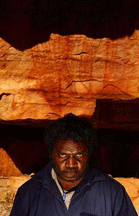
* A strong campaign has put in jeopardy the proposed Angela Pamela uranium mine in the NT. At various stages both the NT Labor government and the Country Liberal Opposition have opposed the mine.
* Traditional Owners have put an end to plans to mine the Koongarra deposit in the NT. Jeffrey Lee (at right) resisted uranium lobby $millions
* At least two proposed uranium mines in WA have been put on hold (and hopefully abandoned).
* The WA Labor Opposition has strongly reaffirmed its no-uranium policy.
* All the eastern states/territories maintain their bans on uranium mining.
* ERA has abandoned plans to use heap-leach uranium mining at Ranger in the NT (though it still has other plans to expand the mine).
* The extraordinary early-1980s film ‘Dirt Cheap’ – about the Ranger mine in the NT – has been updated and is being launched in November/December.
 * Figures from the Bureau of Resources and Energy Economics show a 19% fall in the value of Australian uranium exports from 2009-10 to 2010-11. Uranium accounts for a paltry 0.3% of Australia’s export revenue and 0.03% of jobs in Australia.
The uranium industry is in denial, continuing to claim that the debate has been settled in Australia (in its favour) and making comparisonswith Saudi oil exports which distort reality by several orders of magnitude.
South Australian Parliament trashes state environmental, heritage, aboriginal laws in passing Roxby Downs Indenture Bill
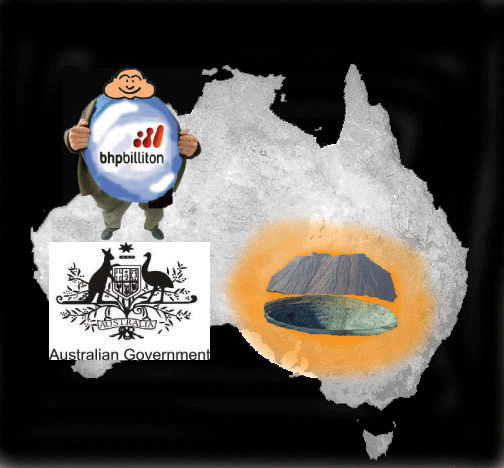
Dark day as state laws trashed in Roxby riches rush The Parliamentary debate over the Roxby expansion Indenture Bill has confirmed that the State Government has delivered a bad deal for South Australia, says Greens Parliamentary Leader Mark Parnell.
“This is a dark day for our State’s democracy. The Government has locked in for the next 70 years the right of the world’s richest resource company to over-ride all relevant State laws,” said Mr Parnell.
“The hours of debate in Parliament has shown that in the rush to get this deal signed before ex-Premier Rann departed, the State Government has given too much away for too little in return.
“The environmental costs are going to be much higher, and the economic return will be much lower than the SA public rightly expect.
“Parliament has exposed the yawning gap between the Government’s hyperbolic spin over the Roxby riches and the dark reality of this terrible deal.
“Future generations are going to be disgusted with us for giving their resources away for a pittance and leaving them to deal with the enormous toxic legacy of managing the world’s largest radioactive waste dump,” he said.
The Greens put forward a package of amendments that would have positively transformed the Indenture contract.
The controversial Bill has now passed both houses of State Parliament, with only the Greens voting against it.
What the debate exposed:
- · The local jobs, manufacturing and local procurement Plan will contain ‘aspirational’ targets only. Not one extra job is guaranteed.
- · The ‘net’ economic return to state coffers in years 10-20 of the project could be as low as $10 million / year – and that’s even before millions are given back to BHPB through Federal subsidies like the diesel fuel rebate.
· No explanation for locking in royalty rates at a low rate for 45 years – apart from that is what BHP wanted.
- · The Government did not do any comparative economic analysis with similar projects interstate and overseas to see if we were getting a good economic deal.
- · There is nothing the Government can do to make BHPB expand their domestic processing up to an additional 200,000 tonnes of ore (as has been promised by the Premier and others). In fact, there is nothing to stop BHP exporting all ore from Roxby Downs to China (including the ore that is currently processed here).
- · Govt has relied entirely on BHPB’s figures for the cost of processing in SA rather than exporting South Australian copper ore to China.
· BHPB can continue to extract fossil water from the Great Artesian Basin until 2082, with costs capped for the next 30 years.
· Third parties won’t have any right to access the railways, roads, ports and airports being constructed for the expansion.
· No cumulative impacts of this expansion (beyond the artificial EIS timeframe of 40 years) have been considered.
- · The Government doesn’t know what impact the ODX will have on the State’s greenhouse pollution reduction targets.
- · The toxic tailings waste dams have been deliberately designed to leak.
- · The final operating conditions to protect the marine environment at Point Lowly will not be known for years and will be negotiated in secret.
Australia to break international law in selling uranium to India
 Ms Gillard not only failed to inform Foreign Minister Kevin Rudd of her nuclear trade ambitions, but she also failed to consult government lawyers.
Uranium for India deal ‘may be illegal’, Canberra Times, BY CHRIS JOHNSON, CHIEF POLITICAL CORRESPONDENT, 29 Nov, 2011 Australia will be in breach of international law if it sells uranium to India without the nuclear-armed nation first opening up its atomic facilities for independent inspection.
Leading international law expert Don Rothwell, from the Australian National University, has provided that legal opinion to the Campaign to Abolish Nuclear Weapons. The non-governmental organisation will issue the formal legal advice today. In it, Professor Rothwell insists that the South Pacific Nuclear Free Zone Treaty, also known as the Treaty of Rarotonga, prohibits Australia from selling uranium to countries that have not accepted full safeguards outlined in the Non- Proliferation Treaty. Continue reading
France’s nuclear firm AREVA turns to wind energy to lift its troubled business
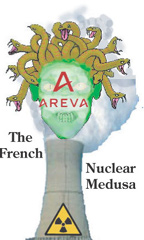 Areva has looked to diversify away from nuclear energy and build up solar, wind and biomass
 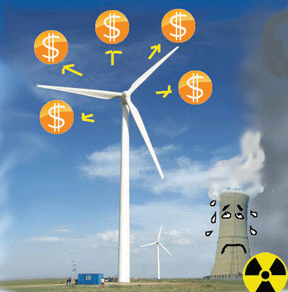 businesses. …..Areva has teamed up with energy group GDF Suez SA and concessions company Vinci SA to bid for a part of the French government’s wind turbine project…The French government aims for a total of 1,200 wind turbines to be eventually built, costing a total of €10 billion.
In mid-December Areva is set to detail the financial impact of the nuclear disaster at Fukushima this March.
Areva Diversifies Further Into Wind, WSJ, 28 Nov, By MAX COLCHESTER And NOÉMIE BISSERBE, PARIS—Areva SA said Monday it is in advanced talks to build about 120 wind turbines at two offshore wind farms in Germany, as theengineering group continues to diversify away from nuclear energy….
The talks represent a rare bright spot for the engineering group that has been buffeted in recent months following the nuclear disaster at the Fukushima Daiichi plant in Japan, which dented demand for the group’s key atomic products. The French state controlled company’s shares ended up 5.2% to €20.25 in Paris on Monday. Continue reading
Australia joins international community in climate action, and credibility for Durban conference
 CLIMATE POLICY We’ve Got Climate Cred – Now What? New Matilda, 29 Nov 2011 With clean energy laws passed, Australian reps can speak with credibility about international climate policy. Sophie Trevitt reports on expectations about the UN climate talks in Durban
This month, the Clean Energy Bills passed through the Senate and were enacted into law. Australia took its first step towards preventing dangerous climate change — joining almost 100 other major economies that have implemented accountable policies to reduce carbon pollution.
Now, Australia stands alongside nearly 200 countries in Durban, South Africa, for the United Nations Climate Conference 2011. Australian representatives can for the first time speak with some credibility in this international forum, having implemented a domestic policy that provides a framework for reducing carbon dioxide emissions.
The International Energy Commission has recently released research which suggests that if our consumption of fossil fuels is not drastically and immediately reduced, we will face runaway climate change within five years. That means more extreme weather events like Cyclone Yasi, bushfires and extreme heat waves for Australia — and it means many of the Pacific Islands will become uninhabitable.
With some progress made in Cancun last year, the question hanging above Durban is how much and how fast substantive progress can be made. Negotiations this year are expected to shift away from the symbolic rhetoric that has characterised previous conferences; and hopes remain high that strong cooperative action will be instigated…..
Australia has good reason to celebrate enacting our first climate laws. The Climate Talks in Durban present an opportunity for Australia to catch up with the rest of the world before it is too late. We’ve taken the first step at home. Now we need to join with the international community and pledge to dramatically cut our emissions by at least 15 per cent; investing in the renewable alternatives available in Australia as one of the sunniest and windiest countries in the world. http://newmatilda.com/2011/11/29/weve-got-durban-cred-now-what
The Nuclear Terrorism Legislation Amendment Bill – new law coming to Australia
Australian Lawmakers to Consider Nuclear Terror Bill, NTI Nov. 28, 2011 Lawmakers in Australia have received a bill intended to bolster the nation’s posture against nuclear terrorism, Australian Attorney General Robert McClelland announced on Wednesday (see GSN, May 8, 2009). The Nuclear Terrorism Legislation Amendment Bill 2011 would institute as national law the requirements set on member nations to the International Convention for the Suppression of Acts of Nuclear Terrorism.
“This bill sends a strong message to the international community demonstrating Australia’s continued commitment to addressing the threat of terrorism,” McClelland said in a press release. “It will also strengthen Australia’s case in encouraging our neighboring countries to ratify the 16 international counterterrorism instruments.”
The legislation increases the number of criminal offenses covered by the 1987 Nuclear Nonproliferation (Safeguards) Act that bans the illicit application of radioactive substances and nuclear plants. It sets a two-decade maximum punishment for crimes listed in the 24-year-old law.
“Acts of nuclear terrorism, including conduct relating to radiological and nuclear material, may result in grave consequences and pose a threat to international peace and security,” McClelland said. “We need to make sure that any act of nuclear terrorism is treated as a criminal offense” (Australian Attorney General Robert McClelland release, Nov. http://www.globalsecuritynewswire.org/gsn/nw_20111128_5611.php
1 This month
To see nuclear-related stories in greater depth and intensity
– go to https://nuclearinformation.wordpress.com/


 Antinuclear