Lack of principle in Australia selling uranium to nuclear-armed India, no proper safeguards
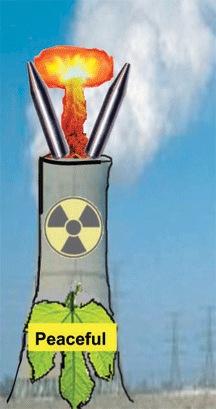 The alternative course for Australia is to side with the large majority of the world’s countries who want to re-establish and reinforce the principle that nuclear trade should be restricted to countries that have signed the Non-Proliferation Treaty and take seriously their non-proliferation and disarmament commitments.
We could take a principled rather than an unprincipled approach. We could lead rather than follow.
Safeguarding uranium exports to India Online Opinion , Dr Jim Green, 1 Dec 11 A big part of the PR pitch for uranium sales to nuclear-armed India is the assertion that ‘strict’ safeguards will ‘ensure’ peaceful use of Australian uranium. Sadly, it’s just PR.
The claim sits uncomfortably with the reality that safeguards are based on occasional inspections of some nuclear plants by the International Atomic Energy Agency (IAEA). The claim sits even more uncomfortably with the observations of recently-retired IAEA chief Mohamed El Baradei that the Agency’s basic rights of inspection are “fairly limited”, the safeguards system suffers from “vulnerabilities” and efforts to improve it have been “half-hearted”, and the system operates on a “shoestring budget…comparable to a local police department”.
To give an illustration of the contrast between reality and rhetoric, the Gillard Government takes credit for insisting that all of Australia’s uranium customer countries must have an ‘Additional Protocol’ in place with the IAEA – an agreement which provides for expanded inspection rights. The genesis of that policy is revealing. Australia waited until all of Australia’s uranium customer countries had an Additional Protocol in place before announcing that it was a requirement for all customer countries. We weren’t driving improvements in the international safeguards regime but merely indulging in a cynical, retrospective PR exercise.
What about safeguards in India? Australia has no capacity for independent monitoring and verification. We are entirely reliant on the IAEA. The safeguards agreement between the IAEA and India is on the public record and it certainly doesn’t provide for strict safeguards. It provides for safeguards that will be tokenistic or non-existent.
Arms Control Today thoroughly dissected the IAEA-India safeguards agreement and noted that: “Reporting provisions…not contained in India’s agreement cover information such as nuclear fuel-cycle-related research and development, nuclear-related imports, and uranium mining. The Indian additional protocol also does not include any complementary access provisions, which provide the IAEA with the potential authority to inspect undeclared facilities.”
A leaked 2009 IAEA document states that the IAEA “will not mechanistically or systematically seek to verify” information obtained from India. It makes another statement of relevance to uranium suppliers: “The verification activities in question are not linked to quantitative yardsticks such as inventories of nuclear materials.”…
K. Subrahmanyam, former head of the India’s National Security Advisory Board, has said that: “Given India’s uranium ore crunch and the need to build up our minimum credible nuclear deterrent arsenal as fast as possible, it is to India’s advantage to categorize as many power reactors as possible as civilian ones to be refueled by imported uranium and conserve our native uranium fuel for weapons grade plutonium production.”
Which leaves advocates of uranium sales to India with the drug-dealer’s defence: some other countries have abandoned the principle that nuclear trade should be restricted to Non-Proliferation Treaty signatories so Australia might as well follow suit. Yet, as Ron Walker, former Chair of the IAEA Board of Governors, argued last week: “India is a democracy and yes we want to be in their good books, but that is no reason to drop our principles and our interests. To make an exception for them would be crass cronyism. If you make exceptions to your rules for your mates, you weaken your ability to apply them to everyone else. How could we be harder on Japan and South Korea if they acquired nuclear weapons? Could we say Israel is less of a mate than India?”
The alternative course for Australia is to side with the large majority of the world’s countries who want to re-establish and reinforce the principle that nuclear trade should be restricted to countries that have signed the Non-Proliferation Treaty and take seriously their non-proliferation and disarmament commitments.
We could take a principled rather than an unprincipled approach. We could lead rather than follow. http://www.onlineopinion.com.au/view.asp?article=12965&page=0
No comments yet.
1 This month
7 April – WEBINAR – Australia and the Doomsday Clock – Preventing nuclear war through NoFirstUse and other policies
Online | Tuesday April 7, 4:00-5:30pm, Australian Eastern Time / 8:00-9:30am Central Europe Time
– Access the registration link
15 April – Zoom –Nuclear Power is Not the Solution
Apr 15, 2026 01:00 AM in Canberra, Melbourne, Sydney

Join the International Physicians for the Prevention of Nuclear War (IPPNW) on Tuesday, April 14th for a timely webinar exploring the risks associated with nuclear power and challenging the myth that it offers a simple, safe, carbon-free solution to the climate crisis

21 April Webinar: No Nuclear Weapons in Australia
Start: 2026-04-21 18:00:00 UTC Canberra, Melbourne, Sydney (GMT+10:00)
End: 2026-04-21 19:30:00 UTC Canberra, Melbourne, Sydney (GMT+10:00)
Event Type: Virtual
A virtual link will be communicated before the event.
Host Contact Info: australia@icanw.org

of the week – Australians for War Powers Reform (AWPR)
To see nuclear-related stories in greater depth and intensity
 Antinuclear
Leave a comment