Hey, let’s Australia sell uranium to gentle, tolerant, Saudi Arabia!

 Religious pilgrimage turns into nightmare The Age Maris Beck and Daniel Flitton December 8, 2011 ” ….. Mansor Almaribe, a father of five, who was last month charged with blasphemy while on a pilgrimage to Saudi Arabia, has been sentenced to a year in prison and 500 lashes. The Shepparton family said it was a death sentence. Mr Almaribe has diabetes, heart disease and was almost crippled in a 2004 car accident that broke his back in five places. “He won’t make 50 lashes,” son Mohammad, 16, told The Age….
..Mr Almaribe, a Shiite Muslim who was travelling in the majority Sunni kingdom, was found guilty of cursing two companions of the prophet Mohammed aloud in a public place…. a radical had reported Mr Almaribe to police after recognising him as Shiite from the green turban he wore. “He was just praying and reading the Koran to himself in an area known to be frequented by Shiites.”… http://www.theage.com.au/victoria/religious-pilgrimage-turns-into-nightmare-20111207-1ojbc.html#ixzz1g0DiYVsM
 Prince Hints Saudi Arabia May Join Nuclear Arms Race, NYT, December 6, 2011 DUBAI, United Arab Emirates (AP) — A Saudi prince, in a remark designed to send chills through the Obama administration and its allies, suggested that the kingdom might consider producing nuclear weapons if it found itself between atomic arsenals in Iran and Israel. The prince, Turki al-Faisal, who has served as the Saudi intelligence chief and as ambassador to the United States, made the comment on Monday at a Persian Gulf security forum in Riyadh, Saudi Arabia. The remark confirmed Western fears about the potential for an arms race in the Middle East if Iran moves to produce a nuclear weapon…..
Prince Turki said at the forum on Monday that an Iranian quest for nuclear weapons and Israel’s presumed nuclear arsenal might force Saudi Arabia to follow suit. Most defense analysts believe that Israel has nuclear weapons, but it has refused to confirm or deny their existence.
“It is our duty toward our nation and people to consider all possible options, including the possession of these weapons,” Prince Turki was quoted as saying…http://www.nytimes.com/2011/12/07/world/middleeast/saudi-arabia-may-seek-nuclear-weapons-prince-says.html
Promoting renewable energy is the way to save the climate change debate
 The heavy polluting industres know they cannot easily shift basic values, so they have undermined solar and wind at the next level of understanding, around jobs, prices and the electricity industry. In reaction to the statement, ‘Investing in renewable energy is good for the economy by creating jobs,’ 80 per cent were in agreement, and only 10 per cent in disagreement.
After two years of campaigning for coal and against renewables, energy-intensive and heavy-polluting industry, along with certain media outlets and Opposition leader Tony Abbott, have done barely any damage to the perceived value of renewables as an industry.
 Cleaning up the climate debate, Climate Spectator , 8 Dec 2011, Dan Cass A recent poll confirms what I have come to believe after watching the global warming issue for 20 years; renewable energy is the only way to save the debate about saving the planet. If the UN wants to make progress in the climate negotiations and closer to home, if Julia Gillard wants to win the next election, then the debate should be couched in terms of the tangible benefits of today’s solar and wind technologies.
A poll by Essential Research, conducted during Australia’s recent carbon price negotiations, shows overwhelming public support for investment in solar and wind, and that this support might just win the politics of a carbon price.
detractors. Solar and wind have been politicised and companies need to step in and vigorously defend their interests. Continue reading
Solar photovoltaics booming on Australian homes
 with high levels of irradiation nationwide, some argue that residential grid parity has arrived, on average, throughout Australia.
Australia’s 500,000 solar homes PV Magazine, 07. DECEMBER 2011 BY: JONATHAN GIFFORD In a report released yesterday at the UN climate negotiations in Durban, the Clean Energy Council of Australia has revealed that more than 500,000 homes in Australia feature photovoltaic systems. The report looked at renewable electricity generation across the board and revealed that power for around four million homes was produced in 2011. This means that the country is well on the way to meet its goal of producing 20 percent of its power through renewable sources by 2020.
The progress of photovoltaics was outstanding, Continue reading
Worldwide decline in nuclear energy consumption and generation
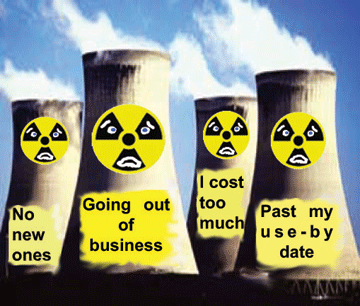 Much of the decline in installed capacity is the result of halted reactor construction around the world. ….. these numbers can hardly encourage the industry,” said Worldwatch President Robert Engelman.”The high cost of nuclear electricity generation and the widespread public perceptions that it poses unacceptable safety risks make it unlikely this form of power will help slow human-caused climate change or offer an attractive alternative to rising fossil-fuel prices any
time soon.”….
Global Nuclear Generation Capacity Falls E News Park Forest 06 DECEMBER 2011 New analysis indicates countries are turning to other energy sources as a result of high costs, low demand, and recent disasters. WASHINGTON–. Due to increasing costs of production, a slowed demand for electricity, and fresh memories of disaster in Japan, production of nuclear power fell in 2011, according to the latest Vital Signs Online (VSO) report from the Worldwatch Institute (www.Worldwatch.org).
…… global installed nuclear capacity—-the potential power generation from all existing plants—-declined to 366.5 gigawatts (GW) in 2011, from 375.5 GW at the end of 2010.
Not surprisingly, this drop in installed capacity corresponds with a decline in global consumption of nuclear energy. Nuclear’s share of world commercial primary energy usage fell to around 5 percent in 2010, having peaked at about 6 percent in 2001 and 2002. Continue reading
Australian uranium to India – a move towards nuclear disaster
Uranium sales to India: a public health disaster? Crikey, 5 Dec 11 Dr Margaret Beavis, a Melbourne GP and Vice President of the Medical Association for the Prevention of War, writes: A world with a nuclear weapons “free for all” would inevitably lead to death and injury on an appalling scale. Conflict, terrorism, human error, greed and natural disasters all occur – and the more weapons there are, the higher the risk of catastrophic health outcomes.
On Sunday, the ALP conference voted to allow uranium sales to India. This significantly undermines the Nuclear Non-Proliferation Treaty (NPT) and is in breach of the Treaty of Rarotonga for a nuclear free Pacific. It also signals the ALP turning its back on previous leadership in advocating for nuclear disarmament.
India dishonestly acquired its nuclear weapons by breaching agreements with Canada and the US in the early 70s. India’s record on the “non-proliferation” of weapons is extremely poor – their testing in 1974 sparked an ongoing nuclear arms race with Pakistan (and indeed with China). This is not a stable part of the world.
Indian authorities have said explicitly that any imported uranium frees up domestic uranium for weapons production. So any safeguards are meaningless, particularly as India will only allow the IAEA to inspect 12 out of their existing 22 reactors.
India has existing supply agreements with five other countries. Even if Australia were to get 20% of India’s uranium imports, this would increase uranium sales by just 1.8% on 2007/8 levels.
Currently uranium provides jobs for just 0.03% of Australia’s workforce, and these workers have significantly higher rates of lung cancer. From a health perspective, uranium has a fair bit in common with asbestos.
In the wake of events at Fukushima, there are increasing levels of protest against nuclear technology in India. In Tamil Nadu there are 40,000 people living within a 5 km radius of the nearly complete Koodankulam reactor, and protests have been escalating since September. One local fisherman was quoted as saying “If a rich country like Japan can’t save their people from radiation up to 200 miles away, how will India save us?”
In a 2009 Lowy poll, 75% of Australians thought nuclear disarmament should be a top priority in Australia’s foreign policy, and in June this year the Lowy poll found 93% of Australians thought helping to prevent the spread of nuclear weapons was important, ahead of both controlling illegal immigration and tackling climate change.
We have weapons conventions for biological and chemical weapons, land mines and cluster bombs. The NPT is not perfect, but it is a lot better than no such treaty. Australia must continue to work towards nuclear disarmament. With hard work and leadership, this is achievable.
Selling uranium to India is selling out the NPT. And nuclear weapons are a preventable health disaster. End of story. http://blogs.crikey.com.au/croakey/2011/12/05/uranium-sales-to-india-a-public-health-disaster/
Tokyo’s food nightmare – radioactive cesium-137 found in baby milk powder
 Cesium in Baby Milk Powder Shows Nuclear Risk for Japan Food December 07, 2011 By Kanoko Matsuyama and Yuriy Humber Dec. 7 (Bloomberg) — Radioactive cesium was found in milk powder in Japan made by a Meiji Holdings Co. unit, raising concern that nuclear radiation is contaminating baby food.
Meiji the past week found traces of cesium-137 and cesium- 134 in batches of “Meiji Step” made in March, the Tokyo-based company said yesterday. The probe was triggered by a customer complaint last month. ….
The finding highlights the radiation threat to food in Japan nine months after the Fukushima nuclear plant was wrecked by an earthquake and tsunami. ….
In a nuclear accident, radioactive isotopes including iodine-131 and cesium-137, which are normally contained inside the fuel rods, may be released into the atmosphere as gases or particulates if the rods are damaged. These can be inhaled or ingested through contaminated food or water. Children are especially susceptible to radiation poisoning from iodine, which can accumulate in the thyroid gland, according to the World Health Organization.
Cesium-137 that enters the body is distributed throughout the soft tissues, especially in muscle….
Radiation is more dangerous for infants because their cells are dividing more rapidly and radiation-damaged RNA may be carried in more generations of cells, according to Lincoln. The risk for children depends on the quantity of radioactive cesium they consume or are exposed to,…
Once again, USA ‘s cruel testing on monkeys with lethal radiation
 Activists Protest Company’s Plan To Test Monkeys For Radiation, care 2 by Sharon Seltzer, December 6, 2011 A research company in Pasadena, CA is feeling the wrath of an animal rights group for a series of radiation tests it’s conducting on 32 monkeys. The company wants to determine the effects of potentially lethal doses of radiation on humans after a nuclear disaster.
ChromoLogic, a private diagnostic technology research company is developing a machine to test humans for levels of radiation poisoning after being exposed to a nuclear event such as Japan’s Fukushima nuclear disaster that occurred in March 2011. On Monday the company began testing 32 Rhesus monkeys for the project.
Animal activists from Stop Animal Exploitation Now! (SAEN) staged a protest outside ChromoLogic’s Pasadena office to halt the tests after a whistleblower leaked they would begin this week. “My goal is to get as many people to know what’s going on and to stop this,” said Josh Gutier, who attended the protest. Julia MacKenzie, SAEN’s L.A. representative said, “I object to them using animals in research and wasting taxpayers’ money.”…: http://www.care2.com/causes/activists-protest-companys-plan-to-test-monkeys-for-radiation.html#ixzz1fz5I0DHs
Contrary to Ziggy Switkowski’s dreams, Australia must not sell uranium to Pakistan
Why Australia must not sell uranium to Pakistan, The Conversation, Peter Meyer 7 December 2011  Predictably, Pakistan is seeking equal treatment with India on uranium sales from Australia……The activities of the AQ Khan network in selling equipment and technology to other states show Pakistan to have been an active proliferator (as Adrian Levy and Catherine Scott-Clark point out in their book, Deception: Pakistan, the United States and the Global Nuclear Weapons Conspiracy). And the military establishment under whose wings Khan – the father of Pakistan’s nuclear programme – operated still dominates public affairs in Pakistan, even under an elected government…..
Ziggy Switkowski spruiks for Australian uranium sales to Pakistan
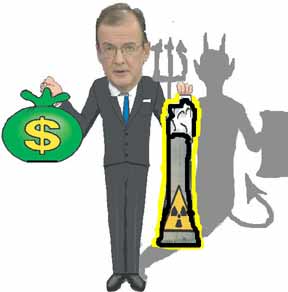 Pakistan a potential uranium customer, says Australian nuclear expert, The Nation, 6 Dec 11 An Australian nuclear expert Dr Ziggy Switkowski said that Australia will have to consider selling uranium to Pakistan in the future after agreeing to export it to India…..over time, as they gain the confidence of the international community and the civilian nuclear program builds, they will need to be considered.”
Earlier, Pakistan’s High Commissioner to Australia, Abdul Malik Abdullah said if Australia is willing to export uranium to India then it should sell it to Pakistan as well.
Abdullah said, “If Australia is going to lift the ban on a country which has not signed NPT (Nuclear Non-Proliferation Treaty) it is much hoped that will also apply to Pakistan the same way.” Australia’s ruling Labour Party voted to overturn a decades-old ban on uranium sale to India, paving the way for Canberra to supply yellowcake to a nation outside the NPT.
First uranium to India, now military ties – Australia-India
India trip follows Australian ruling party’s uranium backflip, Radio Australia, December 7, 2011 Only days after the ruling Australian Labor Party ended its ban on possible uranium sales to India – Australia’s Defence Minister Stephen Smith will visit New Delhi and Mumbai for talks on greater military cooperation….
It’s Mr Smith’s fourth ministerial visit to India but his first in the Defence portfolio and he is emphatic that India’s nuclear neighbour and arch rival, Pakistan, will not be getting any Australian uranium.
http://www.radioaustralia.net.au/connectasia/stories/201112/s3385778.htm
1 This month

of the week – Australians for War Powers Reform (AWPR)
To see nuclear-related stories in greater depth and intensity
 Antinuclear