Nuclear lobby’s underground campaign against renewable energy in Australia
 While Australia’s nuclear lobby has gone a bit quiet , it’s still hard at work. Its best spokesman, Australia’s
  Minister For Nuclear Energy, Martin Ferguson is dutifully campaigning on the nuclear lobby’s goal of stopping the progress of renewable energy. Unfortunately, Ferguson has let them down a bit, stuffing up Australia’s Draft Energy White Paper. I bet Ferguson is glad that people’s minds are on the Christmas season, and not on the inadequacies and inaccuracies of this draft.
In New South Wales, “astroturf” bodies are condemning wind power. the Waubra foundation and Landscape Gardeners are the best known of these. Behind them are pseudo environmental bodies, the Australian [against] Environment Foundation, and the rightwing Institute of Public Affairs.
Another reason why the nuclear lobby is lying low about its products is the gloomy state of the uranium market. Uranium company’s shares have dropped continuously over the year – Energy Resources of Australia’s by 82.1%, Cameco’s by 50%. Overall, uranium companies dropped by 54% over the past 12 months: it’s not just because of Fukushima.
For Australia, the bleakest news must be that China is doing a rethink and a slow-down on its nuclear power project. Disastrous for Australia’s uranium companies who are pinning their last hopes on China!
Japan has announced this “cold shutdown” at Fukushima nuclear plant. This is a creative use indeed of the term, designed to make everyone think that Fukushima is OK now. Not so – indeed this is on of the most glaring lies that the nuclear lobby has come up with.
With all the lies going on – about Fukushima being OK, about ionising radiation being good for you, about wind power being bad for you – this calls for a special focus on NUCLEAR LIES – which will be the theme of next month’s Antinuclear page.
Peace to all readers of this page – Christian Macpherson
Martin Ferguson’s Energy White Paper got renewable and other energy costs wrong
Draft Energy White Paper Gets Renewables Cost Wrong – Bloomberg , Energy Matters, 20 Dec 11 It’s a good thing the Australian Government’s recent Energy White Paper was a draft, because it appears they will be busy rewriting it. According to an article on The Australian, analysis by Bloomberg reveals figures in the Draft Energy White Paper overestimated the cost of solar power threefold and wind power by 50 per cent. Bloomberg says the paper has also underestimated the price of geothermal energy.
Bloomberg points out, as others have done, that some analysts fail to understand just how fast the cost of renewables is dropping. While calculations may be based on figures just a few years old, such data is ancient history given the evolutionary pace in the renewables sector. The Draft Energy White Paper has been widely panned by those committed to a renewable energy future for Australia and Energy Minister Martin Ferguson’s apparent enthusiasm for nuclear power has been treated with suspicion.
The increase in nuclear costs has been attributed to subsidies to nuclear-hosting communities and expenses related to the Fukushima Daiichi nuclear disaster, although whether the increase is sufficient to account for the unsettled costs of the disaster is being questioned by some.
While the Draft Energy White Paper played down the role of renewable energy, it also attempted to bolster the reputation of fossil fuel sources such as coal seam gas (CSG). Greens Senator and environmental lawyer Larissa Waters last week claimed the White Paper sung the praises of coal seam gas without recognising any of its devastating costs.
“This paper appears to have been written by someone living in a last-century bubble, with no consideration of the impacts of coal seam gas beyond the industry spin,” Senator Waters said. “How can you possibly plan for Australia’s energy future without factoring in the true costs of this energy source – the costs to water, to land, the environment and the climate, as well as the economic impacts on other industries?” http://www.energymatters.com.au/index.php?main_page=news_article&article_id=1942
Should USA borrow $billions from China, for outdated nuclear weapons systems?
in a time of soaring national debts, should we be asking the Chinese to lend us more money for outdated weapons?
What Nuclear Weapons Cost Us — It’s the Right Time for a Debate , Huffington Post, Joel Rubin, 12/20/11 The debate over the extent to which the U.S. government is committing itself to spending vast sums of taxpayer dollars on nuclear weapons and related programs over the next decade is in full force in Congress, inside the administration, and in the media.
An open, transparent debate is essential to ensuring that citizens and policymakers alike have the right information in their hands when deciding about our country’s future spending on both these weapons and their related programs. It’s understandable that there will be differences of opinion throughout this debate – one that’s been made more difficult due to a lack of transparency about what our government actually spends on nuclear weapons and related programs.
It is because of this lack of clear information that Ploughshares Fund is providing its third working paper estimate on what it will cost Americans to produce, build, maintain, and clean-up nuclear weapons and related programs over the next decade. To our knowledge, this estimate is the only current comprehensive assessment that projects these costs for the next decade. It is based upon the best publicly available information.
Our conclusion continues to be that current plans for nuclear weapons and related programs over the next decade will cost the American taxpayer approximately $700 billion. Continue reading
Australia’s fossil fuel, nuclear lobbies behind anti-wind power movement
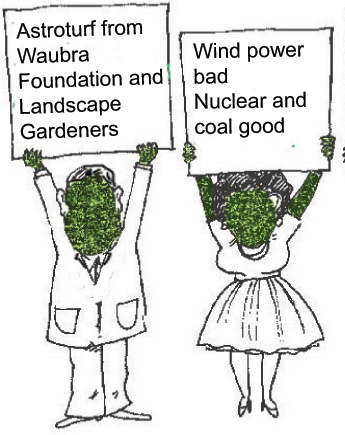 The British equivalent of landscape guardians, ”country guardians”, was funded and supported by elements of the British nuclear energy industry.
Wind farm opponents ‘aided and abetted’ by climate sceptic groups SMH, Ben Cubby, Josephine Tovey, 20 Dec 11 THE anti-wind farm movement that is gaining influence in the NSW Parliament is being ”aided and abetted” by climate sceptic groups and some mining figures.
The cabinet debated new wind farm guidelines yesterday, with division over whether NSW should follow Victoria and order wind turbines to be set further back from houses. The Shooters and Fishers Party, which shares the balance of power in
the upper house with the Christian Democrats, said yesterday it wanted a moratorium on new wind farms.
Industry sources said a US Tea Party-style ”astroturf” campaign, which mimics grassroots local opposition but is at least partly directed from elsewhere, was being waged against wind energy in NSW, which was expected to bring up to $10 billion in investment this decade as it accelerated to meet the national 20 per cent renewable energy target. Continue reading
Canadian tribes reject the lucrative ‘cancer’ of nuclear wastes

 No nuclear waste here, North Shore Tribal Council says, SooToday.com, December 20, 2011 Chiefs of the North Shore Tribal Council say no! to a multi-billion dollar nuclear waste disposal project in their territory CUTLER, ON – The First Nations of the North Shore Tribal Council strongly reject the prospect of the North Shore of Lake Huron becoming a site for the long-term storage of nuclear waste for the Nuclear Waste Management Organization (NWMO). The City of Elliot Lake has publicly expressed interest in possibly becoming one of the sites for the long-term disposal of nuclear waste for Canada’s nuclear industry.
Elliot Lake has a long history of uranium mining that resulted in the boom and bust of the city, as well as significant and lasting environmental damage to the local watershed and nearby ceremonial grounds. In addition, there are dozens of tailings ponds surrounding Elliot Lake currently waiting for a solution for their safe disposal.
“We cannot idly stand by and watch as they inject Mother Earth with this cancer,” says Chief Lyle Sayers, chairman of the North Shore Tribal Council. “We must ensure that the future natural resources of this area are there for our children, generations to come, and businesses alike.”
The half-life of this material is hundreds of thousands of years old and could impact generation after generation. No site can ever be totally safe for nuclear waste storage. “Natural disasters sometimes happen, such as we’ve seen in Japan. It could make this whole area a nuclear wasteland suitable for only that industry,” says Chief Sayers.
Our statement to the Canadian Nuclear Safety Commission and to the Nuclear Waste Management Organization is: Do not waste your financial resources if you plan to conduct a study in this area because a nuclear waste dump is not going to happen here.
The North Shore Tribal Council represents seven First Nation communities across the North Shore of Lake Huron.Chief Lyle Sayers is the chief of the Garden River First Nation and also the chairman of the North Shore Tribal Council. http://www.sootoday.com/content/news/details.asp?c=37141
1 This month
7 April – WEBINAR – Australia and the Doomsday Clock – Preventing nuclear war through NoFirstUse and other policies
Online | Tuesday April 7, 4:00-5:30pm, Australian Eastern Time / 8:00-9:30am Central Europe Time
– Access the registration link
15 April – Zoom –Nuclear Power is Not the Solution
Apr 15, 2026 01:00 AM in Canberra, Melbourne, Sydney

Join the International Physicians for the Prevention of Nuclear War (IPPNW) on Tuesday, April 14th for a timely webinar exploring the risks associated with nuclear power and challenging the myth that it offers a simple, safe, carbon-free solution to the climate crisis

21 April Webinar: No Nuclear Weapons in Australia
Start: 2026-04-21 18:00:00 UTC Canberra, Melbourne, Sydney (GMT+10:00)
End: 2026-04-21 19:30:00 UTC Canberra, Melbourne, Sydney (GMT+10:00)
Event Type: Virtual
A virtual link will be communicated before the event.
Host Contact Info: australia@icanw.org

of the week – Australians for War Powers Reform (AWPR)
To see nuclear-related stories in greater depth and intensity
 Antinuclear