Australia: nuclear wrap up of 2011
 Christina Macpherson, 3 Jan 2012
- The National Radioactive Waste Bill has still not passed the Senate, despite Martin Ferguson pushing for this for over a year. The Aboriginal Traditional Owners, led by Dianne Stokes, have continued the fight to save their land from this waste dump. Their legal case continues, as these traditional owners challenge the Northern Land Council’s choice of one small group, the Ngapa people to “volunteer” their land for a nuclear waste dump.
- BHP Billiton has not yet decided on the creation of their monster uranium hole at Olympic Dam. Yes it IS a new mine, not just an expansion of the existing mine.
- Australia’s antinuclear activists have worked consistently, despite mainstream media generally ignoring their issues. Dr Helen Caldicott has lectured in USA, Asia, Europe. At home, Jim Green, Mia Pepper, Cat Beaton, – to just single out a few – continue to publicise issues.
- For Australia’s URANIUM/NUCLEAR LOBBY 2011 has been a mixed year:
- Already, before the Fukushima nuclear catastrophe, uranium prices were steadily sliding down. In 2011, uranium prices continued to plummet, with no rise in sight for the coming year.
- Uranium companies’ share prices plummeted. Energy Resources of Australia (ERA) shares fell by 82.1%, Cameco by 50%, Uranium One by 45%
- China, the great white hope of the struggling uranium industry, decided to slow down its nuclear programme
- The South Australian Government legislated to place BHP BIlliton above the laws The Roxby Downs Indenture Act exempts BHP from over 20 South Australian laws, laws which apply to all other mining companies. BHP is exempted from the Aboriginal Heritage Act 1988, the Environmental Protection Act 1993, the Freedom of Information Act 1991, the Natural Resources Act 2004 (including water management issues), the Development Act 1993 and the Mining Act 1971
- The Gillard government trampled on Australia’s reputation as a leader in Nuclear Non Proliferation by deciding to sell uranium to India, a non-signatory to the Nuclear Non Proliferation Treaty.
- The Gillard government agreed to enhance USA’s military presence and missile warning systems in Australia
- Perhaps worst of all, the Australian media, by and large, ignored all these issues. (but there were exceptions – the continued reporting from Japan, by ABC’s Mark Willacy, and the courageous video coverage by Channel 9 TV’s Liz Hayes – http://www.asianweek.com/2011/08/14/aussie-60-min-and-kaku-fukushima-and-chernobyl-radiation-in-all-of-us/
Ian Plimer and co. manufacturing doubt on Climate Change?
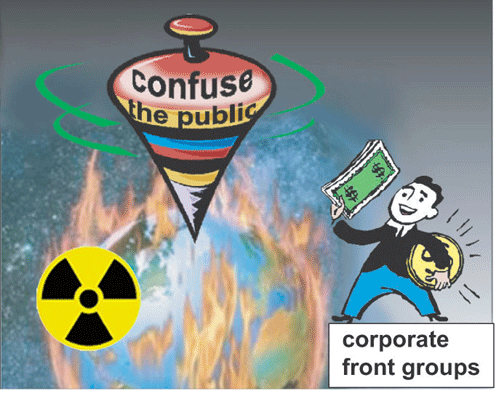 Could their real agenda be in manufacturing doubt rather than the search for scientific truth?
If so, it wouldn’t be a first, as Naomi Oreskes points out in her recent book Merchants of Doubt: How a Handful of Scientists Obscured the Truth on Issues from Tobacco Smoke to Global Warming.
Cherry-picking contrarian geologists tend to obscure scientific truth, THE AUSTRALIAN, BY:MIKE SANDIFORD December 31, 2011 GINA Rinehart notoriously claims she has never met a geologist who believes “adding more CO2 to the atmosphere will have any significant effect on climate”.
To listen to prominent “contrarian” geologists such as Ian Plimer, you might imagine she never could. But, despite the bluster, our contrarian geologists are out of kilter with their own community and seem deeply confused about the way the greenhouse effect – by adding more CO2 to the atmosphere, for example – has shaped both the past and the present.
All geology students learn of the importance of the greenhouse effect. It’s simply impossible to understand the geological record without it……. Continue reading
Solar energy costs, especially small scale, overestimated by 2 Australian agencies
renewable energy is coming down in price and fossil fuels are going up. In a carbon-constrained world, renewable energy is an investment in a lower electricity cost future for all Australians compared to the one they would face without it. Solar power will cost far less and provide far greater benefits over the medium term.”
 Productivity Commission And EUAA Blinkered On Solar by Energy Matters, 3 Jan 2012, Two Australian bodies criticising the cost of solar power have again failed to factor in all the benefits of the technology.
A Productivity Commission report from June this year was widely criticised by the solar power industry and supporters for stating rooftop solar has “generated little abatement for substantially higher cost”.
According to a recent article in The Australian, the backlash saw the Productivity Commission check over its figures recently and the Commissions has revised the cost of the small-scale component of the federal government’s Renewable Energy Target and state-based feed-in tariffs downwards – by tens of millions of dollars.
However, the Productivity Commission continues to dig its heels in relating to small scale solar’s cost generally. Continue reading
UK economy boosted by renewable energy, with annual savings per person of 84 pound sterling
 Renewable energy boosts UK economy by £2.5bn Renewable Energy Focus, 02 January 2012 Figures from the UK Department of Energy and Climate Change (DECC) show that companies have announced plans for almost £2.5 billion worth of renewable energy investment in the UK, with the potential to create almost 12,000 jobs, so far in the financial year 2011/12. By Kari Williamson
A separate report to the European Commission on renewable energy progress, shows that the UK:
Achieved a 27% increase in renewable energy consumption from 42.6 TWh in 2008 to 54 TWh in 2010 – representing 3.3% of total energy consumed;
Increased wind generation by 46% from 7 TWh in 2008 to 10.2 TWh in 2010, and in 2010 achieved 5 GW of offshore and onshore wind capacity; and
Saw a threefold increase in the use of biofuels in transport from 1% of total road transport fuel supply in 2007/8 to 3.33% in 2010……
Renewable energy saves £84 per person annually
Chief Scientific Adviser to DECC, Professor David MacKay, warns that continuing reliance on expensive imports of fossil fuels such as gas and coal would cost the equivalent of £4682 per person per year – as well as missing the carbon reduction targets the UK has signed up to.
At the same time, however, he has calculated that investing in renewable sources of energy such as wind would save £84 per person per year, bringing the cost down to the equivalent of £4598.
His ‘least-cost’ scenario envisages that by 2050, the UK will generate 42% of its electricity from renewable sources, 31% from nuclear and 27% from gas. Adding more renewable energy to the mix could drive down costs by 1.8%.
The figures are based on the total cost of the investment needed to keep the lights on in the UK, and they shouldn’t be confused with the cost of domestic fuel bills, trade association RenewableUK warns.
Jennifer Webber, RenewableUK’s Director of External Affairs, says: “This is a timely reminder from the Government’s Chief Scientific Adviser that doing nothing is not an option – we simply cannot afford to go on relying on high-carbon sources of energy. If we want to act in a manner which is financially prudent, and save money in the long term, we need to invest in renewables such as wind, wave and tidal energy”.
In December alone, Siemens applied for planning permission to build a wind turbine factory in Hull which will employ 700 people. In Chepstow, the wind turbine tower manufacturer Mabey Bridge announced that it is doubling its workforce to 200 and has introduced round-the-clock shifts to meet demand. The Dorset-based small wind turbine manufacturer Ampair announced just before Christmas that it would be taking on 8 extra members of staff.
“At a time when other sectors of the economy are struggling and people are losing their jobs, the wind industry is bucking the trend and creating employment, bringing new opportunities and job security to families around the country,” Webber concludes. http://www.renewableenergyfocus.com/view/22900/renewable-energy-boosts-uk-economy-by-25bn/
Throat cancer caused by ionising radiation
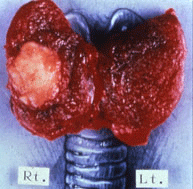 Vital Signs: Thyroid questions answered. The Daily Progress January 01, 2012 The terrible earthquake in Japan, and the resulting nuclear meltdowns, again have placed thyroid cancer in the news. There is a very close link between radiation exposure and thyroid cancer, and it is likely that Japan will see a sharp increase in aggressive thyroid cancers in the coming years, as was the case in Russia after the Chernobyl disaster in 1986.
Here in the United States, there was an increase in thyroid cancer following the nuclear testing in the 1950s in the Southwest. Though we have ceased such open-air testing, there are still numerous ways to be exposed to radiation, such as by receiving radiation therapy for cancer. And there is also a natural incidence of thyroid cancer unrelated to radiation exposure.
January is Thyroid Awareness Month, so it’s an apt time to discuss the thyroid, thyroid cancer and other thyroid conditions……. There are aggressive forms of thyroid cancer unrelated to radiation exposure, but they are very rare and typically occur in older males…. http://www2.dailyprogress.com/lifestyles/2012/jan/01/vital-signs-thyroid-questions-answered-ar-1575329/
1 This month
To see nuclear-related stories in greater depth and intensity
– go to https://nuclearinformation.wordpress.com/


 Antinuclear