As US military leave Iraq, children pay the price of depleted uranium
The US and UK militaries have sent mixed signals about the effects of depleted uranium, but Iraqi doctors like Alwachi and Alani, and along with researchers, blame the increasing cancer and birth defect rates on the weapon.
Abdulhaq Al-Ani, author of Uranium in Iraq, has been researching the effects of depleted uranium on Iraqis since 1991. He told Al Jazeera he personally measured radiation levels in the city of Kerbala, as well as in Basra, and his Geiger counter was “screaming” because “the indicator went beyond the range”.
 Fallujah babies: Under a new kind of siege, Doctors and residents blame US weapons for catastrophic levels of birth defects in Fallujah’s newborns, Al Jazeera, Dahr Jamail 06 Jan 2012 Fallujah, Iraq – While the US military has formally withdrawn from Iraq, doctors and residents of Fallujah are blaming weapons like depleted uranium and white phosphorous used during two devastating US attacks on Fallujah in 2004 for what are being described as “catastrophic” levels of birth defects and abnormalities.
Dr Samira Alani, a paediatric specialist at Fallujah General Hospital, has taken a personal interest in investigating an explosion of congenital abnormalities that have mushroomed in the wake of the US sieges since 2005. “We have all kinds of defects now, ranging from congenital heart disease to severe physical abnormalities, both in numbers you cannot imagine,” Alani told Al Jazeera at her office in the hospital, while showing countless photos of shocking birth defects.
As of December 21, Alani, who has worked at the hospital since 1997, told Al Jazeera she had personally logged 677 cases of birth defects since October 2009. Just eight days later when Al Jazeera visited the city on December 29, that number had already risen to 699. Continue reading
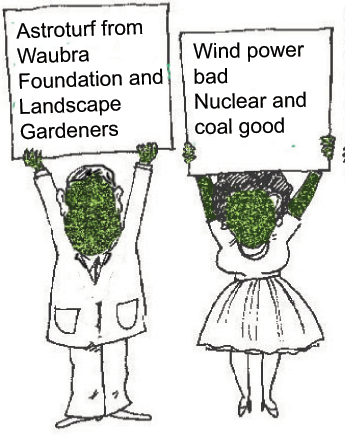
South Australia’s Liberal Party sucked in by anti wind power astroturf
 Liberals to ban wind farms within 2km of homes by: Political Reporter Daniel Wills The Advertiser January 06, OPPOSITION Leader Isobel Redmond has vowed to ban wind farms within 2km of any home. In her second policy announcement since declaring the end of her small-target strategy, Ms Redmond said she would move to “protect”
residents from the possible economic, social and health impacts of wind turbines if the Liberals won the 2014 election.
This comes just more than two months after Planning Minister John Rau released a scheme to reform the wind power industry, including allowing turbines 1km from homes, and follows Ms Redmond’s commitment this week to find savings in public sector wages.
Ms Redmond yesterday labelled wind “probably the least efficient and most unreliable of all the green energy sources”. She said she would not be fazed if the policy caused a drop in turbine investment…..
Government figures show wind energy contributes 21 per cent of power generated in the state. The Clean Energy Council estimates $2.8 billion has been invested in the sector…..
http://www.adelaidenow.com.au/news/south-australia/liberals-to-ban-wind-farms-within-2km-of-homes/story-e6frea83-1226237791196
Community owned wind and solar projects flourishing in UK
 There are now 43 communities [across UK] who are in the process of or already producing renewable energy through co-operative structures. They are set up and run by everyday people – local residents mostly – who are investing their time and money and together installing solar panels, large wind turbines or hydro-electric power for their local communities.
 The communities taking renewable energy into their own hands, Ecologist, Ed Mayo, 5th January, 2012 A new report by Co-operatives UK and The Co-operative Group examines those investing time and money in installing solar panels, wind turbines or hydro-electric power for their local communities
Late last year we – Co-operatives UK and The Co-operative Group – published a new report which reveals the growing number of people who are choosing to start renewable energy co-operatives in their communities, against all the odds.
What is exciting about the report is that it is the first and most comprehensive guide to what amounts to a new movement of communities who are taking action for greener energy into their own hands. Continue reading
Mongolia’s wind power project to power many thousands of homes
 The group has six wind-power plant projects that are due to bring 1,000 megawatts online in the country by 2020. In the U.S., that would be enough to power about 800,000 homes. In Mongolia’s economy, it would stretch much further.
Mongolia’s Renewables Belittle World’s Nuclear Supply, Bloomberg, By Yuriy Humber Jan 5, 2012 Untapped mineral riches are fueling Mongolia’s ambition to compete with Australia and Brazil in Asia. The nation’s resource-based economy grew 21 percent last quarter alone.
This largesse obscures a potential aboveground treasure also awaiting investors.
The world’s most sparsely populated nation has the potential to generate 2.6 million megawatts of wind, solar, geothermal and hydropower, based on data collected by the U.S. National Renewable Energy Laboratory and the Mongolian National Renewable Energy Center.
That’s a fantastic figure. It’s seven times the capacity of all the world’s operable nuclear reactors combined, according to world nuclear association data. In contrast, Mongolia’s current power capacity is less than that of one large coal plant, just 878 megawatts.
That’s what Newcom Group’s acting Chief Executive Office Byambasaikhan Bayanjargal recently told investors in Hong Kong. Of that, close to 40 percent of the potential is in wind, and Bayanjargal is eager to harness it….. Continue reading
Secret research on UK nuclear veterans, to protect nuclear industry
nuclear test veterans have been part of a continued experimental programme for the protection of nuclear industry.

 Why Nuclear Veterans are Being Silenced, Paul Langley’s Nuclear History Blog, 6 Jan 12 “…..the public are overdue an explanation of why successive UK governments, ministers and Prime Ministers remain silent on this issue…. Nuclear test veterans and widows believe the press and the general public deserve to know why compensation for damage to health of UK nuclear test participants is beings so fiercely contested .
Based on political and scientific information obtained by CVFI associates and by individual nuclear test veterans over several decades and passed to the legal team acting on behalf of the AVCG the following provides the explanation .
The fierce contesting of litigation by the MoD results from the 1950’s cold war Prime Ministerial policy edict of Sir Anthony Eden which decided that scientific warnings of the danger of genetic damage in nuclear test veterans from exposure to radiation could be ignored as “ a pity , but it cannot be helped.”
This policy edict has been passed down from officials within the Ministry of Defence (MoD) to all successive Prime Ministers and upheld for over fifty years . Continue reading
Call for Constitutional change, to end Australia’s discrimination against Aborigines
The council recommended “the removal of those remaining sections of the Constitution which discriminate on the basis of race”; a preamble recognising Aboriginal and Torres Strait Islander peoples as the first peoples of Australia, as well as their prior occupation and ownership; and the repeal of “the anachronistic race power” contained in section 51 (xxvi), which allows laws to be made that benefit or discriminate against Aborigines.
Australia was one of the only modern democracies that did not guarantee racial equality in its Constitution and it would be an “unfortunate irony” if Australians voted to recognise Aborigines, but the capacity for discrimination remained within the Constitution.
 Lawyers backed new race power BY: STUART RINTOUL The Australian January 6 A PANEL that recommended constitutional reform to recognise and protect Aboriginal people and culture had the strong backing of the Law Council of Australia. A submission by the council recommended the key changes to the Constitution ultimately adopted by the panel in its report, which will be handed to Julia Gillard this month.
The legal profession’s peak body said a minimalist approach confined to recognising Aboriginal people in the preamble to the Constitution “would be of little if any practical effect”. It supported “an approach to constitutional recognition which goes beyond the preamble to the Imperial Act and secures enforceable rights”. Continue reading
Radioactive colonialism – Autralian company Lynas’ rare earths plant in Malaysia
 This little news item from THE AUSTRALIA barely touches on the salient points about Australian company Lynas’ planned rare earths processing plant in Malaysia. It should not be forgotten that:
- Lynas was well into building the plant before it obtained the necessary permissions from teh Malaysian government
- The plant is in a highly populated area (unlike the rare earths plant in China, which radioactively polluted a huge area)
- Lynas wanted to go ahead with no plan for the permanent disposal of its radioactive wastes
- No doubt the waste disposal problem was Lynas’ reason for not planning the rarenearths processing plant in Australia. As with Australian uranium mining companies in Nigeria, Tanzania etc – another example of radioactive colonialism. – Christina Macpherson
Lynas licence decision date set for Malaysian plant, THE AUSTRALIAN, BY: ROSS KELLY January 05,“………Malaysian authorities have indicated the Atomic Energy Licensing Board will meet January 30 to decide whether Lynas should be granted a temporary operating license, Lynas said in a statement to the Australian Securities Exchange. The decision is then expected to be tabled to a full session of the Malaysian cabinet. …
Rare earths typically occur in deposits that contain uranium and thorium, meaning radioactive waste is present in tailings that require safe disposal. Activists and some politicians have actively campaigned against the Malaysian processing plant, prompting authorities to ask the International Atomic Energy Agency to review the $232 million
development that’s almost complete.
A report by the IAEA in June largely backed the plant, while recommending Lynas deliver a plan for dealing with its waste.
A temporary license will allow the company to ramp up production at the Malaysian facility to nameplate capacity and sell its products, Lynas said. If Lynas complies with the strict monitoring and government oversight requirements of the temporarily license, a permanent operating licence can be issued within two years. …
http://www.theaustralian.com.au/business/mining-energy/lynas-plant-license-decision-set/story-e6frg9df-1226237278015
1 This month

of the week – Australians for War Powers Reform (AWPR)
To see nuclear-related stories in greater depth and intensity
 Antinuclear