Wind energy: South Australian govt in the grip of fossil fuel astroturfers?
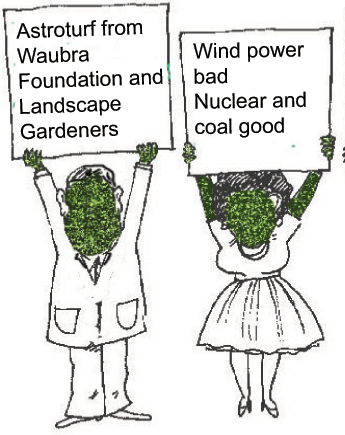 Proposed Policy Threatens Wind Power Investment In South Australia, Energy Matters, 8 Jan 12, Australia’s Clean Energy Council (CEC) says the South Australian Opposition’s policy on wind farms would threaten more than $3 billion of investment and result in a further increase in electricity prices in the state if implemented.
South Australian Opposition leader Isobel Redmond has vowed to ban wind farms within 2 kilometres of any residence. Another key element of the Liberal’s policy is a ban on wind farms within 5 kilometres of townships.
Clean Energy Council Acting CEO, Kane Thornton, said wind power projects currently proposed for South Australia would provide for the electricity needs of more than 567,000 homes and create 948 direct jobs.
“As we’ve seen in Victoria, such measures would effectively make South Australia a ‘no-go’ zone for wind farms, driving billions of dollars of investment from the state. In addition, South Australians would see higher electricity prices as future renewable energy will need to come from higher cost sources,” said Mr. Thornton.
Mr. Thornton pointed out over 20 per cent of South Australia’s electricity is generated by wind power and the wind industry is one of the reasons the state’s carbon emissions fell by 18 per cent over the past five years.
In August last year, then-Premier Mike Rann said South Australia was home to 54% of Australia’s wind power capacity, 5 times more per capita than Victoria and 10 times more than New South Wales.
While Ms. Redmond reportedly claims wind turbines are being installed “willy-nilly with no accountability“, the CEC states current guidelines ensure a proper balance between wind farm developments and community in South Australia.
The CEC says it will work with the South Australian Liberal Party to “ensure they understand the value of the wind industry to the state, and to provide them with a more complete understanding of wind farms and associated issues.” http://www.energymatters.com.au/index.php?main_page=news_article&article_id=1973
Don’t miss this video on the crooked history of nuclear power
“We discovered that our theoretical calculations didn’t have a strong correlation with reality. But we just couldn’t admit to the public that all these safety systems we told you about might not do any good”
 http://www.bbc.co.uk/blogs/adamcurtis/2011/03/a_is_for_atom.html
  VIDEO A IS FOR ATOM Adam Curtis , 16 March 2011As a background to the ongoing crisis at the Fukushima Daiichi nuclear plant I am putting up a film I made a while ago called A is for Atom. It was part of a series about politics and science called Pandora’s Box.
The film shows that from very early on – as early as 1964 – US government officials knew that there were serious potential dangers with the design of the type of reactor that was used to build the Fukushima Daiichi plant. But that their warnings were repeatedly ignored.
The film tells the story of the rise of nuclear power in America, Britain and the Soviet Union. It shows how the way the technologies were developed was shaped by the political and business forces of the time. And how that led directly to inherent dangers in the design of the containment of many of the early plants. Continue reading
Aboriginal land threatened by uranium mining

 Australia’s push to increase uranium mine threatens aboriginal land, RADIO Free Speech NEWS , 01/06/2012 Australia is one of the largest exporters of uranium, a metal essential for nuclear power and weapons production. The country sits on the world’s largest uranium reserves and it’s poised to increase its role in the nuclear industry. The Australian government has made moves to become a major exporter of uranium to India, a growing nuclear power. But opponents — many from the country’s indigenous communities — are fighting the expansion. FSRN’s Jessie Boylan reports from Melbourne. http://fsrn.org/audio/australia%E2%80%99s-push-increase-uranium-mine-threatens-aboriginal-land/9671
Community solar energy for Australia – Mallacoota shows the way
 While these types of schemes are still relatively uncommon in Australia, a popular method of using the power of collaboration to install solar here is the solar buyers group. Consisting of people within a local area, these groups use their collective clout to secure better pricing for installing solar panels on their own rooftops…
In an initiative led by local resident Jim Sakkas, the community banded together to form a solar buyers group and since that time, close to one hundred solar power systems have been installed in Mallacoota by national solar solutions provider Energy Matters under the model.
A Co-operative Approach To Going Solar, by Energy Matters, 6 Jan 12, A growing number of people are starting renewable energy schemes in their communities through co-operatives and other forms of collaboration. A recent report from Co-operatives UK and The Co-operative Group states 43 communities are in the process of or already producing renewable energy by investing money to install solar panels, large wind turbines or hydro-electric power in their area.
£16 million has been invested by over 7,000 people in these schemes, which include a £2 million wind farm and a 98kW solar photovoltaic installation on the roof of a brewery.
The report says green economy co-operatives are the most rapidly growing part of the UK co-op sector, jumping 24% since 2008. In addition to these co-operatives’ efforts seeing clean, renewable energy being supplied to their communities, there is also a financial return to participants through the sale of electricity produced.
The co-operative approach covered in the report basically works like this: Continue reading
Australia’s climate policies – vested interests rule
 Common sense is in the eye of the beholder, The Drum, 9 Jan 12, “……Climate and energy: Australian energy policy is another example of vested interests trumping the national interest. For decades, our strategy has essentially been about digging cheap energy out of the ground – and burning it.
Australia is abundantly supplied with cheap, accessible coal. As a result, three-quarters of our electricity comes from burning the brown or black stuff, in vast power-plants that spew millions of tonnes of carbon into the atmosphere annually.
If burning coal had no consequences for the future of the planet, there would be no problems with this state of affairs. Unfortunately, coal is made from carbon, and burning it is warming the planet. A warming climate is starting to seriously affect Australia’s agriculture, tourism and insurance industries. Australia faces a stark choice in the way it generates its energy: continue down the high-carbon path, or seek to decarbonise our economy.
At this point, the usual arguments against decarbonisation are trotted out. Climate change isn’t real. Or, Australia is too small to make a difference. Or, renewable energy doesn’t work. Or simply that it’s all too expensive. None of them stack up.
Climate change is not just real, but well underway, as the melting glaciers and permafrost attests. Australia contributes around 1.5 per cent of the world’s emissions, so we can’t solve the problem on our own. But we can work diligently in international negotiations to persuade big polluters to join us to make a difference, and we can’t do that if we aren’t walking the walk.
Finally, renewable energy can’t provide base-load power now, but it certainly could in the medium-term future. Renewable technologies are rapidly maturing, particularly in large-scale wind and solar photovoltaic, and could rapidly expand if given the right incentives.
Ultimately, energy policy is a subset of more general problem of perverse incentives in our economy. Fossil-fuel energy users don’t pay anywhere near the true cost of their damage to the environment, and hence this energy is unfairly cheap. But making dirty energy more expensive means taking on hugely influential vested interests in mining, business and the media. It also means forcing consumers to pay more for their electricity. Neither option is politically palatable. But the true costs to the economy of the changing climate are likely to be much greater….. http://www.abc.net.au/unleashed/3762920.html
20-12 more evidence of global warming, more intractable opposition to action on this
So we start 2012 with an unprecedented understanding of climate science and the consequences of warming, and at the same time seemingly irreconcilable differences on what to do,
Another Year Goes By and We’re No Closer to Solving Climate Change, Rocky Mountain Institute, Auden Schendler January 5, 2012 One version of the myth of King Midas holds that he was not greedy. Instead, he loved his daughter so much that he longed to leave her a stable future. When given the chance, he asked for the golden touch as a way to create an endowment. But when they embraced, she turned to gold as well. In trying to protect his beloved daughter, Midas destroyed her.
 Some climate change deniers have the same admirable motive as Midas. The actions required to solve climate, they fear, will preclude us from capturing the wealth that can benefit or save many children today. Even the left argues that a rising economic tide lifts all boats, despite the fact that continued growth probably dooms the planet to runaway warming. Environmentalists fear that no action on climate condemns us to an even more costly fate that threatens every child, forever.
Finding a fix, then, seems close to impossible. What we learned in 2011–a banner year for human understanding of climate change and its impact on our lives–helps explain why.
In October, climate-change skeptic Dr. Richard Muller released the results of a two-year study at the Berkeley Earth Surface Temperature Project that was funded in part by the Koch brothers, leading climate deniers. Muller’s report, in his own words, found that “global warming is real.” In fact, Muller found warming to be “on the high end” of what others had found. The results were reported in the Wall Street Journal’s editorial page.
2011 also gave a taste of what climatologists have long predicted: that a warmer world will experience more severe weather events, both droughts and storms. PBS reported on “mind-boggling extreme weather” resulting from warming, what Dr. Jeff Masters, Director of Meteorology at the Weather Underground, Inc. calls “steroids for the atmosphere.” This summer, droughts in the Southwest matched those of the dust bowl and a tornado outbreak blew away the record 1974 season. USA Today reported how natural disasters were straining FEMA’s budget. In the last week of 2011, Vermont fixed the last of the roads destroyed by flooding from Hurricane Irene.
At the same time, still more peer-reviewed science came out showing that the anthropogenic warming signal is unmistakable. Continue reading
1 This month

of the week – Australians for War Powers Reform (AWPR)
To see nuclear-related stories in greater depth and intensity
 Antinuclear