Australian news, nuclear and uranium wrap up for the week
 Mainstream press continues to tout uranium as having a great future- despite share prices showing otherwise – over the year Energy Resources of Australia (ERA) shares fell by 82.1%, Cameco by 50%, Uranium One by 45%, Paladin 70%. Analysts predict continued low prices for uranium, with a dubious future for nuclear power – even China having doubts now..
Concern arises over the derailed train in Northern Territory – potential for future nuclear transports, uranium , and the planned radioactive waste transports. With climate change bringing more extremes of weather, the dangers of flooding in NT become more important.
Martin Ferguson astounds us all again, as he has engineered a private spy company to watch environmental activists. The National Open Source Intelligence Centre – a nice little commercial venture for Jody and Amanda Lambden, of Croydon, Victoria. This private spy body, unlike ASIO etc, is not accountable to Parliament. – Christina Macpherson
Martin Ferguson helps coal lobby in setting up private spy company
a lack of evidence doesn’t seem to have stopped the federal Minister for Resources and Energy, Martin Ferguson, from successfully advocating for heavy-handed laws framed in the language of anti-terrorism, but designed to repress political advocacy.
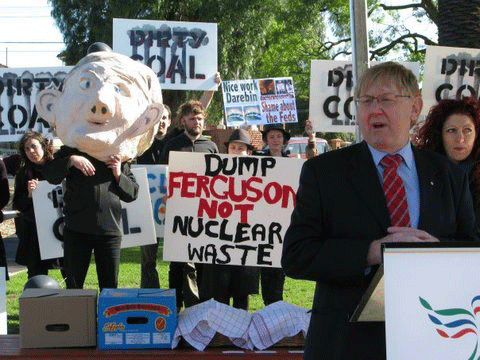
not only does the coal industry appear to be manipulating our political and legislative processes, it continues to pollute, expand, and cause death and massive damage with impunity. For years, it has successfully curtailed government action to combat climate change.
 It is the coal barons, not activists, who threaten society, The Age, Shaun Murray, January 10, 2012 Anti-coal activists pose a political threat. That’s why we’re being spied on. I’d like to know how the government can justify employing a private
company to spy on me. As an anti-coal activist, and member of one of three main community groups in Australia campaigning against the coal industry, I was alarmed by revelations in The Saturday Age that the Australian Federal Police has singled us out as a potential threat and is employing a private company to spy on us.
As peaceful community activists, we collectively have no history of or motivation to disrupt energy supply. We pose no threat to society – unlike the coal industry, which wields massive political influence and holds the greatest responsibility for the hundreds of thousands of deaths, extinction of species, and billions of dollars of damage annually that climate change is causing…. Continue reading
Secretive Victorian government sets up toothless freedom of information watchdog
Federal government figures say the calculations in the press release overestimate the expected costs [of Australia’s carbon tax] and ignore compensation to be offered to some.
Using freedom of information laws, the state [Labor] opposition asked Mr O’Brien’s Department of Primary Industries for all modelling and briefings behind the press release.
Four months later the department wrote back, denying access to all documents
The Baillieu government this year will put in place a freedom of information watchdog. It will not have powers over ministers or department heads, will be unable to review decisions relating to secret cabinet documents, and could ultimately result in longer delays.
 Baillieu hides carbon tax documents, The Age, Clay Lucas, January 10, 2012 THE Baillieu government has been accused of using ”laughable” excuses to block the release of economic modelling it used to attack the Gillard government’s carbon tax.
The government cited public interest and privacy issues as reasons it will not hand over calculations behind a media release by state Energy Minister Michael O’Brien last July. The press release, titled Julia Gillard duds Victorians again, lashed the federal Labor government over its carbon tax plans. Continue reading
Authorities and media ignore report on infant deaths from Fukushima radiation
[In April 2011] the Environmental Protection Agency (EPA) reported increased levels of radiation in the air, water and milk right across the U.S. that were 100s of times above normal levels.
while deaths were reported across all age categories, infants under the age of one-year old were the demographic hardest hit. The increase in 2010-2011 deaths among infants in the spring was 1.8 percent, compared to a decrease of 8.37 percent in the preceding 14 weeks. Infant deaths were highest “because their tissues are rapidly multiplying, they have undeveloped immune systems, and the doses of radioisotopes are proportionally greater than for adults,”
 this study, which was released publicly on December 19, 2011, was not covered by mainstream media, but mostly watchdog groups and alternative, underground and fringe publications. There has been little reported about the after affects of Fukushima of late.
In an audio news conference, Mangano says the reaction of the nuclear industry and government will likely be a smear campaign to the report’s credibility
 14,000 U.S. Deaths Linked to Fukushima Nuclear Meltdown: Infants Hardest Hit, The Province, Tess Zevenbergen January 9, 2012. The first study linking radioactive fallout to 14,000 U.S. deaths as a result of Fukushima’s nuclear meltdown following the 9.0 magnitude earthquake and tsunami that struck the coast of Japan on Friday, March 11th last year has been published in the International Journal of Health Services (IJHS). According to a news release issued over the PR Newswire, the study is the first peer-reviewed study to appear in a medical scientific journal that documents the health hazards associated with the Fukushima nuclear explosion and meltdown catastrophe.
The study, authored by epidemiologist Joseph Mangano MPH MBA and Executive Director of the Radiation and Public Health Project, and Janette Sherman, a toxicologist and adjunct professor at the University of Michigan, states the number of radiation-related deaths linked to the Fukushima disaster is comparable to the number of deaths following the Chernobyl meltdown of 1986. The results of the study were gleaned from looking at U.S. death rates during the period Fukushima occurred, as well as in previous months and years.
“This study of Fukushima health hazards is the first to be published in a scientific journal. It raises concerns, and strongly suggests that health studies continue, to understand the true impact of Fukushima in Japan and around the world. Findings are important to the current debate of whether to build new reactors, and how long to keep aging ones in operation,” stated Mangano. Continue reading
To further nuclear power, India borrows money, and public relations methods from France
 Interesting to watch the developments in India, as the people’s Koodankulam anti nuclear protest continues. The Russian engineers have now left the site, as work cannot proceed, due to the public opposition.
The Indian nuclear corporation cannot afford its planned new nuclear plants at Jaitapur and Koodankulam, which they are buying from France and Russia respectively. But hey! – that’s no problem, because they are going to borrow the money from France and Russia. Seems like the Indian government is working on behalf of foreign companies, not the Indian people. Nuclear Power Corp Looks Overseas for Loans .http://online.wsj.com/article/SB10001424052970204257504577149981322117366.html
The Indian government is also learning from France’s nuclear company, AREVA, on how to manipulate public opinion. With jolly jingles and other cheery messages, they hope to convince the community that nuclear power is just fine. At left, a sample of AREVA’s message to children, in its Australian brochure. – Christina Macpherson
NPCIL launches campaign to clear KNPP concerns,Zee News, January 09, 2012, Chennai: Amid the standoff over the controversial Koodankulam Nuclear Power Plant, the Nuclear Power Corporation of India Limited has launched an intense media campaign to allay safety fears of the people in and around the project site.
“NPCIL has produced 60-second long advertisements to be telecast on TV channels. These will carry messages on cancer and on some issues raised by fishermen,” an official said here today.
In the advertisements, renowned oncologist Dr V Shanta of Cancer Institute, Chennai, marine life experts Murugesan and Sugumaran will clear doubts that locals and fishermen might have (about nuclear
power), they said. The campaign would be telecast on Tamil TV channels, apparently targeting the local population who have been up in arms against the Indo-Russian collaborative project since September last.
NPCIL officials had already aired 60-second long jingles on private radio channels in Tirunelveli district. The commissioning of the plant, earlier slated in December 2011, has been delayed after protests by locals on grounds of safety.
http://zeenews.india.com/news/tamil-nadu/npcil-launches-campaign-to-clear-knpp-concerns_751574.html
1 This month
7 April – WEBINAR – Australia and the Doomsday Clock – Preventing nuclear war through NoFirstUse and other policies
Online | Tuesday April 7, 4:00-5:30pm, Australian Eastern Time / 8:00-9:30am Central Europe Time
– Access the registration link
15 April – Zoom –Nuclear Power is Not the Solution
Apr 15, 2026 01:00 AM in Canberra, Melbourne, Sydney

Join the International Physicians for the Prevention of Nuclear War (IPPNW) on Tuesday, April 14th for a timely webinar exploring the risks associated with nuclear power and challenging the myth that it offers a simple, safe, carbon-free solution to the climate crisis

21 April Webinar: No Nuclear Weapons in Australia
Start: 2026-04-21 18:00:00 UTC Canberra, Melbourne, Sydney (GMT+10:00)
End: 2026-04-21 19:30:00 UTC Canberra, Melbourne, Sydney (GMT+10:00)
Event Type: Virtual
A virtual link will be communicated before the event.
Host Contact Info: australia@icanw.org

of the week – Australians for War Powers Reform (AWPR)
To see nuclear-related stories in greater depth and intensity
 Antinuclear