Wind farming an economic opportunity for Australia’s struggling farmers
Wind farms in Australia face the toughest guidelines in the world in relation to their siting, operation and permissible 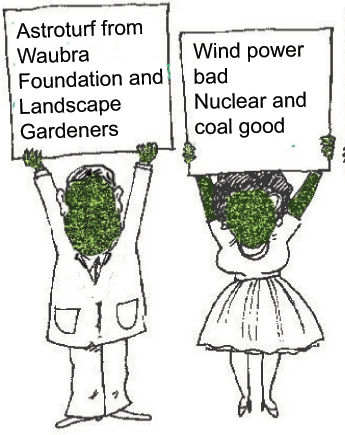
noise levels.
opponents of renewable energy seem determined to use wind farms as political footballs, fuelling community divisions they claim they want to avoid. They make inflammatory claims about noise – when a wealth of scientific research shows that noise from wind farms does not have a harmful effect on people.
Thornton: Winds of change for farmers Adelaide Now, by: Kane Thornton January 11, 2012 WIND turbines can help save struggling farms, argues Kane Thornton. LIFE on the land has only become tougher. The cruel effects of drought, fires and floods, along with the strong Aussie dollar and challenging global markets, have pushed farming families to the limit.
In many cases, diversification has been the key to their survival. Responding to changing market dynamics, consumer demands and weather conditions by moving into different crops, livestock and land uses, is helping save the family farm.

It would be a brave outsider who demanded the removal of the farmer’s right to make those choices for themselves.
Yet that is what the activists opposed to wind farms are doing.
They are saying that individual farmers should not have the right to choose wind farming to help them drought-proof their properties, make better use of marginal farming land, or insure against market downturns. But for those farmers fortunate enough to live in some of the windiest places in the world, farming wind can be the best option.
And those farmers are not the only ones who benefit. Wind farms are
also providing jobs for local communities and contractors and an
economic boost for struggling regional areas. At the Capital wind farm
near Canberra, about $10 million went straight into the pockets of
local people during construction.
It went into the corner store, the local restaurant, motels and more.
Of course, appropriate regulations and community consultation should
apply to any wind farm, as they do to any new farm infrastructure, be
it an extra shed, a tourist development, a road, a dam or a mine.
Wind farms in Australia face the toughest guidelines in the world in
relation to their siting, operation and permissible noise levels.
The wind energy industry is working hard to improve its process of
consultation with local communities and the quality of information
that it shares with them. A lack of information – or the wrong
information – can understandably create anxiety for people who are not
familiar with our new ways of producing electricity.
However, opponents of renewable energy seem determined to use wind
farms as political footballs, fuelling community divisions they claim
they want to avoid. They make inflammatory claims about noise – when a
wealth of scientific research shows that noise from wind farms does
not have a harmful effect on people.
These disingenuous claims increase anxiety within the community.
And, like any form of anxiety, this can have an impact on a person’s health.
Those opponents also ignore the impact that wind farms have on
reducing our carbon emissions, and say wind energy is expensive.
Consider this.
Over the first six months of last year, Australia’s 1188 wind turbines
generated enough electricity to power more than 725,000 homes.
If we are to move away from coal (which itself can create health
issues) then wind energy is one of the cheapest alternative sources we
can introduce on a large scale.
Farmers should have the right to farm the wind and the right to secure
the future of their livelihoods and their families.
* Kane Thornton is Clean Energy Council’s acting CEO
http://www.adelaidenow.com.au/ipad/thornton-winds-of-change-for-farmers/story-fn6br25t-1226241083624
No comments yet.
1 This month
7 April – WEBINAR – Australia and the Doomsday Clock – Preventing nuclear war through NoFirstUse and other policies
Online | Tuesday April 7, 4:00-5:30pm, Australian Eastern Time / 8:00-9:30am Central Europe Time
– Access the registration link
15 April – Zoom –Nuclear Power is Not the Solution
Apr 15, 2026 01:00 AM in Canberra, Melbourne, Sydney

Join the International Physicians for the Prevention of Nuclear War (IPPNW) on Tuesday, April 14th for a timely webinar exploring the risks associated with nuclear power and challenging the myth that it offers a simple, safe, carbon-free solution to the climate crisis

21 April Webinar: No Nuclear Weapons in Australia
Start: 2026-04-21 18:00:00 UTC Canberra, Melbourne, Sydney (GMT+10:00)
End: 2026-04-21 19:30:00 UTC Canberra, Melbourne, Sydney (GMT+10:00)
Event Type: Virtual
A virtual link will be communicated before the event.
Host Contact Info: australia@icanw.org

of the week – Australians for War Powers Reform (AWPR)
To see nuclear-related stories in greater depth and intensity
 Antinuclear
Leave a comment