Radioactivity over Sunshine Coast likely to have come from Lucas Heights Nuclear Facility
In a long article, Paul Langley traces the history of nuclear radiation releases and coverups. Marcus Grezechnik of Australian Radiation Protection and Nuclear Safety Agency (ARPANSA) was reassuring, and vague about the origin of this radiation But – this same Marcus Grezechnik is one of the authors of the only research study done on radioactive clouds in Austtralia. That study of radioactivity in the atmosphere above Melbourne, in 2008 and 2009 found that the source was the Lucas Heights nuclear facility, in Sydney. – Christina Macpherson
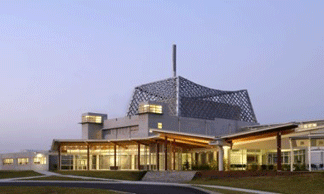 That cloud of reactor gas reported off the Sunshine Coast – Not Fukushima. It’s Lucas Heights, Paul Langley’s Nuclear History Blog, 14 Jan 2012,
Quote: “Evaluation of radioxenon releases in Australia using atmospheric dispersion modelling tools.
The origin of a series of atmospheric radioxenon events detected at the Comprehensive Test Ban Treaty Organisation (CTBTO) International Monitoring System site in Melbourne, Australia, between November 2008 and February 2009 was investigated. Backward tracking analyses indicated that the events were consistent with releases associated with hot commission testing of the Australian Nuclear Science Technology Organisation (ANSTO) radiopharmaceutical production facility in Sydney, Australia. Forward dispersion analyses were used to estimate release magnitudes and transport times. The estimated (133)Xe release magnitude of the largest event (between 0.2 and 34 TBq over a 2 d window), was in close agreement with the stack emission releases estimated by the facility for this time period (between 0.5 and 2 TBq). Modelling of irradiation conditions and theoretical radioxenon emission rates were undertaken and provided further evidence that the Melbourne detections originated from this radiopharmaceutical production facility. These findings do not have public health implications. This is the first comprehensive study of atmospheric radioxenon measurements and releases in Australia. Crown Copyright (c) 2010. Published by Elsevier Ltd. All rights reserved.
Rick Tinker, Blake Orr, Marcus Grzechnik, Emmy Hoffmann, Paul Saey, Stephen Solomon. Evaluation of radioxenon releases in Australia using atmospheric dispersion modelling tools. Journal of environmental radioactivity. 2010 May;101(5): 353-61 ” end quote.
Australian Radiation Protection and Nuclear Safety Agency, 619 Lower Plenty Road, Yallambie, Victoria, Melbourne 3085, Australia. rick.tinker@arpansa.gov.au
Journal of environmental radioactivity 2010 May http://www.nextbio.com/b/search/article.nb?id=20346548
Mysterious radioactive cloud detected by Geiger counter over Sunshine Coast
 Radiation cloud ‘not harmful’ , Sunshine Coast Daily, Kate Clifford | 14th January 2012 A RADIOACTIVE cloud lingering off the Sunshine Coast on Sunday was not dangerous, according to the Australian Radiation Protection and Nuclear Safety Agency.
Caloundra IT manager Peter Daley picked up the cloud’s radioactivity on his Geiger counter, a device that measures ionizing radiation in the atmosphere. The reading was taken at 6.30pm and measured 0.80 microsieverts, which is eight times over the average level of radiation in the atmosphere.
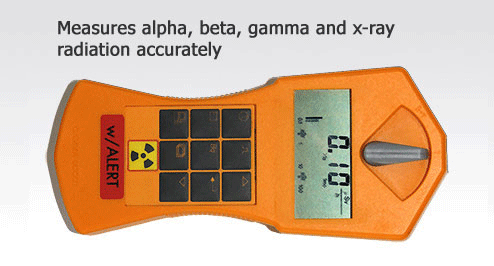
Mr Daley said he was concerned the cloud could have formed from a radioactive fall out from the Fukushima nuclear disaster in Japan. “This may be just a one off but even still, any exposure to an increase in radiation is not good,” Mr Daley said. He first noticed the hike when his Geiger counter began erratically beeping.
He then watched the rise in radiation fluctuate for three hours, peaking for 20 minutes at 0.80. “I was shocked to hear the Geiger alarm going off, I have been recording radiation in the atmosphere for four years and the highest it has ever gone was 0.20 microsieverts.”
Australian Radiation Protection and Nuclear Safety Agency senior environmental scientist Marcus Grezechnik said the reading was unusualbut not concerning for the Coast…..
http://www.sunshinecoastdaily.com.au/story/2012/01/14/radiation-cloud-not-harmful-sunshine-coast/
10, 000 delegates at Global Conference for a Nuclear Power Free World, at Yokohama
The organisers, want to seize the moment to mobilise others across borders and generations and phase out nuclear power around the world. “Now is the time to start to discuss how to reduce nuclear dependency and promote natural energy for future society,” Tatsuya Yoshioka, chair of the conference
 Anti-nuclear meeting offers lessons learned from Fukushima Business Recorder, JANUARY 14, 2012 TAKEHIKO KAMBAYASHI Rebecca Harms, a European Parliament member from Germany, was braced for severe power shortages on arriving in Japan, with only six of the nation’s 54 nuclear reactors in service, but was shocked to find wasted electricity all over the country.
The country, which experienced the world’s worst nuclear disaster in 25 years, “is wasting electricity everywhere,” a heated toilet seats and garish neon signs to large air heaters outside hotel entrances, said Harms, co-president of the Greens in the European Parliament. “It was really astonishing,” said Harms, who is among speakers at a weekend anti-nuclear conference in Yokohama, south of Tokyo. Continue reading
Pacific region meeting on renewable energy- why wasn’t Ferguson there?
Renewable resources are a competitive, low-cost alternative for fossil fuels for the Pacific, and some inspiring renewable energy goals are being set.
Today’s meeting – which included six Heads of State and IRENA Members in the Cook Islands, Federated States of Micronesia, Fiji, Kiribati, Marshall Islands, Nauru, Niue, Palau, Papua New Guinea, Samoa, Solomon Islands, Tonga, Tuvalu and Vanuatu – discussed IRENA’s proposed role in accelerating its deployment, opportunities for collaboration with
other stakeholders and development partners, and provided guidance on IRENA’s new proposals, ensuring that they accord with the Pacific Leaders’ policy goals and priorities.
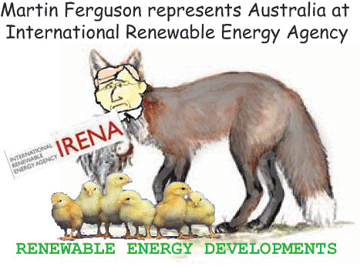
 IRENA meeting heralds new Regional Energy Era (Wam) Khaleej Times, 13 January 2012 ABU DHABI – A Pacific Leader’s Meeting held on Friday in Abu Dhabi by the International Renewable Energy Agency (IRENA) in advance of its Second Assembly, (January 14-15), issued a public communique confirming the Agency’s proposed work activities to accelerate renewable energy deployment in this important region, which is currently heavily dependent on fossil fuels. Continue reading
Australia part of world’s record investment in renewable energy
 Australia’s investment was on track to rise to $6.8 billion next year and $45 billion by 2020, meeting the target of renewable sources such as solar, wind and geothermal making up 20 per cent of energy supply.
Global investment in clean energy hits record levels SMH David Wroe, Canberra January 14, 2012 DESPITE the turbulence in the global economy, the world invested a record $251 billion in clean energy last year, with the US streaking ahead of China in green spending and boosting confidence among climate action advocates.
New figures from Bloomberg New Energy Finance showed the US spent $54 billion on clean energy, retaking the No. 1 spot it lost to China in 2009 and defying assumptions that the world’s largest economy is flagging on greenhouse gas reductions.
Australia also hit a record, spending $4.7 billion on clean energy in 2011, a jump of 11 per cent on the previous year, mostly from increases in rooftop solar. ”Despite financial crisis, and even though carbon pricing schemes haven’t developed quite the way they were expected to … investment keeps growing, which reflects the world view of many major economists that clean energy is going to be the major industrial driver of economic growth this century,” said Kobad Bhavnagri, Bloomberg New Energy Finance’s lead clean energy analyst in Australia. Continue reading
1 This month

of the week – Australians for War Powers Reform (AWPR)
To see nuclear-related stories in greater depth and intensity
 Antinuclear