Monitoring radiation in from Fukushima in ocean fish
 Buesseler has already reported some results from the 15-day cruise last May and June….. “It implies the groundwater is contaminated or the facility is still leaking radiation.”
“There is no safe level of radiation. They should be making every effort to monitor food.”.
After Fukushima, fish tales, By Alex Roslin, The Montreal Gazette January 14, 2012“.………..evidence has emerged that the impacts of the disaster on the Pacific Ocean are worse than expected.
“People want to know what’s happening with the cesium and how much is in the fish, but we don’t know. It’s frustrating,” said oceanographer Buesseler.
“It’s disconcerting how big of an event Fukushima was and how little data are out there. No one has taken responsibility for studying this in a single agency (in the U.S.), even though we also have reactors on the coast and other events could happen,” he said.
SUNY’s Fisher agrees: “In the U.S., it’s very difficult to acquire
funding to do that work. A lot of people are very frustrated. Funding
agencies are already spread incredibly thin, and they were not
prepared for this,” he said.
After governments refused to provide funds, Buesseler, Fisher and
other scientists secured funds from a private foundation for a
research voyage in the Pacific to gather radiation data on fish,
plankton and water.
Fisher can’t discuss his findings because they aren’t published yet.
He expects to send them for publication in coming weeks.
Buesseler has already reported some results from the 15-day cruise
last May and June.
He co-authored the study in October that said cesium levels in the
Pacific had gone up an astonishing 45 million times above pre-accident
levels. The levels then declined rapidly for a while, but after that,
they unexpectedly levelled off.
In July, cesium levels stopped declining and remained stuck at 10,000
times above pre-accident levels.
It meant the ocean wasn’t diluting the radiation as expected. If it
had been, cesium levels would have kept falling. The finding suggested
radiation was still being released into the ocean long after the
accident in March, Buesseler said in an interview.
“It implies the groundwater is contaminated or the facility is still
leaking radiation.”
The Japanese fisheries data seems to support this conclusion. Far from
declining, contamination levels in some species were flat or even rose
last fall, including species that Japan exports to Canada like
skipjack tuna, cod, sole and eel.
In November, the average Japanese catch had 111 becquerels of cesium
per kilogram – above the new radiation ceiling of 100 becquerels per
kilo that Japan has announced it will implement for food this spring.
The November level declined from a peak level of 373 becquerels per
kilo last April. But it was an increase from the October average of 78
becquerels per kilo.
Such persistently elevated levels of radiation warrant more monitoring
and research, Fisher said. “It’s not something we can easily dismiss.”
Continuing radiation leaks from Fukushima could be to blame, he said.
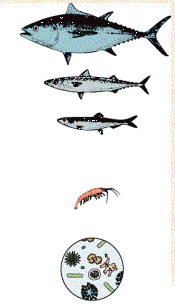
Another culprit, he said, may be a phenomenon called bio-magnification
– the tendency for radiation concentrations to increase in species
that are farther up the food chain.
About 2.7 per cent of the fish catches also exceeded Japan’s existing
ceiling for food of 500 becquerels per kilo. That was also up from one
per cent in October.
In November, 0.8 per cent of Japanese catches exceeded Canada’s
ceiling of 1,000 becquerels per kilo, up from 0.2 per cent in October.
But food with radiation below these limits can still pose health
risks, Edwards believes. “There is no safe level of radiation. They
should be making every effort to monitor food.”….
Read more: http://www.montrealgazette.com/news/After+Fukushima+fish+tales/5995345/story.html#ixzz1jx0TCaBv
No comments yet.
1 This month

of the week – Australians for War Powers Reform (AWPR)
To see nuclear-related stories in greater depth and intensity
 Antinuclear
Leave a comment