The success of rooftop solar energy, in Germany, but in Australia, too
Last year, roof-mounted solar panels in Australia were able to compete favourably against peak-priced electricity from coal-fired power stations for the first time – without factoring in market-distorting subsidies. Solar PV panel wholesale prices are now about $1 per watt, compared to $3.50 per watt only a couple of years ago.
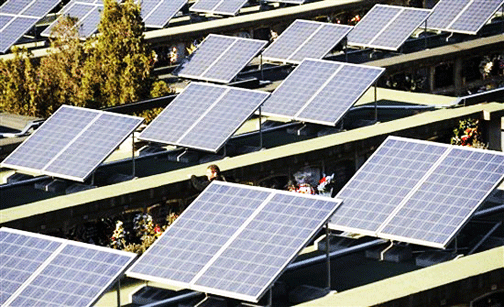
The proof is in the heating – solar’s shining success story, SMH, Martin Green January 21, 2012 Something extraordinary happened to the German national power grid during the pleasantly mild early weeks of last summer. Not only did the country’s almost 1 million, mainly rooftop (photovoltaic) solar panels pump 13.2 gigawatts into the grid – the equivalent output of up to a dozen nuclear power plants, or about 40 per cent of the highest-ever demand in Australia’s national electricity market – but they did so at exactly the right time.
That is, when demand was peaking. Whatever variability there might have been in the output of individual solar panels, due to shadowing, passing clouds or local rain, was smoothed out by the geographic range and sheer number of panels nationwide.
What the German experience demonstrates is that the stars are aligning for conventional roof-mounted solar, or photovoltaic (PV) panels, as a reliable and increasingly competitively-priced power source to make a significant contribution to electricity generation.
For many reasons – including the phenomenal uptake of PV panels in Germany, the economies of scale driven by mass production of panels in China, and increasingly efficient solar arrays – prices really are down. Continue reading
America’s National Center for Science Education fights back against climate change denialism
 NCSE’s climate change initiative launched, National Center for Science Education, January 16th, 2012 NCSE is proud to announce the launch of its new initiative aimed at defending the teaching of climate change. Like evolution, climate change is accepted by the scientific community but controversial among the public.
As a result, educators trying to teach climate change, like their counterparts trying to teach evolution, are often likewise pressured to compromise the scientific and pedagogical integrity of their instruction. But there was no NCSE for climate — no organization, that is, specializing in providing advice and support to those facing challenges to climate change education.
With the launching of the initiative, NCSE itself becomes that organization. As NCSE’s executive director Eugenie C. Scott explained in a January 16, 2012, press release, “We consider climate change a critical issue in our own mission to protect the integrity of science education.” She added, “Climate affects everyone, and the decisions we make today will affect generations to come. We need to teach kids now about the realities of global warming and climate change, so that they’re prepared to make informed, intelligent decisions in the future.”
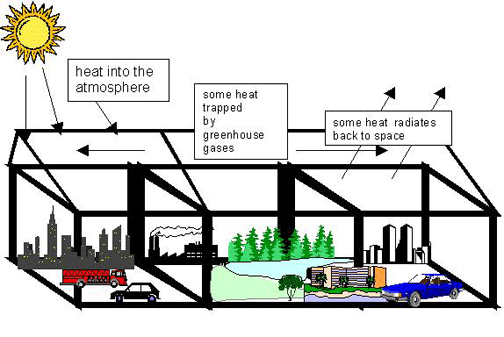
The response from the scientific and education communities has been enthusiastic…. Included in the climate change initiative is a new area of NCSE’s websitedevoted to climate change education….. http://ncse.com/news/2012/01/ncses-climate-change-initiative-launched-007149
Why we should continue to worry about Fukushima and nuclear radiation
 Radiation used to be a word that evoked serious concern in a lot of people. However, the nuclear industry and its supporters have done a masterful job in allaying public fears about it. They do this in significant part by relying on outdated and highly questionable data collected on Japanese atom bomb survivors, while at the same time ignoring and dismissing inconvenient but much more relevant evidence that shows the actual harmful effects of radiation exposure from nuclear accidents.
neglecting to monitor the fallout will not make it go away. In fact, another enormous problem with radioactive contamination is that it bioaccumulates in the environment, which means it concentrates as it moves up the food chain. (Think of mercury in fish.) Because many radionuclides are so long-lived, this can be a problem for a very long time.
 Fukushima Update: Why We Should (Still) Be Worried Business Insider, Russ Baker, WhoWhatWhy | Jan. 20, 2012, After the catastrophic trifecta of the triple meltdowns at the Fukushima Daiichi nuclear complex in Japan last March—what the Japanese are referring to as their 3/11—you would think the Japanese government would be doing everything in its power to contain the disaster. You would be wrong—dead wrong.
Instead of collecting, isolating, and guarding the millions of tons of radioactive rubble that resulted from the chain reaction of the 9.0 earthquake, the subsequent 45- to 50-foot wall of water that swamped the plant and disabled the cooling systems for the reactors, and the ensuing meltdowns, Japanese Environment Minister Goshi Hosono says that the entire country must share Fukushima’s plight by accepting debris from the disaster……
The enormous volume of waste is much more than the disaster areas can handle. So, in an apparent attempt to return this region to some semblance of normal life, the plan is to spread out the waste to as many communities across the country as will take it. Continue reading
The 10 last years: unmistakable global warming
 Globally, 9 of the 10 warmest years on record occurred since 2000 Environmental news Network, From: Reuters January 20, 2012 The global average temperature last year was the ninth-warmest in the modern meteorological record, continuing a trend linked to greenhouse gases that saw nine of the 10 hottest years occurring since the year 2000, NASA scientists said on Thursday.
A separate report from the U.S. National Oceanic and Atmospheric Administration (NOAA) said the average temperature for the United States in 2011 as the 23rd warmest year on record.
The global average surface temperature for 2011 was 0.92 degrees F (0.51 degrees C) warmer than the mid-20th century baseline temperature, researchers at NASA’s Goddard Institute for Space Studies said in a statement. The institute’s temperature record began in 1880.
The first 11 years of the new century were notably hotter than the middle and late 20th century, according to institute director James Hansen. The only year from the 20th century that was among the top 10 warmest years was 1998.
These high global temperatures come even with the cooling effects of a strong La Nina ocean temperature pattern and low solar activity for the past several years, said Hansen, who has long campaigned against human-spurred climate change.
The NASA statement said the current higher temperatures are largely sustained by increased concentrations of greenhouse gases in the atmosphere, especially carbon dioxide. Carbon dioxide is emitted by various human activities, from coal-fired power plants to fossil-fueled vehicles to human breath.
Current levels of carbon dioxide in the atmosphere exceed 390 parts per million, compared with 285 ppm in 1880 and 315 by 1960, NASA said. http://www.enn.com/ecosystems/article/43880
1 This month

of the week – Australians for War Powers Reform (AWPR)
To see nuclear-related stories in greater depth and intensity
 Antinuclear