The success of rooftop solar energy, in Germany, but in Australia, too
Last year, roof-mounted solar panels in Australia were able to compete favourably against peak-priced electricity from coal-fired power stations for the first time – without factoring in market-distorting subsidies. Solar PV panel wholesale prices are now about $1 per watt, compared to $3.50 per watt only a couple of years ago.
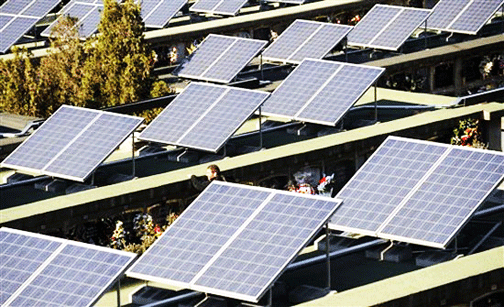
The proof is in the heating – solar’s shining success story, SMH, Martin Green January 21, 2012 Something extraordinary happened to the German national power grid during the pleasantly mild early weeks of last summer. Not only did the country’s almost 1 million, mainly rooftop (photovoltaic) solar panels pump 13.2 gigawatts into the grid – the equivalent output of up to a dozen nuclear power plants, or about 40 per cent of the highest-ever demand in Australia’s national electricity market – but they did so at exactly the right time.
That is, when demand was peaking. Whatever variability there might have been in the output of individual solar panels, due to shadowing, passing clouds or local rain, was smoothed out by the geographic range and sheer number of panels nationwide.
What the German experience demonstrates is that the stars are aligning for conventional roof-mounted solar, or photovoltaic (PV) panels, as a reliable and increasingly competitively-priced power source to make a significant contribution to electricity generation.
For many reasons – including the phenomenal uptake of PV panels in Germany, the economies of scale driven by mass production of panels in China, and increasingly efficient solar arrays – prices really are down.
Last year, roof-mounted solar panels in Australia were able to compete
favourably against peak-priced electricity from coal-fired power
stations for the first time – without factoring in market-distorting
subsidies. Solar PV panel wholesale prices are now about $1 per watt,
compared to $3.50 per watt only a couple of years ago.
Industry analysts reported a 140 per cent increase in production
worldwide in 2010 alone, and a 60-fold rise between 2000 and 2010.
The Germans kick-started their own industry with those much maligned
feed-in tariffs, which initially pay solar power generators, including
ordinary households, a much higher price for the clean, green power
they deliver to the grid. However, Germany’s sliding tariff scale
means it hasn’t been trapped by high costs in the same way as we have
in NSW – due to the excessively high, fixed feed-in tariffs rolled out
under the former government.
As much as market economists complain about these distortions,
Germany’s long term policy vision, plus the European Union’s carbon
trading market, kick-started the global mass production of solar PV
panels.
Global demand was initially driven by Europe, but growth in the Asian
and US markets is taking over, thanks in part to China’s $48 billion
“green stimulus” package. The University of NSW has exceeded the 25
per cent efficiency barrier for conventional solar PV panels and is
working with the world’s largest single producer, China’s Suntech, to
get a premium 20 per cent efficient panel on the world market, up from
an average of 14 per cent to 15 per cent.
Suntech’s fortune is built largely on Australian expertise developed
at the University of NSW, but with critical input from Suntech’s chief
executive and scientist, Shi Zhengrong, who completed his PhD here.
There’s been some negative press over the commercialisation of
Australian solar technology in China and elsewhere. But, as the leader
of that University of NSW research team for the past 30 years, it’s
not something that I think is a major issue.
I am more interested in getting the real solar story out, that solar
panels are a proven, reliable, ever-cheaper source of electricity that
can play a major role in powering the world.
If Australians don’t understand that reality, we’ll be left scrapping
on the global sidelines long after China, Germany and the rest have
run off with the renewables ball.
http://www.smh.com.au/opinion/society-and-culture/the-proof-is-in-the-heating–solars-shining-success-story-20120120-1qa2o.html#ixzz1k7ZGUy00
No comments yet.
1 This month

of the week – Australians for War Powers Reform (AWPR)
To see nuclear-related stories in greater depth and intensity
 Antinuclear
Leave a comment