The week’s nuclear news – Australia
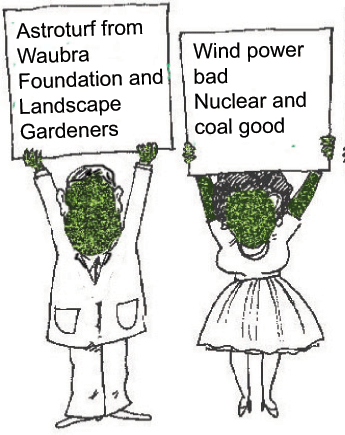
 Renewable energy The anti renewable energy movement has taken a decidedly political turn in three States. Victoria and New South Wales persist in strong anti wind energy policies, despite scientific reports about wind energy not being harmful to health. (An extraordinary double standard here, as Victoria’s government pushes ahead with permits for coal seam gas exploration). In South Australia, Family First rears its astroturfing head, as it vows a political fight against wind energy.
Dubious claims that wind farms make people sick
Science on wind turbine illness dubious, say experts. SMH, Ben Cubby, January 24, 2012 FEARS that wind turbines make people sick are ”not scientifically valid”, and the arguments mounted by anti-wind farm campaigners are unconvincing, according to confidential briefings given to the state government by NSW Health.
Documents obtained under freedom-of-information laws show that health officials repeatedly warned ministers last year that there was no evidence for ”wind turbine syndrome”, a collection of ailments including sleeplessness, headaches and high blood pressure that some people believe are caused by the noise of spinning blades.
But the department’s advice contrasts with the view of the Planning Minister, Brad Hazzard, who was responsible for draft guidelines, released in December, that significantly tighten the approvals process……
One study by Nina Pierpont, which is central to the claims that wind turbines make people ill, was dismissed as ”not of sufficient scientific rigour” by NSW Health. ”This ‘study’ is not a rigorous epidemiological study; it is a case series of 10 families drawn from a wide range of locations,” according to the ministerial briefing on July 5 last year. ”This work has not been properly peer reviewed. Nor has it been published in the peer-reviewed literature. The findings are not scientifically valid, with major methodological flaws stemming from the poor design of the study.”
The documents, obtained under FOI laws by the environment group Friends of the Earth, say existing studies had been examined and no known causal link could be established. The assessment undermines the claims of an anti-wind farm group, the Waubra Foundation, which had been lobbying the government for a moratorium on new wind farms.
“The documents from NSW Health confirm our belief that the foundation has been ‘cherry picking’ data that supports its allegations about ‘wind turbine syndrome’ by talking with people who believe they have … symptoms,” said a Friends of the Earth spokesman, Cam Walker. ”This becomes a self-fulfilling prophesy and is not the basis of good science … Yet, as has been noted by a growing number of medical authorities, there is no credible evidence of a causal link between turbines and ill health.”……
A landowner near Lake George, Marcia Osborne, said her family had had no medical problems or trouble sleeping from the seven or eight turbines close by. ”Quite the opposite really, they’ve done nothing but help us,” she said.
”We are farmers … things were pretty tough [during the drought] … When they asked us if they could put a wind farm on the place it was like a gift from God. We used to curse the wind, now we get paid for the wind.”

The guidelines are on exhibition until March 14. http://www.smh.com.au/environment/energy-smart/science-on-wind-turbine-illness-dubious-say-experts-20120123-1qe98.html#ixzz1kPuwgvpd
ABC Rural Radio on wind farms and rural communities
 Audio http://www.abc.net.au/rural/telegraph/content/2012/s3413587.htm Rural acceptance of wind farms, ABC Rural Radio – Bush Telegraph, By Greg Muller, 23 January 2012 Wind farms are popping up across the country and the forthcoming carbon tax will make renewable energy projects even more attractive to developers.
But wind turbines are dividing regional communities. Most objections are based on the aesthetics and noise but others see a diversity of income for farming communities, tourism opportunities and a source of clean energy.
The CSIRO has just completed a study, ‘Exploring community acceptance of rural wind farms in Australia’ and found support for wind energy is often greater than the media coverage suggests.
Dr Jim Smitham, Deputy Director of energy technology at the CSIRO; David Griffin, General manager of development at Infigen Energy http://www.abc.net.au/rural/telegraph/content/2012/s3413587.htm
Australia’s Family First Party jumps on the anti wind power bandwagon
 Better coordination urged in wind farm fight, ABC News, January 23, 2012 The Family First Party says a state-wide group is needed to tackle wind farm developments. A number of groups have been formed to oppose wind farms in various regions, including Keyneton near the Barossa Valley.
The party’s Rob Brokenshire says a more coordinated approach will be discussed at a forthcoming meeting. “The Government and those that are pro-wind farm at all costs want to brand them in a certain name but I won’t accept that,” he said… Mr Brokenshire says he is organising a meeting for early next month.
“One of the main items of the meeting is the concept of forming a state-wide group that looks at the big picture of the impact from wind farms on rural and regional people,” he said…. http://www.abc.net.au/news/2012-01-23/better-coordination-urged-in-wind-farm-fight/3787778
Citizens galvanise against uranium mining in Virginia USA
“Virginia Conservation Network works on a broad range of environmental issues all across the state, but never have I seen such an issue galvanize people like the prospect of uranium mining,” said director Nathan Lott. “Black and white, urban and rural, Republican and Democrat – Virginians agree that mining is just too risky.”
Citizens expressed deep concerns about the potential contamination of water sources in the Roanoke River watershed

 Citizens pack General Assembly offices to voice opposition to uranium mining, Star Tribune, January 23, 2012 RICHMOND – Citizens from across the state converged in the Capitol Monday to call on their elected representatives in the General Assembly to keep Virginia’s 30-year ban on uranium mining.
Following significant warnings from the National Academy of Sciences, the ban will now remain in place for 2012. Citizens are seeking to make that victory permanent.
To highlight their message, they offered legislators “yellowcake” cupcakes with the message: “These yellow cakes are not harmful – but making uranium yellowcake and leaving behind radioactive waste in Virginia is. Protect our health, our
heritage and our future. Keep the Ban on Uranium Mining in Virginia.” Also, the Keep the Ban Coalition announced that over the last year, more than 10,000 citizens have signed an online petition or sent emails to Virginia legislators urging them to keep the ban, and 102 organizations and government entities – from the cities of Virginia Beach, Norfolk and Roanoke to the state chapter of the NAACP and Halifax County Chamber of Commerce – have either passed a resolution or taken other action expressing deep concerns about impacts that would result from lifting the ban. Continue reading
Australia’s new draft Murray River plan is a threat to groundwater
 Groundwater ‘at risk’ in basin plan The Age, 24 Jan 12, A GROUNDWATER expert has attacked the government’s draft Murray-Darling Basin Plan, saying it points to a risky over-allocation of precious underground water.
At a conference on groundwater in Sydney yesterday, Professor Craig Simmons said the federal government had done a ”major U-turn” from the draft guide released in 2010 that proposed a reduction of 160 gigalitres of groundwater.
”We have now seen a proposal to increase that from current groundwater extraction in the basin – which is around 1740 gigalitres of water – to up to 4340 per annum,” the director of the National Centre for Groundwater Research and Training in South Australia said.
Professor Simmons said groundwater was being treated as a free resource that could be tapped at will. In reality, the usage of groundwater in the Murray-Darling basin often exceeded the rate of recharge. It will become more important in the future as surface supplies are depleted, he said.
Professor Robert Glennon, from the University of Arizona, warned that Australians were in the grip of a ”hydro-illogical cycle”, with concerns about water management fading as rainfall improved.
Was Australia going to deny reality and backtrack on water reforms simply because the country was no longer in drought, he asked….. http://www.theage.com.au/national/groundwater-at-risk-in-basin-plan-20120123-1qdua.html#ixzz1kQ4KnkpT
Worldwide depletion of groundwater
since the year 1900 up to the year 2008, something in the order of 4,500 cubic kilometres of depletion; most of that occurring in the last 50 years. That’s how much less water is in the ground today than 108 years ago.
Audio http://www.abc.net.au/pm/content/2012/s3413882.htm Is the world facing a groundwater crisis? ABC Rural radio Dubravka Voloder reported this story on January 23, 2012 MARK COLVIN: Water is not just a sensitive subject in Australia. In a crowded world of seven billion people, water is an increasing source of friction and the lack of it could have damaging results.
International water researchers say that water shortages could affect world food production in the next few decades unless something’s done about it. The scientists are meeting in Sydney to discuss whether there’ll be a groundwater crisis. Continue reading
Water concerns in planned nuclear power reactor in USA
“the Nuclear Regulatory Commission is notorious for cozying up to the nuclear industry and basically never says no,”
“approval of the application doesn’t actually guarantee there will be enough water to operate the plant.”
Water Rights Approved for Nuclear Plant 01.22.2012 by Whittney Evans, (KCPW News) Utah State Engineer Kent Jones has approved water rights from the Green River for Blue Castle Holdings’ proposed nuclear power plant in Emery County, much to the dismay of environmental groups.
Matt Pacenza, Policy Director of the anti-nuclear group HEAL Utah, says the decision was the only opportunity for a Utah official to reject the plan. He says the company now faces two hurdles, the easier of which will be getting permission from the U.S. Nuclear Regulatory Commission.
“Although the process will take several years and will cost them quite a bit of money, the NRC is notorious for cozying up to the nuclear industry and basically never says no,” he says. “So one imagines that they will fairly easily convince Washington bureaucrats that it’s okay to put a nuclear reactor in Utah.”
Pacenza says the bigger hurdle is finding investors and customers for the power. Rob Mrowka with the Center for Biological Diversity says taking almost 54,000 acre-feet of water a year from the Green River would impact rare fish, among other problems. “…to the point of perhaps driving those already listed for protection to the point of extinction and necessitating the addition of the other three to the endangered species act list of protected species,” says Mrowka.
A call to the state engineer’s office was not returned. In a news release, he said concerns raised about the water rights application were considered, adding that an application must be approved by law if the water is available, it won’t interfere with existing water rights, and it would not be detrimental to the public welfare. And approval of the application doesn’t actually guarantee there will be enough wate rto operate the plant.
http://kcpw.org/blog/local-news/2012-01-22/water-rights-approved-for-nuclear-plant/
On not bombing Iran, and the difficult road to alternatives
 How About Not Bombing Iran? NYT, Bill Keller, January 22, 2012, If you need more convincing of the grave risks of a preemptive bombing attack on Iran, I recommend these freshly published arguments from Colin H. Kahl, who was until recently Deputy Assistant Secretary of Defense for the Middle East in the Obama administration; R. Nicholas Burns, who was Under Secretary of State for Political Affairs in the George W. Bush administration; and my Times colleague Roger Cohen, who
sums it up this way:
Here’s the bottom line: an Israeli attack unites Iran in fury, locks in the Islamic Republic for a generation, cements the Syrian regime, radicalizes the Arab world at a moment of delicate transition, ignites Hezbollah on the Lebanese border, boosts Hamas, endangers U.S. troops in the region, sparks terrorism, propels oil skyward, triggers a
possible regional war, offers a lifeline to Iran just as Europe is about to stop buying its oil, adds a Persian to the Arab vendetta against Israel, and may at best set back Iran’s nuclear ambitions a couple of years.
But if not bombing, then what?……
http://keller.blogs.nytimes.com/2012/01/22/how-about-not-bombing-iran/
Climate change could cause a colder Europe
 Huge Pool Of Arctic Water Could Cool Europe: Study, Planet Ark,: 23-Jan-12, UK, Nina Chestney ,A huge pool of fresh water in the Arctic Ocean is expanding and could lower the temperature of Europe by causing an ocean current to slow down, British scientists said Sunday.
Using satellites to measure sea surface height from 1995 to 2010, scientists from University College London and Britain’s National Oceanography Center found that the western Arctic’s sea surface has risen by about 15 cms since 2002.
The volume of fresh water has increased by at least 8,000 cubic km, or about 10 percent of all the fresh water in the Arctic Ocean. The fresh water comes from melting ice and river run-off.
The rise could be due to strong Arctic winds increasing an ocean current called the Beaufort Gyre, making the sea surface bulge upwards.
The Beaufort Gyre is one of the least understood bodies of water on the planet. It is a slowly swirling body of ice and water north of Alaska, about 10 times bigger than Lake Michigan in the United States.
Some scientists believe the natural rhythms of the gyre could be affected by global warming which could have serious implications for the ocean’s circulation and rising sea levels.
Climate models have suggested that wind blowing on the surface of the sea has formed a raised dome in the middle of the Beaufort Gyre, but there have been few in-depth studies to confirm this.
If the wind changes direction, which happened between the mid-1980s to mid-1990s, the pool of fresh water could spill out into the rest of the Arctic Ocean and even into the north Atlantic Ocean, the study said.
This could cool Europe by slowing down an ocean current coming from the Gulf Stream, which keeps Europe relatively mild compared with countries at similar latitudes.
“Our findings suggest that a reversal of the wind could result in the release of this fresh water to the rest of the Arctic Ocean and even beyond,” said Katharine Giles at UCL’s Center for Polar Observation and Modelling and lead author of the study, published in the journal Nature Geoscience. The team plans to investigate further the relationship between sea-ice cover and wind changes http://planetark.org/enviro-news/item/64485
Uranium mining in Western Australia’s still dubious despite Labor’s new wishy washy policy
Uranium miners fear uncertainty despite Labor policy change, SMH, Rania Spooner January 24, 2012 –The company likely to become WA’s first uranium miner has welcomed a significant change in WA Labor’s policy on uranium mining, but warned the fledgling industry still faced plenty of uncertainty.
Within hours of taking over WA Labor yesterday, Opposition leader Mark McGowan announced the party would pull away from its pledge to shut down any approved uranium project if elected next year.
Mr McGowan said WA Labor remained against uranium mining and would not approve any new applications, but the change in policy meant the state would not be open to compensation claims.
Applications only part way through the approvals process would not be allowed to continue under a Labor government.
One or two miners are so advanced in the approval process that they are likely to get the nod before the March, 2013 election.
One of those is South Australia-based Toro Energy, which is among a handful of uranium hopefuls to have pursued WA deposits since the Colin Barnett government lifted the state’s long-standing ban in November 2008…….
Greens nuclear affairs spokesman and Senator for Western Australia Scott Ludlam condemned the policy “backflip”, saying Labor couldn’t “have it both ways” on uranium.
“It is a dangerous, toxic industry that operates to provide fuel to the dangerous, toxic nuclear energy sector. If Labor is opposed to uranium mining they should make their position clear,” Senator Ludlum said in a statement.
“Mr McGowan has spoken of providing certainty to the industry.
“It is far better to let the nuclear industry know it is certain they have no future in Western Australia.”..
Netherlands utility shelves plan for nuclear plant
 Utilty Shelves Nuclear Plans In The Netherlands –...– Move highlights tough climate for nuclear energy programs… WSJ, By Maarten van Tartwijk, JANUARY 23, 2012 AMSTERDAM (Dow Jones)–In the latest example of waning appetite for
atomic power in Europe, Dutch utility Delta NV said Monday it has shelved its plan to build a second nuclear plant in the
Netherlands….
.. The move comes against a backdrop of waning appetite for new nuclear power programs. Last year’s disaster at the Fukushima plant in Japan has prompted many European governments to review their atomic power policies on renewed safety concerns. Germany even decided to fully exit nuclear power, and offset the lost electricity with a
massive buildup of renewable energy….
1 This month

of the week – Australians for War Powers Reform (AWPR)
To see nuclear-related stories in greater depth and intensity
 Antinuclear