Australian media: lies and distortions about a legitimate Aboriginal protest
 That evening the WIN TV news repeatedly referred to “violence” and used other inflammatory terms so inaccurate as to amount to lies. The Canberra Times front page next day screamed “Australia’s day of disgrace”. There are disgraces involved, but the rowdy protest was not one.
The media, unfortunately typically, reported inaccurately and used inflammatory language, thereby promoting division.
Aussie Day ‘riot’: perspective and balance hard to find The Drum, Geoff Davies, 30 Jan 12 The bias, hysteria and divisiveness of our public political conversation is never far from view, but this week I encountered it firsthand.
I watched outside as the Aboriginal protest unfolded at The Lobby restaurant on Australia Day. The event reported in the media and reacted to by many commentators is a lurid parody of what actually happened. Perspective and balance are hard to find.
The protest was not violent. It was certainly rowdy and confronting. The protesters chanted loudly and angrily, and some beat time on the glass walls of the restaurant. There was some pushing and shoving as the VIP cars finally moved out. Police on the day said there were”scuffles” and no arrests would be made. Continue reading
Western Australia’s new Labor leader speaks with forked tongue
 from our Western Australian commentator 30 Jan 12 Few remember McGowan’s sabotage of Geoff Gallop’s Core Consultative Committee on Hazardous Waste (3Cs) a committee dedicated to reforming the hazardous waste industry, protecting public health and a fragile biodiversity.
Remember the Bellevue chemical fire at a hazardous waste plant, allegedly the largest chemical fire in Australia’s history? The disgraceful mismanagement of the Brookdale hazardous waste plant? The lead poisoning of Esperance and the destruction of 9,500 native birds by Magellan Metals? The 400 strong protest march in Kalgoorlie against the foulness of Total Waste Management, operating just 500 metres from a restaurant and a fuel station?
Industry, lobbyists of the haz. waste industry (including Burke and Grill) and the Chamber of Commerce and Industry were jubilant when McGowan sacked the 3Cs without explanation in November 2006.
It will come to pass when the people of WA will understand that both Barnett and McGowan are the dancing boys of industry – both wear the same hat in the environmentally desecrated state of WA which has 85,000 abandoned and toxic mine sites.
December 8th, 2011: “No Labor minister or public servant responsible to a Labor minister will issue any approval to facilitate a uranium mining project under a WA Labor government. It does not matter how advanced the projects are. I’m putting the industry on notice. You won’t have your final approvals by the time of the next election and they will not be granted if WA Labor is elected.” (Eric Ripper)
The duplicitous McGowan speaks with forked tongue. Be afraid, be very afraid.
Uranium deal to India- a last gasp effort for a dying industry?
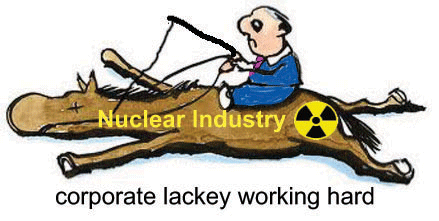 In short, the deal with India is seen by some as little more than a short term means to prop up an industry breathing its last gasp……
[For uranium explorers] the 52 week highs and lows paints the same picture as we saw for the producers – market participants doubt the viability of exploring for a product whose demand may be in jeopardy.
Share market participants have spoken and they clearly doubt the future of nuclear energy.
URANIUM STOCKS HIT HARD BUT BULLS ARE BELLOWING, The Bull, By Bob Kohut | 30.01.2012 As the dismal trading in 2011 global share markets ground down to its agonising year-end finish, some Australian investors were heartened by the news that our government was about to lift the ban on uranium sales to India.. Continue reading
How the nuclear lobby used climate change to get control of government policy

 The threat of climate change gained traction in the global imagination after the end of the Cold War. And as warming worries grew, nuclear power became an anti-emissions trump card in the eyes of many, fueling a reactor building spree.
“Government policy came to incorporate promotion of nuclear power. It was taboo for us to even make an issue of it.”
Nuclear power boosters used climate change to ride to energy supremacy, Mainichi Daily  News, 30 Jan 12 In 1997, in the midst of the international negotiations that would eventually result in the Kyoto Protocol, the Japanese delegation was pondering whether it could realistically accept the protocol’s main point: a commitment to a 6 percent decrease in greenhouse gas emissions from 1990 levels. They were also grappling with what such a commitment would mean for Japan’s energy supplies.
Strangely enough, though the Japanese delegation was grappling with issues of carbon emissions and energy needs, there was not a single representative of the then Environment Agency on hand. Osamu Watanabe, vice minister at the former Ministry of International Trade and Industry at the time of the talks and now president of Japan Petroleum Exploration Co., sums up Japan’s thinking like this:
“Taking nuclear power into account was a prerequisite for accepting the 6 percent reduction. Speaking for the industry ministry, we thought that the more nuclear power we had, the more we could reduce greenhouse gas emissions.”
Meanwhile, at the Environment Agency — which became the Environment Ministry in 2001 — there were many staff who took a more cautious attitude to the promotion of nuclear power. Their skepticism did not, however, often find effective expression.
“The industry ministry put up a lot of resistance to the Environment Agency getting involved in energy policy,” a senior agency official from the time says. “We just couldn’t get a word in.” Continue reading
1 This month

of the week – Australians for War Powers Reform (AWPR)
To see nuclear-related stories in greater depth and intensity
 Antinuclear