Australian farmers missing opportunity to profit by farming energy
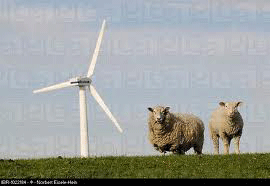 Farmers squeezed out of energy boon, MATTHEW CAWOOD, Stock and Land 04 Feb, 2012 LANDHOLDERS should be capitalising on seismic changes in how we generate energy, says Matthew Wright, but instead they are being
pushed aside.
Mr Wright, executive director of Beyond Zero Emissions, thinks the thrust of current government policy will be to deny many landholders the ability to profit from wind generation, while compromising the enterprises of other landholders who host coal seam gas (CSG) operations without sharing in CSG profits.
Beyond Zero Emissions, a non-profit organisation, has the goal of moving Australia “from a 19th century fossil fuel based economy to a 21st century renewable powered clean tech economy”.
Wind turbines are “about as benign as it gets” for power generation, Mr Wright said, adding CSG is a “fairly destructive option for resource exploitation”.
Continue reading
Lindsay Soutar’s drive for renewable energy, making life uncomfortable for politicians
 Her 100% Renewable campaign, which she began from scratch two years ago, now has about 100 groups with tens of thousands of members nationwide, making life uncomfortable for politicians with actions that go well beyond demonstrations and banner waving..
She argues some in the climate movement are naive because they think making a persuasive case without applying political pressure is enough, when ”massive vested interests” such as mining companies run counter-campaigns…..
Knocking on doors of change, SMH, February 4, 2012 No topic is off limits for the environmental optimist who thinks it’s time to stop ‘scaring the pants off people’, writes Debra Jopson. – Lindsay Soutar…. the Young Environmentalist of the Year…..Soutar, 30, is something of a legend in green circles for giving up her paid work advising local councils on emissions reductions and then creating a national campaign aimed at shifting Australia to 100 per cent renewable energy. …. Continue reading
Insuperable problems facing nuclear energy: wastes, risks of catastrophe
 Disadvantages of nuclear energy, Biofuelswatch, by Max Rutherford, February 1st 2012 Nuclear Waste The biggest problem with nuclear power plants is the waste created during the generation of energy as an unwanted and dangerous byproduct. All waste products from a nuclear power plant are radioactive and thus they are detrimental to almost all kinds of living beings. What is even more hazardous is the fact that they remain radioactive and dangerous for thousands of years, which makes them virtually a permanent hazard. This is the most important reason as to why nuclear power plants cannot be built in close proximity to localities, which of course, limits the opportunity to expand the plants. Scientists and experts all around the world are working on ways to properly neutralize or get rid of the radioactivity from the waste, but they are yet to come up with a solution that is good enough.
At this time, radioactive nuclear wastes are usually put inside concrete structures and buried under the ground because concrete and earth are found to be efficient at containing radioactivity. However, these dump sites must be looked after for thousands of years to make sure that the toxic wastes are not set free accidentally as that could contaminate the entire planet. This in fact, would be an unending process unless we are able to find better ways to get rid of the waste because by the time the radioactivity from today’s nuclear wastes comes down; there would be new radioactive waste to dump from tomorrow’s nuclear plants. Eventually, it is very much possible that the reactors may run out of uninhabited places to dispose their waste products.
While the toxic nuclear waste mainly refers to the used up reactor rods and nuclear fuel residues, even the purifying resins, various tools, clothes, towels and other similar objects that become contaminated with radiation after coming in contact with it at the nuclear plants can also be dangerous. Although they are nowhere near as dangerous as the main waste products, even these less radioactive objects can cause health hazards. The danger lies in the fact that these regular objects may get out by mistake because it is impossible to detect the radioactivity on these day to day items without a Geiger counter……
Effects of Radioactivity Even Under Normal Conditions Unfortunately, even when a nuclear plant is built well and is ‘safe’ as per the safety guidelines, it is not totally safe. What this means is that though it might be possible to avert disasters through the practice of the safety measures, the workers at a nuclear plant are exposed to small levels of radiation every day, in spite of their special suits. While it may not matter much in the short term, it might be the cause behind cancers if one is exposed to even such small amounts of radiation over a long period of time. ….
Possibility of Accidents with Catastrophic Effects Previously, it was believed that the safety measures are good enough to avoid accidents, but after consecutive incidents at the Three Mile Island in 1979, at Chernobyl in 1986 and finally at the Fukushima Dai-ichi in 2011; that belief is proven to be a myth only. The Chernobyl Disaster is by far the most devastating and dangerous accident that has happened yet and it has not only affected thousands of people with cancers and other deformities that are results of the radioactivity which was released into the environment from the accident, but it has also rendered portions of places like Belarus, Prypiat, Ukraine and Russia uninhabitable for thousands of years to come. The possibility of a nuclear reactor accident is therefore the most fearsome disadvantage of nuclear energy and both theory and history clearly shows us that such accidents can happen. As no nuclear plant can be made in a way so that it is safe from everything, the risk of accidents will increase with each new nuclear reactor. http://www.biofuelswatch.com/disadvantages-of-nuclear-energy/
Australia’s radioactive colonialism in Malaysia, (and a test case for Southeast Asia nuclear power)
 Readers of this website might wonder why I give so much attention to Lynas’ project for a rare earths processing plant in Malaysia. After all, rare earths are supposed to be good, aren’t they? They’re needed for wind turbines, mobile phones, electric cars etc. And they don’t make that much radioactive waste.
But the thing is – Lynas’ plant will be the biggest rare earths refining plant in the world. And make a lot of radioactive wastes, and heaps of money for Australian investors. And we like BIG. We applaud BHP – the Big Non -Australian because it’s going to dig the biggest man made hole in the world.
If the Lynas plant is so OK, why not put it in Australia?
The answer – radioactive colonialism. Just as Australia has been a victim of Britain’s radioactive colonialism, in atomic bomb tests in the 1950s, and today, with our largely foreign owned uranium mines – well, we Australians like to do our bit of radioactive colonialism, and put the nasty stuff in Malaysia.
Not In Our Backyard for radioactive wastes, as long as we can park them in Malaysia.
The nuclear industry watches this with interest. If Lynas can overcome public opinion in Malaysia, well, perhaps the nuclear lobby can do the same in Southeast Asia.
Greens and Australian Conservation Foundation speak out against Lynas plan for Malaysia
 Rare-earths decision big boost for Lynas SMH, Peter Kerr and Vince Chadwick February 3, 2012 “…….Dave Sweeney of the Australian Conservation Foundation said the low-lying, coastal environment meant holding ponds containing toxic waste might be breached during the wet season.
Mr Sweeney also drew attention to the timing of the board’s decision, which came days after a member of the opposition party in Malaysia said her party would not approve the plant if it won power at coming elections. ”There would be questions being asked and confidence being eroded in the integrity of the approval process, which appears to have become politicised,” Mr Sweeney said.
Lynas had been unable to start exporting ore to Malaysia for refining since its $100 million Mount Weld mine in Western Australia opened in August.
Federal Greens senator Scott Ludlam questioned the business model of exporting rare earths to Malaysia, which takes three weeks, rather than processing them at home. ”This imposes an economic cost on Australia and an environmental cost on Malaysia,” he said.
Nuclear renaissance becoming a stillbirth in Southeast Asia?
 In Malaysia, the government has quietly put a proposal to build two 1,000 MW nuclear power plants “on the back burner,” said a senior government source.
The decision came after environmentalists targeted a plan by Australian rare earths miner Lynas Corp to commission a processing plant in central Malaysia that would have to dispose of radioactive waste….
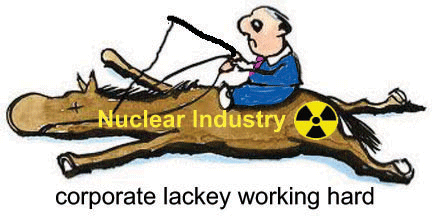 Analysis: Southeast Asia goes slow on nuclear, Reuters, By John Ruwitch HANOI Feb 2, 2012 “…..Vietnam, Indonesia, Malaysia, the Philippines, Thailand and Singapore are among some 35 countries considering going down the nuclear path, likely doubling the number of operational reactors in the next few decades, according to Lloyds Register.
But even the most ambitious plans will run up against barriers and constraints. In most Southeast Asian countries where there is interest in nuclear power, politics are holding it back. Indonesia’s National Atomic Energy Agency has been researching reactors for more than four decades and preparing the human resources, but the political will is lacking. Continue reading
The Ugly Australian – Lynas rare earths company’s rocky ride in Malaysia
 Malaysian group to file suit to challenge approval for Aussie rare earth plant Washington Post, : February 2 LAWSUIT PLANNED: A Malaysian group representing villagers and civil groups will file a legal challenge to the government’s decision to approve a $230 million rare earths plant by Australian miner Lynas Corp., a lawmaker said Thursday. http://www.washingtonpost.com/business/industries/malaysian-group-to-file-suit-to-challenge-approval-for-aussie-rare-earth-plant/2012/02/02/gIQAmIwDlQ_story.html
Key victory, but battle is not over yet BY: ROWAN CALLICK, : The Australian February03, 2012 “….Environmental concerns have been driving greater political involvement in Malaysia as the population becomes better educated.
Growing ecological awareness has provided a common cause for middle-class activists of the three races — Malays, Chinese and Indians — who have tended otherwise to be divided by the country’s political parties…. The plant approval intensifies the need for Lynas to operate it impeccably and to build its community relations, because an election is almost certain to be called in Malaysia later this year. Opposition leader Anwar Ibrahim has already warned that his three-party coalition would scrap the plant if it wins the election.
 Fuziah says Lynas plant will scare off other investors, The Malaysian Insider, By Shannon Teoh January 31, 2012 KUALA LUMPUR, — Kuantan MP Fuziah Salleh has hit back at Lynas Corp, insisting that the presence of the Australian miner’s RM2.5 billion rare earth plant would deter investors from Pahang.
Earlier today, Lynas executive chairman Nicholas Curtis warned against any move by Pakatan Rakyat (PR) to shut the company’s refinery, which has raised fears of radiation pollution, saying such action would deter foreign investors.
Fuziah, who has led protests by locals and environmentalists against the plant, said yesterday the federal opposition would shut down the plant if it won a general election that must be called by May next year.
“Would any foreign investor want to site their operations right beside a rare earth plant? Would companies like Siemens want to set up near Lynas?
“This is not a strategic investment in terms of risk versus benefit. We don’t need rare earth to be high-tech. Germany doesn’t have rare earth,” she told The Malaysian Insider…… Continue reading
Lest we forget – the history of Australia’s Aboriginal tent embassy
 Lease of ‘own land’ was impetus for campaign, Canberra Times, BY BREANNA TUCKER 28 Jan, 2012 It was pitch black in the earliest hours of the morning the minute the tent embassy was born.
About 1am on January 26, 1972, four Aboriginal men from Sydney had pitched a beach umbrella on the lawns of Old Parliament House and waited for the sun to rise so they could declare a new ”embassy” for Canberra.
The Koori men – Billie Craigie, Tony Coorie, Michael Anderson and Bert Williams – claimed to be ”aliens in our own land” after the federal government of the day announced a land rights policy suggesting Aboriginal people take out 50-year leases on land parcels they believed already belonged to them. A mate of the crew, Aboriginal activist Chicka Dixon, later said the men decided that if their country would not treat them fairly, they would establish an embassy to fight for their rights as foreigners.
”I … joined them on the Friday. The Member for the ACT, Kep Enderby, informed me that there was no legislation under the federal Act to remove campers, so we put up eight tents and gave ourselves portfolios,” he said. ”A dear, kind lady from Canberra gave us a big blue tent which became the official tent embassy.
”Like all embassies we needed a flag, so Harold Thomas, [designer of the Aboriginal flag] from Adelaide, gave us his flag to fly.” The creation of the tent embassy became the trigger for what would become a controversial 40-year campaign for Aboriginal rights…
.. The embassy was pulled down by authorities and re-established by demonstrators time and time again, moving from Old Parliament House to an army corporal’s home in Red Hill, across to Capital Hill and back to its roots at Old Parliament House.
The tent embassy has recorded several victories with the creation of the Aboriginal Land Rights Act, the negotiation of an Aboriginal rights treaty and a National Heritage Listing that made the camp the only nationally recognised site for the political struggle of Aboriginal people. http://www.canberratimes.com.au/news/local/news/general/lease-of-own-land-was-impetus-for-campaign/2435783.aspx
Cosy deals between USA energy official and nuclear industry

 Spencer Abraham Cashes, DC Bureau, By Joseph Trento, February 2nd, 2012 “…
 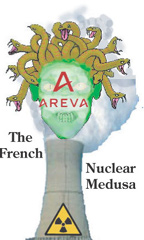 January 30 was former U.S. Secretary of Energy Spencer Abraham’s last day as the non-executive chairman of Areva Enterprises Inc, the French atomic power firm’s American operation. This marked the end of a very lucrative arrangement for both Abraham and the French government own nuclear company – mostly at U.S. taxpayers’ expense.
It all began in the 1990s when the United States’ response to disposing of 34 metric tons of plutonium from shuttered nuclear weapons programs was a proposed mixed oxide (MOX) fuel fabrication facility at the Savannah River Site (SRS) near Aiken, South Carolina. When Abraham became Energy Secretary in 2001, Areva was a key contractor for the MOX plant. According to his DOE calendars, among his first trips were to France to visit their nuclear officials and operations. Abraham maintained a close relationship with the then head of Areva, Anne Lauvergeon. In turn, not long after he left the Energy Department, Abraham cashed in and went to work for Areva and “Atomic Annie,” as she was known. In 2007, DOE broke ground on the MOX plant.
Today, the DOE’s MOX fuel plant is still under construction. It has cost billions of dollars, is over budget and behind schedule. But Spencer Abraham will never be held responsible for the cost overruns and delays. In fact, he has been handsomely rewarded.
Despite spending billions of dollars on the MOX plant, DOE has yet to line up a single customer even with massive government subsidies being offered to buy the fuel. No utility will touch it…..
But the good news for Areva is the tax paid contract is still bringing in the big bucks with no end in sight…..
When is enough, enough? How much money do former government officials have to make before they go home and give back to their communities rather than take money to influence their friends in Washington? Perhaps if we knew that answer, we could save the American taxpayers money. Instead of drafting ethic laws that become jokes before the ink is dry, perhaps we could just cut to the chase, cut them a check, and make them go home. http://www.dcbureau.org/201202026986/natural-resources-news-service/spencer-abraham-cashes-in.html
Japanese nuclear cult Aum Shinrikyo and its Australian activities
 Aum In Australia Aum also launched a scheme of exploring the uranium mines in Australia. …… They also formed two Aum companies – Mahaposya Australia Pvt Ltd and Clarity Investments Pty Ltd – as front businesses to cover up their true activities…
Aum Shinrikyo In Pursuit Of Nuclear Weapons – Analysis, Eurasia Review by: Muhammad Jawad Hashmi February 2, 2012 Aum Shinrikyo has an apocalyptic belief  structure where the world is divided into two opposing forces, good and evil. Shoko Asahara, who is leader of the cult, firmly believes that they will prevail after the apocalypse and are motivated to trigger the apocalypse because their own salvation depends upon fighting the final fight and eliminating the enemy. The prospect of nuclear war shaped Shoko Asahara’s concerns to preach that Aum followers would be the only survivors of a coming Armageddon.
Central Australia ideal for becoming a renewable energy exporter
 http://www.abc.net.au/rural/news/content/201202/s3421358.htm Central Australia bursting with renewable gold, ABC Rural, By Caddie Brain, 02/02/2012 A new study shows central Australia could become a major renewable energy exporter to Asia and major Australian cities. The former chair of the Climate Impact Group at the CSIRO, Dr Barrie Pittock, says the region holds an abundance of solar and geothermal resources.
He says the cost to harness the energy would be similar to the National Broadband Network, but would create local employment. “Eventually if we were generating so much electricity, we could start exporting it by undersea cable to Indonesia. There would be a huge market up there. “But I think in the near future we’re just talking about getting it to the west Australian grid or the east Australian grid.”
Renewable Energy Project for Wagga
Energy plant back on the agenda Daily Advertiser, 02 Feb, 2012 THE development of a proposed $13 million renewable energy plant in Wagga looks to be back on the agenda after the company behind the project received $800,000 to put towards new business ventures.
Representatives from the Adelaide-based company, Syngas, arrived in Wagga on Tuesday to continue the negotiations which began in April last year. Plans were first announced then for a power plant that would use green waste from Wagga’s kerbside collections to generate electricity.
Last September Syngas managing director Merrill Gray said the plant would be established on a 16,000 square metre block at the Bomen Industrial Park, with an underground cable connecting the power plant to neighbouring abattoir Tey’s Australia. The renewable energy generated by the plant would then be sent through
the cable, circumventing the grid….. http://www.dailyadvertiser.com.au/news/local/news/general/energy-plant-back-on-the-agenda/2441039.aspx
1 This month

of the week – Australians for War Powers Reform (AWPR)
To see nuclear-related stories in greater depth and intensity
 Antinuclear