Grattan Institute shows its true pro nuclear colours
 Australia’s relatively new “think tank” – the Grattan Institute, has done some good work on
  environmental and climate change issues.
However, let’s not forget that it is largely funded by BHP.
And, sure enough, today, Grattan Institute shows itself in its true pro nuclear colours. Its latest report puts a subtle case for nuclear power, and a subtle brake on renewable energy development.
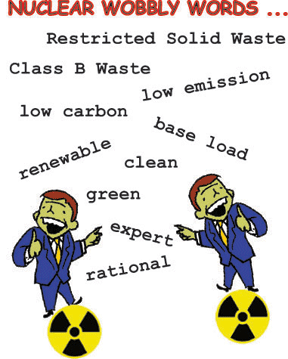
A good clue to when there’s a sophisticated and subtle spruik for nuclear, is when they drop the term “renewable” in favour of “low emission” – Christina Macpherson
Low-emission technology ‘needs support’ SMH Julian Drape, February 5, 2012 Once Labor’s carbon tax kicks in governments will need to decide how to best provide extra support for low-emissions technologies, including nuclear energy and carbon capture and storage (CCS), a Melbourne-based think tank says.
The Grattan Institute has studied the potential of wind, solar, geothermal, bio-energy, nuclear and CCS to generate near-zero emissions power. Its report, No Easy Choices, to be released on Monday, says that given the lack of any “sure bets” Australia should keep all options on the table.
That includes perhaps the most controversial technologies, nuclear and CCS, Grattan energy program director Tony Wood told AAP.
Both may be needed if Australia is to meet its target of reducing greenhouse gas emissions by 80 per cent by 2050.
“If you ignore those two that’s very risky because it’s very difficult to believe that renewables can get there without prices going through the roof,” Mr Wood said.
He argues that while Australia might be better off waiting for other countries to develop cheaper and better nuclear plants, it has a very strong interest in developing CCS…….
The report acknowledges that nuclear and CCS are unlikely to be demonstrated in Australia anytime soon “unless government takes on most of the material risk of the project”….The Gillard government, at the behest of the Greens, is establishing a $10 billion Clean Energy Finance Corporation which will leverage private sector financing for renewable energy and clean technology projects…..
But the Grattan Institute report says more needs to be done aside from support for research and development.
It advocates scrapping all existing subsidies for fossil fuels and technology-specific programs such as solar feed-in tariffs.
Further, it calls on governments to expand exploration and mapping of solar and geographical resources to aid in the development of solar thermal and geothermal energy and the location of suitable sites for carbon storage.
Finally, the think tank’s report stresses the need for a complete overhaul of Australia’s distribution network.
Australia’s compulsory airport scanning will be of the safer type – not ionising radiation
It’s a pity that the Australian government has not yet explained clearly their choice of millimetre wave radio waves scanners for compulsory use in Australian airports.
 They might be compulsory, but these scanners do not emit ionising radiation, and are therefore not a cancer risk in public health terms. The American system, (which does allow passengers the choice of a “pat down” examination instead), uses the “backscatter” type, which does subject passengers to low level of ionising radiation.- Christina Macpherson
Australian Airports To Get Compulsory Body Scans, Gismodo, 5 Feb 12, Danny Allen In a $28 million security upgrade, new “no scan, no fly” laws are expected to be proposed this week for Aussie international airports — removing the option to request a pat down instead. After trials last year, full body scanners (from the same company used in US checkpoints) will roll out in Sydney, Melbourne, Brisbane, Adelaide,
In Sydney and Melbourne, the government trialled competing scanner technology specifically designed not to identify gender or reveal body details. Gizmodo covered these: ThruVision (passive terahertz radiation detection) and L3 Communications (millimetre wave radio waves). Ultimately, the latter got the nod, and has been approved by
Australia’s Privacy Commissioner.
Images will be deleted after each traveller is cleared. Continue reading
Airport scanners – “backscatter” uses radiation, “millimetre wave” is safer

 “backscatter scanning” “……….There are two types of Whole Body Imaging (WBI) technologies in place. They are backscatter and millimeter-wave. The first uses low-level X-rays to image the body. This passes through clothing and into you, but a portion reflects off of your skin, or “backscatters”, technically called “Compton scattering.” This radiation does penetrate, but a small amount reflects and is detected by a bank of detectors. The data are computer processed to create a whole-body image. Frontal and rear images are usually obtained simultaneously. The resulting two-part image is of the subject’s skin surface, all of it, in excruciating fine detail. The processing software blanks out facial features.
It must be acknowledged that this is X-ray radiation, which is ionizing radiation. That is, it penetrates atoms and cells and can modify or damage them. Hence, it is designated by the government–EPA?, CDC?, CPSC? I’m not sure who–as a non-threshold carcinogen. This means no level is low enough to be 100% safe. Even though the amount of radiation is small–comparable to what we are subjected to in everyday life–this energy is focused on the skin and adds to the normal background radiation from the Sun and other sources. Cell damage from ionizing radiation is permanent, so the risk, again very slight, is cumulative. Therefore, despite assurances from the TSA and others, radiation from airport backscatter body scanners is not totally innocuous. There is a very tiny added risk of genetic damage. Again, the question is, is it worth it?
The other technology is millimeter wave. This method utilizes Extra-High Frequency (EHF) radiation in the range of 30 GHz– think microwave on steroids–to create an image. EHF radiation will penetrate clothing but reflects off of skin which it does not significantly penetrate. Thus, there is no risk of genetic damage but it can burn. At the levels employed by the airport scanners, this is highly unlikely unless you fall asleep in one. Unfortunately, this safer technology is the less common. I’m not sure why, but it might the state of development or perhaps the cost…………
The health risk from backscatter scans is minimal. There is a very small possibility of genetic damage, no more than might be experienced in some other activities. However, it is an additional exposure exacerbated by the focused nature of the radiation. So, there is an undeniable very slight risk, especially with repeated exposure as the effect is cumulative. There is no known risk from millimeter-wave scanning, unless you believe that cell phones cause brain cancer……….
Finally, I leave you with a quote from Rafi Sala, an Israeli airport security expert who helped design security at Ben Gurion International Airport: “I don”t know why everybody is running to buy these expensive and useless machines. I can overcome the body scanners with enough explosives to bring down a Boeing 747. … That’s why we haven’t put them in our airport.”
El-Al, Israel’s airline, relies on sophisticated profiling techniques. They haven’t had a terrorist incident since 1970, and that one failed. Peek-a-Boo, I C U – Living Lake Country
Childhood leukaemia – high rates near nuclear reactors

 French researchers have confirmed that childhood leukaemia rates are shockingly elevated among children living near nuclear power reactors.Independent Australia http://www.independentaustralia.net/2012/health/study-shows-childhood-leukemia-spikes-around-french-nuclear-reactors/ John LaForge from Truthout reports. The ‘International Journal of Cancer’ has published in January a scientific study establishing a clear correlation between the frequency of acute childhood leukaemia and proximity to nuclear power stations.


The paper is titled, “Childhood leukaemia around French nuclear power plants – the Geocap study, 2002-2007.”
This devastating report promises to do for France what a set of 2008 reports did for Germany — which recently legislated a total phase-out of all its power reactors by 2022 (sooner if the Greens get their way).
- The French epidemiology – conducted by a team from the Institut National de la Santé et de la Recherche Médicale (INSERM), the Institut de Radioprotection et de Sûreté Nucléaire (IRSN) and the National Register of haematological diseases of children in Villejuif, outside Paris – demonstrates during the period from 2002-2007 in France the doubling of childhood leukaemia incidence: the increase is up to 2.2 among children under age five. Continue reading
Australian rare earths company Lynas involved in Malaysia’s coming election
 Rare earth plant and general election 2012-02-03 , By LIM SUE GOAN Translated by SOONG PHUI JEE Sin Chew Daily, 6 Feb 2012, “……….Since the AELB has granted the Lynas a temporary operating licence (TOL), Lynas should have complied with the 11 recommendations made by the IAEA. The authority has also listed another five extra conditions under the TOL, including a detailed plan for a permanent disposal facility (PDF), to avoid repeating a similar waste disposal issue of the Bukit Merah rare earth plant.
However, why is Lynas given 10 months after the TOL’s issuance date to submit the plans and location of the PDF? In addition, the authority also has the right to appoint independent consultants to evaluate Lynas’ adherence to the set standards and regulations. Does it mean that the government may suspend the plant’s operation, if the conditions are found broken?
Also, Lynas must comply with the financial assurance condition by paying the government a US$50 million security bond in installments. However, it is not the main concern as the people’s health is priceless. With Lynas’ financial strength, US$50 million is nothing.
Would the anti-Lynas protest groups compromise after so much have been done by the government? Would the MCA and Chinese community groups change their stand? From the attitude of the Anti-Lynas groups and the public response, the Bukit Merah rare earth plant tragedy seems to be still clear in their minds. Under the international trend of concern over environmental issues, it is quite impossible to eliminate the opposition voices from the public.
The people resist even high-tension cables, telecommunication towers and garbage incinerator, how would they tolerate a rare earth plant that could bring radiation problems?
In addition, the authorities have left some doubts in dealing with the issue. For example, why the construction work of the plant was not suspended during the period when Lynas is required to fully comply with the 11 recommendations put forward by the IAEA? The progress of the construction work of the Mount Weld plant in Western Australia has even gone beyond expectation. Lynas had also constantly announced the date of operation, seemed like it was very sure of being granted an operation licence.
The uproar might be avoidable if the government has high credibility and supervision efficiency, which are also the key of the issue. http://www.mysinchew.com/node/69705
Although the Lynas rare earth plant is the world’s largest rare earth plant with the capacity to meet a fifth of the world’s demand, the people’s health is still the most important issue. The rare earth plant issue will be a thorny issue for the election.
1 This month

of the week – Australians for War Powers Reform (AWPR)
To see nuclear-related stories in greater depth and intensity
 Antinuclear