The nuclear/uranium industry and WATER – theme for February 2012
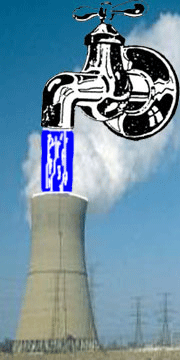 Effects of uranium mining and nuclear power on water.
Overuse of precious fresh water.One of the greatest dangers of the nuclear/uranium industry is in its use of water. Both uranium mining and nuclear reactors require enormous amounts of water. This is a threat to the world’s scarce resources of fresh water.
Pollution. Both uranium mining and nuclear reactors also pollute water. In uranium mining, water is often used to pour over radioactive dust tailings: radioactive water can leach down into groundwater. In the “in situ leach” process, radioactive water is disposed of into the aquifer.
Nuclear reactors use water for cooling – the resulting hot water is released into the source, river, or coastal sea, to thermally pollute the area, damaging plants and fish.
Effects of water scarcity, and hot water on nuclear reactors.. In heat waves, nuclear reactors often will need to be shut down, as their river sources of cooling water become too warm to function as a coolant.
As global warming brings about a rise in average temperatures and ocean levels, inland reactors will increasingly contribute to, and be affected by, water shortages. During the record-breaking 2003 heat wave in France, operations at 17 commercial nuclear reactors had to be scaled back or stopped because of rapidly rising temperatures in rivers and lake. Spain’s reactor at Santa María de Garoña was shut for a week in July 2006 after high temperatures were recorded in the Ebro River.
Paradoxically, then, the very conditions that made it impossible for the nuclear industry to deliver full power in Europe in 2003 and 2006 created peak demand for electricity, owing to the increased use of air conditioning. http://chellaney.net/2011/03/14/paradox-of-nuclear-power-water-guzzler-yet-vulnerable-to-water/
Seawater can be used to cool reactors, but it has to be purified. Corrosive elements in the seawater would otherwise ruin the reactors – so seawater is a last resort for cooling. As in the case of the Fukushima emergency – seawater was used, as ruining the reactors was preferable to a catastrophic nuclear meltdown.
Routine nuclear operations release radioactive water
 RADIOACTIVE “DRINKING WATER” for million american people… While US licenses first nuclear reactors since 1978. by RNA International February 11, 2012 – Press Conference, Red Wing, Minnesota My name is Christina Mills. I am a staff scientist and policy analyst with the Institute for Energy and Environmental Research (IEER) which provides policymakers, journalists, and the public with understandable and accurate scientific and technical information on energy and environmental issues.
IEER’s aim is to bring scientific excellence to public policy issues in order to promote the democratization of science and a safer, healthier environment.
As the report “Too Close to Home” discusses, nuclear power plants pose a threat to the drinking water of millions of Americans. Unfortunately many Americans have been and continue to be exposed to radioactive drinking water as the result of routine operations at the country’s nuclear reactor fleet. Continue reading
Nuclear industry is moribund, despite 2 new reactors licensed in USA
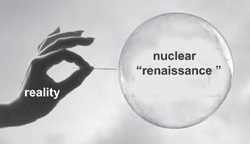 These US reactors are only happening in Georgia, where the electricity price is regulated. Elsewhere, the nuclear renaissance has ground to a halt.
building a nuclear power plant is risky and that risk falls on the banks and the banks are not happy with that.
There were only ever two firm orders for nuclear power plants in the West using these new designs; one is in Finland and one is in France and both of those are going badly wrong. All the other projects are no more than projections of what might happen in the future……. And the industry needs China more than it needs nuclear.

 http://www.abc.net.au/pm/content/2012/s3428147.htm No nuke comeback despite US approval of two reactors, Matt Peacock reported this story , February 10, 201 ABC Radio P.M.Listen to MP3 of this story
MARK COLVIN: In the United States, the Nuclear Regulatory Commission has approved construction of two new nuclear power plants in Georgia. They’ll be the first nuclear reactors in the US since the Three Mile
Island accident more than 30 years ago.
While the nuclear industry is hailing this decision as a breakthrough, Matt Peacock reports; a so-called nuclear renaissance seems further away than ever. Continue reading
Small scale, decentralised solar energy paying off for Queensland
 Queensland has embraced small scale solar – and that is set to continue.
Queensland Aims For 9000 Gigawatt Hours Of Renewable Energy Generation, by Energy Matters, 10 Feb 12, Queensland Renewable Energy Plan (QREP) 2012 has been launched by Energy Minister Stephen Robertson – and the future of solar in the state continues to look bright.
“QREP 2012 places Queensland front and centre of Australia’s clean energy future. It positions Queensland to leverage up to $8.9 billion in renewable energy investment and deliver 9000 gigawatt hours of renewable energy generation by 2020,” said Minister Robertson.
The Minister sees the state benefiting from the Australian Government’s Clean Energy Future initiative.
“Substantial opportunities will emerge for Queensland from this national plan. With a strong ongoing program of initiatives and new focus on collaboration and capacity building, QREP 2012 aims to position Queensland as a primary beneficiary.” Continue reading
Expensive, hazardous, uncertain, radioactive cleanup in Japan
Japan Starts Nuclear Cleanup, With Little Idea of How By HIROKO TABUCHI NYT February 10, 2012 IITATE, Japan — As 500 workers in hazmat suits and respirator masks fanned out to decontaminate this village 20 miles from the ravaged Fukushima Daiichi nuclear reactors, their confusion was apparent. “Dig five centimeters or 10 centimeters deep here?” a site supervisor asked his colleagues, pointing to a patch of radioactive topsoil to be removed. He then gestured across the village square toward the community center. “Isn’t that going to be demolished? Shall we decontaminate it or not?”
A day laborer wiping down windows at an abandoned school nearby shrugged at the work crew’s haphazard approach. “We are all amateurs,” he said. “Nobody really knows how to clean up radiation.” Continue reading
World’s biggest uranium company cuts production, amid doubts on nuclear industry’s future
 Cameco outlook sours amid doubts on nuclear’s future * Company sees 2012 revenue flat to down 5 percent
* Eyes lower production in 2012
* Shares down 1 pct at C$23.12
TORONTO, Feb 10 (Reuters) – Uranium producer Cameco forecast lower sales and highlighted doubts about the takeup of nuclear power in its stronger than expected quarterly results, and its shares edged lower on Friday, ……
Cameco, the world’s No.1 publicly-listed uranium producer, also lowered its 2012 uranium production outlook by 3 percent to 21.7 million pounds and said delays and cancellations after last year’s Fukushima nuclear disaster could hit prices.
Germany, which represents about 5 percent of the global market for uranium, plans to phase out its reactors by 2022.
Japan shut down most of its reactors for testing after the March 2011 earthquake and tsunami that crippled the Fukushima Daiichi power plant, and is expected to take its remaining three reactors offline for maintenance in the next few months.
“It remains unclear what level of nuclear power Japan itself – which represents 12 percent of global nuclear generating capacity – will depend on in the future,” Cameco said.
1 This month

of the week – Australians for War Powers Reform (AWPR)
To see nuclear-related stories in greater depth and intensity
 Antinuclear