The psychological toll, as well as the cancer risk, in Fukushima’s radiation
 Radiation is still leaking from the now-closed Fukushima Dai-ichi nuclear plant, though at a slower pace than it did in the weeks after the March 11 earthquake and tsunami. It’s not immediately fatal but could show up as cancer or other illnesses years later.
The uncertainty breeds fear.
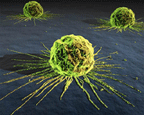 The [cancer] risk is cumulative. The radioactivity in one’s body builds up through various activities, including eating contaminated food every day or staying in a hot spot for an extended period.
 Uncertain risks torment Japanese in nuclear zone, THE HINDU, 8 March 12, Yoshiko Ota keeps her windows shut. She never hangs her laundry outdoors. Fearful of birth defects, she warns her daughters — never have children.
This is life with radiation, nearly one year after a tsunami-hit nuclear power plant began spewing it into Ota’s neighbourhood, 60 km away. She’s so worried that she has broken out in hives.
“The government spokesman keeps saying there are no immediate health effects,” the 48-year-old nursery school worker says. “He’s not talking about 10 years or 20 years later. He must think the people of Fukushima are fools. It’s not really OK to live here,” she says. “But we live here.”
Ota takes metabolism-enhancing pills in hopes of flushing radiation
out of her body. To limit her exposure, she goes out of her way to buy
vegetables that are not grown locally. She spends 10,000 yen ($125) a
month on bottled water to avoid the tap water. She even mail-ordered a
special machine to dehusk her family’s rice.
Not everyone resorts to such measures, but a sense of unease pervades
the residents of Fukushima. Some have moved away. Everyone else knows
they are living with an invisible enemy.
Radiation is still leaking from the now-closed Fukushima Dai-ichi
nuclear plant, though at a slower pace than it did in the weeks after
the March 11 earthquake and tsunami. It’s not immediately fatal but
could show up as cancer or other illnesses years later.
The uncertainty breeds fear. Some experts say the risks are quite low
outside the 20-km no-go zone, and people can take steps to protect
themselves, such as limiting intake of locally grown food, not
lingering in radiation “hot spots” such as around gutters and foliage,
and periodically living outside the area. But risks are much higher
for children, and no one can say for sure what level of exposure is
safe.
What’s clear is Fukushima will serve as a test case that the world is
watching for long-term exposure to low-dose radiation.
More than 280,000 people live in Fukushima city alone, though some
have left, and many more live in surrounding towns, including many of
the 100,000 who have been evacuated from the no-go zone.
“People are scared to death,” says Wolfgang Weiss, chairman of the
U.N. Scientific Committee on the Effects of Atomic Radiation, which is
studying Fukushima. “They are thinking, ‘Tell me. Is it good or bad?’
We can’t tell them. … Life is risky.”
It hasn’t helped that the government has given only the most
optimistic scenarios of the risks to avoid mass panic.
PUBLIC SCEPTICISM
Public scepticism of government assurances grew when the man appointed
as health adviser for Fukushima prefecture, Shunichi Yamashita,
repeatedly said exposure to 100 millisieverts of radiation a year was
safe.
Studies have found that cancer risks rise at an annual exposure of 100
millsieverts or above but aren’t statistically detectable at lower
levels. Below 100, experts can’t say for sure whether it’s safe, just
that a link to cancer can’t be proven.
In Fukushima and nearby areas, outside the 20-kilometre evacuation
zone, the annual exposure is 20 millisieverts in some places and as
high as 50 in others. Before the disaster, people in Japan were
exposed to about 1 millisievert of natural background radiation a
year; in the United States the average is about 3 millisieverts….
The nature of the threat has changed over time. Initially, it was
exposure to the large releases of radiation from explosions at the
plant. The risk from leaks remains but at a much reduced level.
These days, the main danger is less obvious but just as real —
consuming contaminated food and water and ingesting radioactive
particles. Radioactive material has accumulated in gutters where
rainwater collects and shrubs with leaves that suck in radiation.
The risk is cumulative. The radioactivity in one’s body builds up
through various activities, including eating contaminated food every
day or staying in a hot spot for an extended period.
Schools are restricting outdoor activities, and radiation meters dot
the streets. Some people are using their own devices to measure
radioactivity.
At area hospitals, thousands of people are on waiting lists to get
their radiation levels measured with whole-body counters. One child at
Minami Soma Hospital, southeast of Fukushima, was found with 2,653
becquerels of radioactive cesium.
It’s a big number, but is it dangerous? Jacques Lochard, an
International Commission on Radiological Protection official advising
Fukushima prefecture, says the child’s exposure could amount to as
little as 0.3 millisieverts a year, or as much as 8 millisieverts,
depending on how the child was exposed to the radiation.
Most residents know is that their bodies are contaminated. What the
numbers mean is unanswered…..
http://www.thehindu.com/sci-tech/article2970842.ece
No comments yet.
1 This month

of the week – Australians for War Powers Reform (AWPR)
To see nuclear-related stories in greater depth and intensity
 Antinuclear
Leave a comment