The right policy mix – Australian Renewable Energy Agency (ARENA) and the Clean Energy Finance Corporation (CEFC)
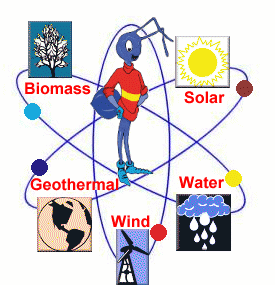 Luckily, in Australia, we are developing precisely such a [correct] policy mix. R&D support is taken care of by the Australian Renewable Energy Agency (ARENA), a price on carbon starts in mere months, and the Clean Energy Finance Corporation (CEFC) focuses on rolling out clean energy projects.
If subsidies are an economic evil, then let’s deny them across the board. Let’s wind back the billion dollar depreciation subsidies for oil and gas and wind back the billions in fuel tax exemptions for the mining industry for a start.
Right track for a clean energy future Climate Spectator, 8 Mar 2012 Simon O’Connor “…….that policy option, [supporting renewable energy combined with a price on carbon] is far and away the most cost-effective climate change mitigation strategy, delivering emissions reductions at significantly lower cost..
….. At a time when most economies are blindly groping for industries that will create jobs and open new markets, the renewable energy industry is a global superstar. Over $260 billion was invested globally in renewables last year, with more renewable energy infrastructure built than fossil fuels since 2010.
Germany is the world’s biggest market for solar power, producing about half of all solar output in 2010, and was recently responsible for lodging around a quarter of the world’s patents for renewable energy technologies. Considering the more than $40 billion invested there last year in the midst of a tumultuous eurozone economy, and the 370,000 jobs in the renewable sector, it seems odd to suggest that support for clean energy has been poorly targeted.
German growth in this sector has without doubt been primarily due to strong government support. Having nurtured the industry to the point that it is becoming genuinely commercially competitive, the German government is now slowly unwinding its support. Far from a demonstration of the failure of public support, this is a textbook example of how innovation should be considered a public good, one that should be supported then left to stand on its own two feet once mature. ..… the long-term advantages to encouraging investment in clean energy.
Renewable energy policies in general – and the German feed-in tariff
in particular – are not primarily aimed at cutting emissions cheaply
in the short term. Rather, they play a critical role in
cost-effectively cutting greenhouse pollution in the medium to long
term.
If Australia were to rely solely on a carbon price to lower carbon
pollution, there are myriad potential market failures that would
result in poor investment decisions….
investment barriers and market failures have been highlighted by the
International Energy Agency, which stated that both renewable energy
support plus a carbon price form an “optimal portfolio of policies
[that] achieves emissions reductions at significantly lower cost than
a single policy”. That “optimum mix of policies”, they concluded,
includes support for R&D, a price on carbon, and support for rolling
out renewable energy.
Luckily, in Australia, we are developing precisely such a policy mix.
R&D support is taken care of by the Australian Renewable Energy Agency
(ARENA), a price on carbon starts in mere months, and the Clean Energy
Finance Corporation (CEFC) focuses on rolling out clean energy
projects.
In other words, the Clean Energy Future package is the optimal means
to build a cost effective response to climate change. Anything less,
according to the IEA, would simply impose additional costs.
The benefits of a cohesive policy approach are many. By supporting new
clean energy projects, we can create jobs, build vibrant new
industries and make clean energy cheaper, sooner. But the CEFC will
contribute to reducing Australia’s emissions, and like in Germany,
this contribution will be fully considered by the Climate Change
Authority as they recommend appropriate national targets, allowing
Australia to drive deeper cuts in our pollution…..
If subsidies are an economic evil, then let’s deny them across the
board. Let’s wind back the billion dollar depreciation subsidies for
oil and gas and wind back the billions in fuel tax exemptions for the
mining industry for a start.
Anything short of this full package of measures would be a serious,
long-term policy mistake, merely for some marginal gain in the
short-term. The CEFC makes sense and represents a profound improvement
on the ways we’ve been supporting many of our industries,
ineffectively, for decades. Rather than take a swipe at the CEFC,
Australia has a lot to learn from this new model of driving public
benefit at least cost.
It’s high time that Australia, with its abundance of clean renewable
energy assets, kicks its addiction to burning fossil fuels. And we
know how to do it.
http://www.climatespectator.com.au/commentary/right-track-clean-energy-future
No comments yet.
1 This month

of the week – Australians for War Powers Reform (AWPR)
To see nuclear-related stories in greater depth and intensity
 Antinuclear
Leave a comment