Which Australian politician would support a nuclear reactor in their electorate?
We know how to de-commission wind turbines and solar panels at the end of their life, at little cost and with no risk to the community. So, why should taxpayers fund a slow and expensive energy option when alternatives are significantly cheaper and pose less risk? Finally, which elected politician would now support a reactor in their electorate?
 A Fukushima end to the nuclear argument Taking responsibility for Australian uranium, Climate Spectator, Ian Lowe, 13 March, 12 We now know that Australian uranium fuelled the Fukushima reactors, so we have some responsibility for the accident and its consequences. It is a reminder that we should have a serious public debate about the mining and export of uranium, rather than simply seeing it as an export earner like gold or diamonds.
The bipartisan agreement in Canberra to allow export of uranium to India, suspending our traditional insistence that importing countries being signatories of the Nuclear Non-Proliferation Treaty, is a real worry. As Robert Milliken wrote 30 years ago in the National Times, whenever our safeguards get in the way of a commercial deal, the safeguards get
watered down.
Still a risky business
Before Fukushima, there had been a surge of enthusiasm here for
nuclear power. The problems in Japan have probably ended the risk of
Australia going down the nuclear path for the foreseeable future.
Fukushima is also a reminder that financial considerations can lead to
dangerous short cuts in design and operation….
While enthusiasts claim new reactors would not have the technical
limitations of Chernobyl or be sited as dangerously as Fukushima,
there will always be some risk of accidents. I was recently in
Christchurch and saw the ruins of the city centre, including the
coffee shop where I had been waiting for my lunch on February 22 2011
when the earthquake struck. Given the devastation caused by that
event, I am glad New Zealand does not have nuclear reactors.
If we wanted to build power reactors in Australia, the need for
cooling water would demand a coastal location, where there will always
be a risk of storm surges or tsunamis.
We simply don’t know enough about the Earth to be totally confident
that any specific location is safe. An accident in a nuclear power
station is a much more serious risk than a problem with any form of
renewable energy supply.
Nuclear doesn’t appeal to governments
When I was a young physicist, it seemed that nuclear power would be
cheap, clean and safe. I went to the UK and accepted support from
their Atomic Energy Authority for research on a problem affecting the
useful life of fuel elements in power reactors.
But nuclear power has remained expensive, needing public subsidies
wherever it operates. With insurance companies unwilling to back
nuclear energy, taxpayers foot the bill when things go wrong.
The peak of installed nuclear power happened last century. Despite
some claims, there hasn’t been a renaissance of nuclear energy, only a
resurgence of pro-nuclear talk. In the years 2008 and 2009, the world
retired 3000 Megawatts of old nuclear capacity and only 1000 MW was
brought on line. In the same two years, about 60,000 MW of new wind
power was commissioned.
As with other products that are unacceptable in advanced countries,
the nuclear industry is now concentrating its efforts in the
developing world……
Nuclear is certainly not a timely response to climate change. The
pro-nuclear Switkowski committee concluded it would take 10 to 15
years to build one nuclear reactor. Their hypothetical crash program
of 25 reactors by 2050 would only slow the growth in our release of
greenhouse gases, not achieve the needed reduction.
It is too expensive. Again, Switkowski’s group conceded there would
need to be both a carbon price and other government subsidies to make
nuclear look competitive.
The problem of waste remains unsolved. Accidents are not the only risk
to society from nuclear power. Nobody has yet demonstrated safe
permanent management of radioactive waste, more than 55 years after
the nuclear experiment began.
There are better alternatives. A Commonwealth report 20 years ago
found that we could get all our electricity from a mix of renewables
by 2030. A study released last year concluded that we could achieve
that goal by 2020 if we were serious about it. That would be a
responsible approach to slow down global warming.
The clean energy response is quicker, less expensive and less
dangerous than nuclear reactors. There is no risk to the community
from terrorists stealing wind turbine blades or earthquakes shattering
solar panels.
A mix of renewable supply systems would also decentralise energy
production, so it would be good for regional Australia. It would not
require new regulatory systems, development of new technical skills or
an unwise dependence on foreign expertise.
We know how to de-commission wind turbines and solar panels at the end of their life, at little cost and with no risk to the community. So, why should taxpayers fund a slow and expensive energy option when alternatives are significantly cheaper and pose less risk? Finally, which elected politician would now support a reactor in their electorate? http://www.climatespectator.com.au/commentary/fukushima-end-nuclear-argument
No comments yet.
1 This month
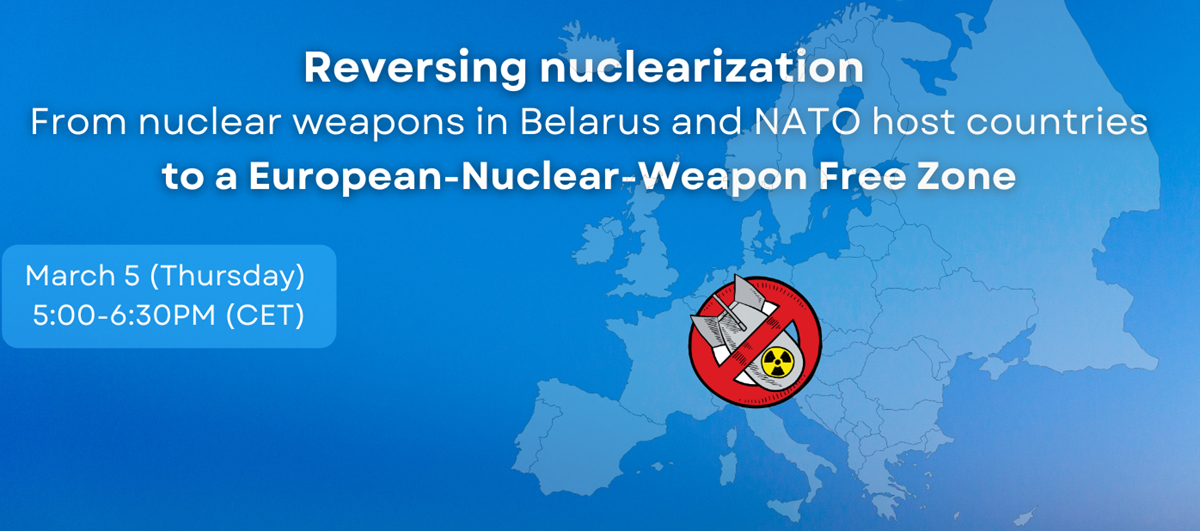
6 March -Online – Reversing nuclearization:
From nuclear weapons in Belarus and NATO host countries to a European-Nuclear-Weapon Free Zone
Mar 6, 2026 03:00 AM in Canberra, Melbourne, Sydney

of the week – Australians for War Powers Reform (AWPR)
To see nuclear-related stories in greater depth and intensity
 Antinuclear
Leave a comment