Wind energy a winner for South Australia
Wind Power costs a lot less than the savings it makes – it’s like a preventative measure; an insurance that you buy against high electricity prices. In the case of South Australia, they did just that and it paid off.
Wind Works. It’s giving South Australia climate security through decarbonising its economy, energy security through reduced imports of expensive volatile fossil fuels. And it works so well that South Australia can now go further and target 50 per cent of the state to run on wind power and put much more solar on rooftops while planning to integrate this with
Baseload Solar Thermal plants installed in locations like Port Augusta.
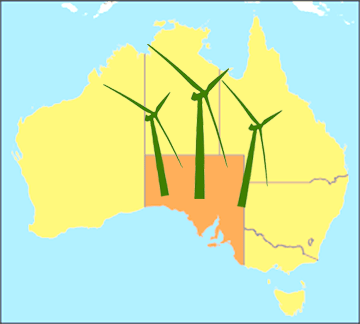
South Australia’s big win with wind, REneweconomy, By Matthew Wright 21 March 2012 Wind Power in South Australia has been a howling success; it now provides more electricity in the state than coal and in just a decade the wind industry has developed into one of the world’s leaders – and all to the benefit of South Australians.
Back in 1998 when the National Electricity Market was formed, South
Australian generators charged more for electricity than generators in
any of the other states. Today South Australian electricity is at its
lowest price since the creation of the NEM and that is largely because
of its choice to significantly develop its wind resources.
Wind Power costs a lot less than the savings it makes – it’s like a
preventative measure; an insurance that you buy against high
electricity prices. In the case of South Australia, they did just that
and it paid off. According to the Essential Service Commission of
South Australia wind power adds just 0.366c per kWh to the average
South Australian electricity bill or just on 1 per cent (based on AEMC
2013/2014 South Australian 32c retail rate) The oft claimed
outrageously high cost of wind is just $18.00 a year per household.
However offsetting this small cost is South Australia’s transition
from having the highest cost wholesale electricity to the lowest cost
in the country (AEMC 2013/2014). This lower-cost electricity has been
a result of the Merit Order Effect, and a number of reports have
quantified this value to consumers.
The Australian Energy Market Operator (AEMO) recently stated that
South Australian pool prices are now the lowest since the start of the
NEM, and data in a published report shows the wholesale price is half
the ‘normal’ price when it’s windy, and shows that wholesale prices
are at least 0.5c per kWh lower thanks to wind power in that state.
The analysis was current until 2010, savings on wholesale electricity
in 2011 are expected to be even greater.
This means that South Australian householders are paying 0.366cents
($18 a year) for wind but saving 0.5cents ($25 a year) on wholesale
electricity. In other words, they’re already better off to the tune of
$7 and we’ve only just started shifting to renewables…..
Uninformed critics of South Australia’s rollout of wind claim that the
state would not save significantly on its carbon emissions, that it
would burn as much, or more, coal and gas and that it would continue
to rely on electricity imports from Victoria to prop up its high
penetration renewable power grid.
None of this has proven to be the case….. Wind Works. It’s
giving South Australia climate security through decarbonising its
economy, energy security through reduced imports of expensive volatile
fossil fuels. And it works so well that South Australia can now go
further and target 50 per cent of the state to run on wind power and
put much more solar on rooftops while planning to integrate this with
Baseload Solar Thermal plants installed in locations like Port
Augusta.
As for the rest of Australia, we should be ratcheting up our efforts
and not missing out on the benefits that have been afforded to those
in Australia’s least-populated mainland state.
http://reneweconomy.com.au/2012/south-australias-big-win-with-wind-56374
No comments yet.
1 This month
7 April – WEBINAR – Australia and the Doomsday Clock – Preventing nuclear war through NoFirstUse and other policies
Online | Tuesday April 7, 4:00-5:30pm, Australian Eastern Time / 8:00-9:30am Central Europe Time
– Access the registration link
15 April – Zoom –Nuclear Power is Not the Solution
Apr 15, 2026 01:00 AM in Canberra, Melbourne, Sydney

Join the International Physicians for the Prevention of Nuclear War (IPPNW) on Tuesday, April 14th for a timely webinar exploring the risks associated with nuclear power and challenging the myth that it offers a simple, safe, carbon-free solution to the climate crisis

21 April Webinar: No Nuclear Weapons in Australia
Start: 2026-04-21 18:00:00 UTC Canberra, Melbourne, Sydney (GMT+10:00)
End: 2026-04-21 19:30:00 UTC Canberra, Melbourne, Sydney (GMT+10:00)
Event Type: Virtual
A virtual link will be communicated before the event.
Host Contact Info: australia@icanw.org

of the week – Australians for War Powers Reform (AWPR)
To see nuclear-related stories in greater depth and intensity
 Antinuclear
Leave a comment