Wrap up of the week’s Australian nuclear news
 Renewables. I know that they are not strictly a nuclear topic – but what can I do? There’s just a whole lot more happening there, than in the tired out nuclear stillbirth. In Queensland. Scouller Energy, is pressing ahead with a plan to build a10-megawatt solar plant near Normanton – even as the Queensland government withdraws support for solar . In Western Australia, Horizon Power comes up with a solar feed-in tariff that will reward remote communities according to the costs saved in transmission of electricity over distance. Energy efficiency gets a boost with Sydney‘s plan for cogeneration and on-site production of electricity
Future Fund. New Chairman David Gonski confronted with the facts on its investment in nuclear weapons, while Australia proclaims its nuclear non proliferation stand. Rising public condemnation of this hypocrisy.
Court case. Uncle Kevin Buzzacott’s legal action against the planned new huge Olympic Dam uranium mine. The judge is considering the mass of doumentary evidence, and has deferred his judgment. I is not all going BPH Billiton’s way. Among other considerations, there was much debate about BHP’s planned use of water resources.
Climate change. While new scientific evidence confirms human caused climate change, Australia’s monopoly media is shown to have given an inordinate amount of coverage to the climate denialist point of view, – in a forensic study by Wendy Bacon, of 6 months of news coverage of the Gillard government’s carbon tax plan.
Warren Mundine – the nuclear industry’s Aboriginal puppet
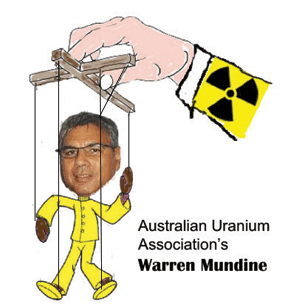 Mundine’s claim to support Aboriginal empowerment is contradicted by his consistent failure to speak out when mining and nuclear interests and governments that support those interests disempower Aboriginal people.
Warren Mundine’s nuclear allegiances. Online opinion, By Jim Green , 11 April 2012 Warren Mundine, a member and former National President of the ALP, and co-convener of the Australian Uranium Association’s Indigenous Dialogue Group, has been promoting the nuclear industry recently. Unfortunately he turns a blind eye to the industry’s crude racism, a problem that ought to be core business for the Indigenous Dialogue Group.
Mundine could have mentioned the legacy of uranium mining in the Wiluna region of WA; to pick one of many examples. Uranium exploration in the region in the 1980s left a legacy of pollution and contamination. Greatly elevated radiation levels have been recorded despite the area being ‘cleaned’ a decade ago. Even after the ‘clean up’, the site was left with rusting drums containing uranium ore. A sign reading “Danger − low level radiation ore exposed” was found lying face down in bushes. Continue reading
Australia’s uranium promoters working hard against the reality of falling profits
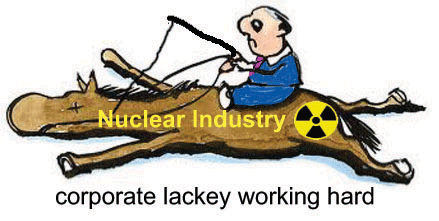 Uranium bulls have spent much of the past 12 months arguing there is a serious disconnect between the way the sharemarket and short-term investors view the outlook for uranium and the way long-term industry players (the CGNPCs and Rios of the world, for example) see it.
No sweeteners for yellowcake players, The West, Kate Emery April 11, 2012, A little over a year after the Fukushima nuclear disaster and despite endlessly positive outlook statements from the uranium industry, the fact remains it’s a still a tough time to be in the yellowcake business. Continue reading
To keep the nuclear industry going, Japanese government adopts hasty, sloppy, safety standards
It even appears that the government intentionally worked out looser standards so that utilities can meet them in order to hasten the reactivation of Oi nuclear plant’s idled reactors.
Economy, Trade and Industry Minister Yukio Edano says there is no need for reactivation of nuclear reactors stopped for regular inspections if the overall supply of electric power is sufficient.

 New standards for reactivating nuke reactors are too hasty and sloppy , 11 April 12, http://mainichi.jp/english/english/perspectives/news/20120409p2a00m0na018000c.html The government should be criticized for having moved too hastily and in a sloppy manner when it set new standards for deciding whether to reactivate nuclear reactors, even though the criteria are crucial in ensuring the safety of the public.
Prime Minister Yoshihiko Noda and three Cabinet ministers concerned approved the standards on April 6 with an eye to approving resumption of operations at the No. 3 and 4 reactors at the Oi Nuclear Power Plant in Fukui Prefecture, which are currently suspended for regular inspections.
The standards apply to not only the Oi reactors but also to all nuclear plants across Japan. Nevertheless, the government spent only three days on working out the standards — from the prime minister’s instruction to do so until the adoption. Continue reading
Decline in Ranger uranium mine’s production, profit and morale – time to close it down
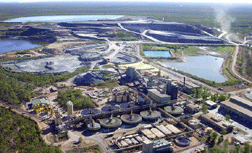 ERA tightens 2012 guidance, Colin Jacoby , 10 April 2012 …The uranium miner Energy Resources of Australia reported production of 612 tonnes of uranium oxide for the March quarter, down 41% from its December 2011 quarter production of 1030t.. The company was dogged by high rainfall at Ranger and access to high-grade ore was restricted due to the water level in the pit.
With ERA unable to access the high-grade ore located at the bottom of the pit, the ore milled during the quarter was sourced from stockpiled material. … the company said 2012 production remained highly dependent on the level of rainfall for the remainder of the year.
Kakadu uranium miner faces growing criticism. ACF, 11 April 12, Mining at the troubled Ranger uranium operation in Kakadu has been described as dirty, dangerous and desperate by the Environment Centre NT and the Australian Conservation Foundation. The groups have used Energy Resources of Australia annual meeting today in Darwin to re-affirm their concerns about uranium mining inside the World Heritage listed Kakadu National Park.
 ”ERA’s open cut mine has seen over 150 leaks, spills and breaches; radioactive exposure to workers; mismanagement of water and a mine shutdown that resulted in a $150 million dollar loss last year. The mine continues to pose ongoing environmental risk to Kakadu and the creation of more unwanted and poorly managed radioactive waste,” said Environment Centre NT campaigner Cat Beaton.
“Much of that waste is stored in an overloaded tailings dam that continues to leak over 100,000 litres of contaminated water a day.” Continued Ms Beaton.
In recent years ERA’s controversial Ranger mine has been plagued by declining production, morale and profit, with operations severely impacted by severe weather events. The company is attempting to reverse this decline by moving away from open cut mining in favour of underground mining.
“ERA’s fortunes are in systemic decline and will not be turned around by a tunnel to nowhere,” said ACF nuclear campaigner Dave Sweeney. “In the shadow of Fukushima – which we know was fuelled by Australian uranium – we need an open assessment of the costs and consequences of the uranium trade, not piecemeal approvals of short term projects that generate long term risks and problems”. “Uranium mining is unclean and unsafe, and this industry remains contaminating and contested”. Concluded Mr. Sweeney.
Brain cancer risk from overuse of dental X rays
Dental x-rays linked to brain tumours, ABC News, 10 April 12, People who get regular dental x-rays are more likely to suffer a type of brain tumour, according to new research, suggesting that yearly exams may not be best for most patients. The study in the US journal Cancer showed people diagnosed with meningioma who reported having a yearly bitewing exam were 1.4 times to 1.9 times as likely as a healthy control group to have developed such tumours.
A bitewing exam involves an x-ray film being held in place by a tab between the teeth. Also, people who reported getting a yearly panorex exam – in which an x-ray is taken outside the mouth and shows all the teeth on one film – were 2.7 to three times more likely to develop cancer, said the study.
A meningioma is a tumour that forms in the membrane around the brain or spinal cord. Most of the time these tumours are benign and slow growing, but they can lead to disability or life-threatening conditions. The research, led by Elizabeth Claus of the Yale University School of Medicine, was based on data from 1433 US patients who were diagnosed with the tumours between the ages of ages 20 and 79 years. For comparison, researchers consulted data from a control group of 1350 individuals who had similar characteristics but had not been diagnosed with a meningioma.
Dental patients today are exposed to lower radiation levels than they were in the past, but the research should prompt dentists and patients to re-examine when and why dental x-rays are given, says Claus. “The study presents an ideal opportunity in public health to increase awareness regarding the optimal use of dental x-rays, which unlike many risk factors is modifiable,” she says……
Associate Professor Matthew Hopcraft of the University of Melbourne Dental School says there are no strict guidelines regarding dental x-rays in Australia. “Dentists in Australia would normally do a risk assessment for their patients … weighing up the risk of disease versus the risk of potential harm from radiation from the x-rays,” says Hopcraft. He says most patients would undergo one x-ray every one or two years, while a patient with a high risk from tooth decay would need one every six months. Hopcraft says improvements in radiographic equipment has seen the dosage rate received by patients undergoing an x-ray reduce over time.
“We’ve moved a lot in Australian practice towards digital radiography from traditional film and that’s allowed the dosage of radiation to decrease significantly as a consequence.” http://www.abc.net.au/science/articles/2012/04/10/3474085.htm
1 This month
7 April – WEBINAR – Australia and the Doomsday Clock – Preventing nuclear war through NoFirstUse and other policies
Online | Tuesday April 7, 4:00-5:30pm, Australian Eastern Time / 8:00-9:30am Central Europe Time
– Access the registration link
15 April – Zoom –Nuclear Power is Not the Solution
Apr 15, 2026 01:00 AM in Canberra, Melbourne, Sydney

Join the International Physicians for the Prevention of Nuclear War (IPPNW) on Tuesday, April 14th for a timely webinar exploring the risks associated with nuclear power and challenging the myth that it offers a simple, safe, carbon-free solution to the climate crisis

21 April Webinar: No Nuclear Weapons in Australia
Start: 2026-04-21 18:00:00 UTC Canberra, Melbourne, Sydney (GMT+10:00)
End: 2026-04-21 19:30:00 UTC Canberra, Melbourne, Sydney (GMT+10:00)
Event Type: Virtual
A virtual link will be communicated before the event.
Host Contact Info: australia@icanw.org

of the week – Australians for War Powers Reform (AWPR)
To see nuclear-related stories in greater depth and intensity
 Antinuclear