Senator Bob Brown to resign. Senator Christine Milne to take over Greens leadership
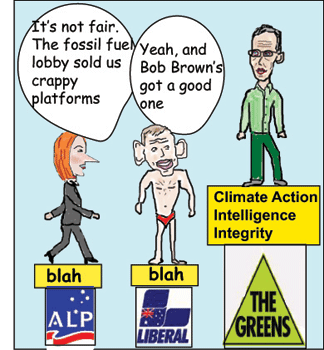 Brown’s protests and causes in his trailblazing career, ABC News, April 13, 2012 After 16 years at the helm of the party he founded, Bob Brown has retired as Greens leader and will stand down as a senator in June. His resignation ends a trailblazing career in federal politics which saw him become Australia’s first openly gay member of Parliament.
Since his early career as a doctor, Senator Brown adopted left-leaning causes and was passionate about the environment and human rights.
In 1976 he held a fast for one week on top of Mt Wellington in protest of the arrival of the nuclear-powered warship USS Enterprise……
Senator Brown was an advocate for a range of human rights and green issues, introducing bills for forest protection, to ban mandatory sentencing of Aboriginal children and to block the dumping of nuclear waste.
Parliamentary rebel He was an opponent of the war in Iraq and campaigned for justice for David Hicks, the Australian who was imprisoned at Guantanamo Bay. Senator Brown was famously suspended from Parliament in 2003 when he
disrupted a speech being delivered by visiting United States president George W Bush.
During Mr Bush’s speech Mr Brown demanded the American “return Australians” respect Australians. He was barred for 24 hours but he and Mr Bush shook hands afterwards despite the altercation.
Later, when US president Barack Obama visited Australia in 2011 Senator Brown said he did not intend to interrupt his speech to Parliament. “We’ve got a president now who knows a lot more about equality and respect than his predecessor, George W Bush,” he said…… http://www.abc.net.au/news/2012-04-13/brown27s-trailblazing-career/3948578
Council of Australian Governments (COAG) to weaken Australia’s environmental protection
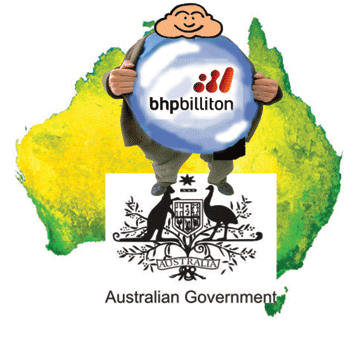 The ‘Green Tape’ Furphy, New Matilda By Ben Eltham, 13 April 12, Reducing ‘green tape’ is on the COAG agenda – but fast-tracking environmental regulation will end up hurting productivity in the long term, writes Ben Eltham“……..Yesterday’s roundtable ended with a statement from those assembled which pledged to cut some of the burdensome duplication of regulatory approvals between state and Commonwealth levels. “The Government has agreed to develop bilateral arrangements with the states to fast-track state assessments and approvals,” it reads. “This means states will be accredited to do certain Commonwealth assessments.” There will also be a commitment to form inter-governmental taskforces for major projects, “so approvals are administered by a single state agency and unnecessary duplication is removed.”
But the Greens maintain that federal environmental legislation is sometimes the only thing that prevents pro-development state governments from giving bulldozers the green light. “All the big environmental wins of recent history have been when the federal government stepped in to protect an area from development the state government had approved,” Queensland Greens Senator Larissa Waters pointed out.
Waters is right. Federal legislation is generally the last line of resort for blocking big projects that impinge on sensitive habitats or threatened species, but which have been waved though by state authorities. The experience of Tasmania shows how, in a small state, the interests of a powerful industry can often subvert the interests of the broader environment, as happened when regulatory approval the Bell Bay pulp mill proposed by Gunns was rammed through parliament with little due diligence. It was the Commonwealth that stepped in protect the Franklin in the early 1980s, and the Commonwealth that stepped in to protect Coronation Hill. More recently it is the Commonwealth that has provided world-leading benchmarks for no-fish zones in the Great Barrier Reef…. http://newmatilda.com/2012/04/13/greentape-furphy
Queensland Premier Campbell Newman wants his State to have open slather on environmental assessments
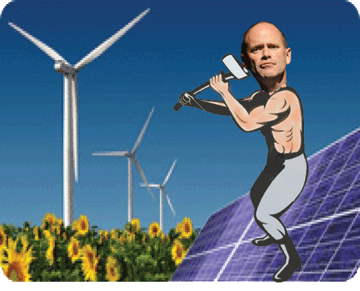 Premier Campbell Newman says Julia Gillard’s move to remove duplication on environmental approvals with the states falls short Courier Mail, by: Steven Scott From: The Courier-Mail April 13, 2012 CAMPBELL Newman has demanded the Federal Government hand over complete control of environmental assessments to the state in a move designedto cut business costs.
But Julia Gillard has vowed to retain the final say over high-risk and World Heritage area developments, warning Mr Newman’s plan could allow Queensland to build a nuclear reactor without any input from the rest of the country……
Liberal premiers including Mr Newman say they want the carbon tax on the table as part of the talks, which will continue at the Council of Australian Governments summit in Canberra today.
But Mr Newman has gone further than other Premiers and called for complete control over environmental assessments in the Sunshine State….. Ms Gillard said her plan to streamline environmental rules with states
would mean developers “don’t go through double assessments”. But she said the Federal Government still had to oversee developments in World Heritage areas in Commonwealth waters and nuclear power.
Ms Gillard said Mr Newman’s proposal would stop the Federal Government having a say if there was a plan for another nuclear reactor like the Lucas Heights plant in Sydney…..
the Greens said the plan to streamline assessments could cut environmental protection….
http://www.couriermail.com.au/news/queensland/deal-will-cut-green-tape/story-e6freoof-1226325279269
Solar powered air conditioning – the answer to Australia’s electricity peak load

 How solar air-con could avoid costly network upgrades http://reneweconomy.com.au/2012/how-solar-air-con-could-avoid-costly-network-upgrades-46101 REneweconomy By Giles Parkinson 13 April 2012 The biggest strain on our electricity networks right now – and the cause for at least one third of the $45 billion network upgrades, and at least half of the recently announced tariff increases – are the “super” peak demand periods triggered when everyone returns home from work and flicks on their air conditioning.
In some states this might only occur for a few hours a year, more in others, but network operators have been at a loss to address the issue, apart from building more capacity. Other solutions have been offered – demand management being one of them – but what if the network operators could turn to solar-powered air conditioners as the solution to reduce peak load? Continue reading
BHP’s Marius Kloppers leads the fight against renewable energy
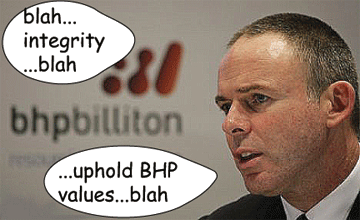 Renewables target under fire , The Australian BY: ANNABEL HEPWORTH, DAVID CROWE April 13, 2012
LABOR faces growing business pressure to scale back its renewable energy target when it is reviewed this year, with BHP chief executive Marius Kloppers urging the Gillard government to “take a cold, hard look” at how it will interact with the carbon tax. …
Lynas Advanced Materials Plant (LAMP) – profits to Australians, radioactive wastes to Malaysia
 Today, the government is the official custodian of this repository in Bukit Merah. This site in Bukit Merah is declared as a restricted and dangerous dump site for radioactive materials but a curtain of official silence has descended on it. Has the government not learnt from Bukit Merah?
The Lynas project is likely to be a replay of the ARE fiasco but on a much larger scale.
The benefits gained by Malaysia from the Lynas investment are very little relative to the risks involved. Whilst the profits of the project go to Lynas (untaxed) and the few Malaysian companies that are involved in the construction of and the provision of supplies to the Gebeng rare earth plant, the radioactive waste will remain in
Malaysian soil for hundreds of years.
 Lynas issue: Not learning from bitter experience —The Malaysian Insider, Richard Pendragon, April 12, 2012 — Every Malaysian should know that Australia has a land mass 58 times bigger than peninsular Malaysia. But the Australian government and people have not permitted rare earth processing to take place on Australian soil.
With a population that is vigilant and a government that answers to the people, Australia dares not permit a rare earth plant because the health and environmental risks are too high.
Why does Malaysia – a country with less scientific and engineering expertise – think it is all right to go ahead with the plant? Continue reading
Gloomy uranium prices. Ranger mine likely to quietly shut down
 Spot Uranium Grafting, 9 News Finance, 13 April 12, “………Activity in general remains sluggish, and while two transactions were reported last week in the term market they were both pretty small by term market standards…
..Energy Resources of Australia managed a 5% price increase over the quarter but remains in the 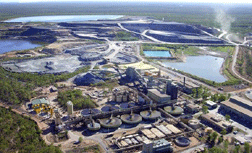 balance. The company has elected to spend $120m to explore the underground potential at its premier Ranger mine in the northern territory, known as the Ranger Deeps project.
If ERA decides the Deeps is not a commercially viable proposition, Ranger is destined to quietly shut down. Merrills suggests known reserves are unlikely to last beyond this year and stockpiles would be gone in 3-4 years.
Meanwhile, Merrills has ceased coverage of Extract Resources post takeover and its impending de-listing this week.
The broker has also taken the opportunity to review its uranium price forecasts to account for weaker Japanese demand now apparent one year after Fukushima. The analysts’ 2012 spot price forecast falls to US$56.25/lb from US$58.50/lb and 2013 to US$67.50/lb from US$70.00/lb. Merrills’ long term price drops to US$63.00/lb from US$65.00/lb. …
http://finance.ninemsn.com.au/newscolumnists/greg/8449091/spot-uranium-grafting
The endless money pit that is nuclear power technology
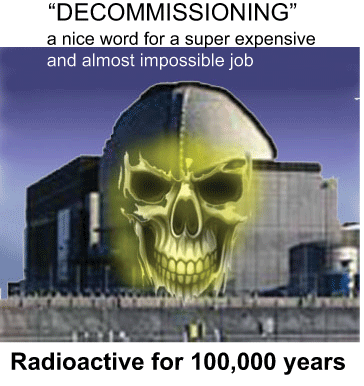 The Nuclear Powers of Japan and United Kingdom Enformable, 13 April 12,”…….so far, the true cost and impact of the Fukushima disaster has been massively and criminally downplayed and delayed.
Fukushima has resulted in vast areas of Japan, including some parts of Tokyo becoming so contaminated that the comparisons of the samples taken would show the Soviets would have evacuated and the Americans would designate the area as a hazardous radiological area if part of any US facility.
The fact of the matter remains, nuclear power is a money pit of an unrivaled parallel; whether building, operating, waiting to be transferred while waiting in spent fuel pools, waiting to be transferred to permanent storage in non-existent facilities, or smoldering as the case at the crippled Fukushima reactors.
Even the rosiest estimates for the decontamination and remediation, if such a thing is even possible, involve a multi-decade, multi-trillion dollar nightmare….. http://enformable.com/2012/04/uk-and-japanese-agree-to-act-in-unison-on-nuclear-interests/
Energy Resources of Australia – no decision on new uranium mining until 2014
ERA to wait two years on new uranium, Northern Territory News, ALISON BEVEGE | April 12th, 2012 A DECISION won’t be made on mining an estimated 34,000 tonnes of uranium at a new Territory resource until 2014, uranium miner Energy Resources of Australia has said.
Shareholders caught a ray of hope at ERA’s annual general meeting at SkyCity Casino yesterday after a gloomy 2011 where the company lost $154 million and halted dividends….. The company will begin extensive mapping of the new find this year with construction to begin on a $120 million exploration decline on May 1.
Mr Atkinson said no decision on mining it would be considered for two years. “2014 is to be the year of decisions,” he said….. http://www.ntnews.com.au/article/2012/04/12/298551_ntnews.html
ERA’s Ranger uranium mine should be closed down – Australian Conservation Foundation
Meanwhile, the Australian Conservation Foundation is calling for all Ranger operations to end. Foundation spokesman Dave Sweeney says there are severe environmental risks associated with the mine.
“Over the course of the history of ERA’s operations, we have seen over 150 publicly documented leaks, spills, accidents and breaches,” he said. “Some of them have been small but some of them have been severe.”
ERA flags future for Ranger uranium despite loss http://www.abc.net.au/news/2012-04-11/ranger-uranium-era-agm/3943640 By Phoebe Stewart, April 11, 2012 Operations at the Ranger facility were closed for five months last year because of extremely wet weather. One of the world’s biggest uranium miners is forecasting a strong future despite reporting a big loss last year. Continue reading
Rural communities like Broken Hill keenly taking up solar energy
Broken Hill embraces solar power, Margaret Paul, ABC News, April 12, 2012 The peak body representing renewable energy in Australia says regional New South Wales is leading the way in terms of the number of households installing solar panels.
The Federal Government’s Renewable Energy Regulator office has released the latest figures which show 19 per cent of properties in Broken Hill have installed solar panels….. Russel Marsh, policy director with the clean energy council, says it is no surprise to see regional areas ranked highly. “Increasingly, the people and the households who are installing solar
panels are not those who live in the urban areas, but those who live in regional areas who tend to be on lower incomes.
“We think that’s because they have the most to gain from installing solar panels on their roof, in terms of the savings they can make on their electricity bill as a result of generating their own electricity from the sun.”….
http://www.abc.net.au/news/2012-04-12/solar-postcodes/3945504
1 This month
7 April – WEBINAR – Australia and the Doomsday Clock – Preventing nuclear war through NoFirstUse and other policies
Online | Tuesday April 7, 4:00-5:30pm, Australian Eastern Time / 8:00-9:30am Central Europe Time
– Access the registration link
15 April – Zoom –Nuclear Power is Not the Solution
Apr 15, 2026 01:00 AM in Canberra, Melbourne, Sydney

Join the International Physicians for the Prevention of Nuclear War (IPPNW) on Tuesday, April 14th for a timely webinar exploring the risks associated with nuclear power and challenging the myth that it offers a simple, safe, carbon-free solution to the climate crisis

21 April Webinar: No Nuclear Weapons in Australia
Start: 2026-04-21 18:00:00 UTC Canberra, Melbourne, Sydney (GMT+10:00)
End: 2026-04-21 19:30:00 UTC Canberra, Melbourne, Sydney (GMT+10:00)
Event Type: Virtual
A virtual link will be communicated before the event.
Host Contact Info: australia@icanw.org

of the week – Australians for War Powers Reform (AWPR)
To see nuclear-related stories in greater depth and intensity
 Antinuclear