BHP and Lynas – BIG is not necessarily beautiful or commercially successful
 Australia’s a great place for the myth of BIG. Apart from its odd icons like The Big Banana, Big Pineapple, Big Cow – for kids to gawk at, – Australia also boasts BIG mining/processing plans for adults to gawk at.
So – we have the prospect of – The Biggest Man-Made Hole on the planet – BHP Billiton’s new open cut Olympic Damn uranium mine. And the prospect of the Biggest Rare Earths Processing Plant on the planet – Lynas Advanced Materials Plant (LAMP) – being placed in Malaysia, but by an Australian company.
Or do we have those prospects? There’s some doubt that the new Olympic Dam will be commercially viable, or will even get the go ahead from the BHP Board. There’s some doubt that LAMP will go ahead, in its present planned form, as Malaysia might insist on a proper plan for long term disposal of its radioactive wastes
Australia’s Environment Protection and Biodiversity Conservation Act is not much use
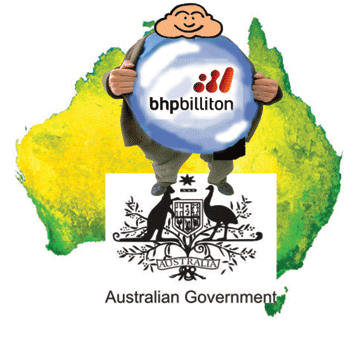 MINING GIANT SEEKS COSTS FROM ARABUNNA ELDER AFTER RULING ON CHALLENGE TO FEDERAL APPROVAL OF THE OLYMPIC DAM EXPANSION 20 April 12, In a packed courtroom today Justice Besanko dismissed Uncle Kevin Buzzacott’s challenge of the Federal approval of the Olympic Dam expansion. The judge did not discuss his reasons in the court.
Both BHP and the Federal government are seeking costs from Kevin Buzzacott. The hearing was held in the Federal Court on the 3rd and 4th April, after which the Judge reserved his judgement. Both BHP Billiton and the South Australian government had successfully sought to become parties to the proceedings.
“The speed with which this decision was made suggests pressure to resolve the matter as quickly as possible so as not to impact the project,” said Nectaria Calan of Friends of the Earth Adelaide.
“The judgement is really a product of the constrained nature of such administrative challenges. It really rests on interpretation of two pieces of legislation which govern the Ministers approval. The merits of the project were never on the table for discussion.”
“If such an approval with so many future plans yet to be approved constitutes a proper approval under the Environment Protection and Biodiversity Act, how can such an open-ended project be judicially reviewed?” said Ms Calan. “The question we are left with is whether the EPBC Act protects the environment,” Ms Calan continued.
“This is a very sad day,” said applicant Kevin Buzzacott. “We offered the judge the issue on a platter, and he wasted an opportunity to make changes that will reverberate in this nation for thousands of years.”
“But we’re not going away. This isn’t over yet,” Mr Buzzacott concluded. Both Kevin Buzzacott and Nectaria Calan will be available for comment on the details of the ruling early next week once the lengthy judgement has been considered.
A sad day for Aborigines, as BHP wins court case, and will seek costs from Aboriginal elder.
 Elder loses court fight over outback mining plan, ABC News, April 20, 2012 The Federal Court has dismissed an application by an Aboriginal elder to overturn a proposed expansion of the Olympic Dam uranium and copper
mine in outback South Australia. Kevin Buzzacott challenged the Federal Government’s approval for the
expansion, which was granted last year.
He argued environmental risks from the planned expansion of underground mining to an open pit operation had not been properly considered. But Justice Anthony Besanko dismissed the application.
Mine owner BHP Billiton is seeking court costs from Mr Buzzacott. Outside court, he said he was disappointed with the result. “We were expecting something like that to happen,” he said. “I guess it’s another sad day for the people of South Australia and especially my people as well.”….. The mining company’s board is due to make a final decision later in the year on whether to proceed with the expansion.
BHP spokesman Kym Winter-Dewhirst says the company was always confident the court would rule in its favour. ….
http://www.abc.net.au/news/2012-04-20/federal-court-elder-challenge-bhp-mine-expansion/3963312
BHP’s Olympic Dam mine expansion might not go ahead anyway

Acting chief executive of the South Australian Chamber of Mines and Energy Nigel Long said the state’s mining industry was not solely reliant on the expansion of Olympic Dam because there were other “exciting opportunities” ahead,
“The decision to press the pause button is a decision to be made by the BHP board, but we see a very good future for other projects in South Australia regardless…..
The BHP board will be considering whether to approve the project at a time when cost pressures in Australian mining are rising and profit margins are contracting.
BHP has Olympic hurdles to overcome, Financial Review 17 APR 2012 The South Australian government says it is not inclined to grant BHP Billiton an extension on an approvals expiring in December that cover the $US20 billion expansion of the Olympic Dam mine at this stage. Jamie Freed and Lucille Keen
“They’d need a ministerial exemption to continue those approvals,” the state’s Minister for Natural Resources Tom Koutsantonis told ABC Radio South Australia yester day. “Thus far I’ve seen nothing that would incline me to grant an exten sion.”
His comments followed a report in The Australian Financial Review on Saturday that BHP was weighing whether to hit the pause button on the project amid a weaker outlook for commodities, industry-wide cost inflation, added government imposts and pressure from shareholders to return more cash.
BHP’s largest shareholder, Black- Rock, has lowered its stake in the miner’s Australian arm from 5.7 percent to 4.99 per cent over the past six months, according to US regulatory filings. “BlackRock are realising BHP are going to press the button on Olympic Dam so they are getting out,” Continue reading
Can Lynas really turn 300,000 tonnes of contaminated waste into a safe commercial product?
 The anti-Lynas groups also questioned today whether the market “can fully absorb the colossal amount produced given that Lynas will be producing at least 300,000 tonnes of contaminated waste every year.”
 Locals say market won’t buy Lynas’ recycled waste, ww.themalaysianinsider.com/
 mobile/malaysia/article/locals-say-market-wont-buy-lynas-recycled-waste/ The Malaysian Insider ,21 April, By Shannon Teoh KUALA LUMPUR, — Lynas Corp’s plans to recycle waste from its controversial RM2.5 billion rare earth plant in Kuantan into a
commercial product will not be accepted by the market, local residents opposed to the refinery said today.(Jan 26 )
The Stop Lynas Coalition (SLC) and Save Malaysia Stop Lynas (SMSL) groups said in a joint submission to the government that the synthetic gypsum the Australian miner hopes to produces from its waste is the subject of an international safety campaign due to radiation fears.
“The use of phospho-gypsum plaster-board and plaster cement in buildings as a substitute for natural gypsum may constitute an additional source of radiation exposure to both workers and members of the public,” the document quoted from Internet-based environmental organisation Zero Waste America.
“The American Gypsum Association does not accept gypsum made with contaminated materials. Contaminated gypsum in the USA has resulted in a class action against the supplier and the importers,” the groups said. Continue reading
Australian company Lynas suing Malaysian news portal for defamation
Local regulators Atomic Energy Licensing Board (AELB) had said in January it would approve a TOL subject to added conditions including identifying a suitable long-term waste disposal site.
Lynas had said last month that identifying this site “is a work in progress.” It also said prior to AELB’s decision that a permanent depository facility (PDF) will only be needed in a “worst-case scenario” where it is unable to reprocess the waste into a commercial product.
 Lynas sues news portal, protest groups for defamation, The Malaysian Insider, By Anisah Shukry April 20, 2012 KUALA LUMPUR, — Lynas Corp has filed a defamation suit against online news portal Free Malaysia Today for “false and misleading statements” in a recently published article.
The Australian mining group is also suing Save Malaysia, Stop Lynas’s (SMSL) directors and committee members over an open letter published on the group’s web site…..
Lynas has faced fierce protests from Kuantan residents and opposition politicians who say that the RM2.5 billion rare-earth refinery in nearby Gebeng will cause radiation pollution Continue reading
On shaky ground – Lynas’ ambitions for world’s biggest rare earths plant
 Opposition leader Anwar Ibrahim said on Feb. 26 that his People Alliance coalition would scrap the project if it wins the country’s next general election, due by early next year.
 The licensing board said in February that a temporary license would be subject to certain conditions, including a plan for permanent waste disposal.
Lynas Counts Costs as World’s Largest Rare-Earths Plant Held Up, Bloomberg, By Gan Yen Kuan – Apr 19, 2012 Lynas Corp. (LYC), an Australian miner, said it’s been “very seriously” impacted by delays in being issued with a refining license in Malaysia where the first phase of the world’s biggest rare-earths plant is nearing
completion…… Continue reading
Australia needs Renewable Energy Target for financial reasons, as well as for jobs, and climate action
 But one of the most important reasons for the RET has nothing to do with reducing carbon emissions, nor the $20 billion of investment and 30,000 jobs it would secure in rural and regional Australia where most of our renewable resources are found.
It is the need to make sure we’ve got lots of renewable energy to call on in the future as we face the spiralling costs of fossil-fuelled electricity….
Let’s keep our power pants on, SMH, Kane Thornton, April 20, 2012 Suggesting we don’t need a Renewable Energy Target because we have a carbon price is like suggesting you don’t need pants because you have a jacket. Sure there’s a little overlap, but heading boldly into the world without your pants isn’t going to earn you any respect – particularly when just about everyone else is wearing them.
Over the last week, both the Business Council of Australia and the NSW Government have argued against our 20 per cent Renewable Energy Target (RET). While the cost of renewable energy is falling quickly, the carbon price alone is not high enough to generate sufficient investment in renewable energy projects. That’s why we need the RET too. Each also has a role to play in reducing our carbon emissions.
Both sides of Australian politics understand the importance of the RET. It was established by Liberal Prime Minister John Howard, and Labor’s Kevin Rudd increased it to 20 per cent with the support of the Coalition and Greens in 2009. In recent weeks, both Climate Change Minister Greg Combet and his opposition counterpart, Greg Hunt, have
restated their support for the policy. Continue reading
72% of Japanese businesses oppose early restart of nuclear reactors, preferring safety
 Japan businesses choose nuclear safety over profits, First Post, Apr 20, 2012 Tokyo: Nearly three-quarters of Japanese firms want safety guaranteed before idled nuclear reactors in the country are restarted, seeing no need to rush the process despite the impact the loss of the power source could have on their businesses.
Japan is set to have no nuclear power within weeks for the first time in over 40 years following last year’s crisis at the Fukushima Daiichi nuclear plant, which crushed public trust in nuclear power and prevented the restart of reactors shut for regular maintenance checks.
The poll, taken alongside the monthly Reuters Tankan company sentiment survey, showed only 15 percent of firms want an early restart for idled reactors, while 72 percent said safety should be the key priority…… Trade Minister Yukio Edano this week signalled two reactors idled after the Fukushima disaster would not be back online before the last one currently operating is shut down….. http://www.firstpost.com/world/japan-businesses-choose-nuclear-safety-over-profits-282207.html
Australia-Japan Foundation helps Fukushima children
Australian playground for Fukushima children, Children from the evacuation area near the Fukushima nuclear plant are checked for radiation. ABC Radio, 20 Apr 2012 An Australian-funded playground has been officially opened at a new kindergarten in Japan’s disaster-ravaged Fukushima prefecture. The kindergarten is attended by children who survived last March’s devastating earthquake and tsunami, and the subsequent Fukushima nuclear disaster.
The playground is funded by the Australia-Japan Foundation. Australia’s ambassador to Japan, Bruce Miller, who officially opened the playground, told Radio Australia it was an honour to help the children. “With this new temporary kindergarten being put up we were able to, for the children that had been evacuated, give them the playground and
equipment to go with that,” he said…. http://www.radioaustralianews.net.au/stories/201204/3482476.htm?deskto
Replace Port Augusta’s old brown coal plants with baseload solar thermal power
 Solar power would boost Port Augusta: BZE http://news.ninemsn.com.au/article.aspx?id=8454161 Apr 19 2012 Port Augusta’s ageing brown coal power stations should be replaced with base-load solar thermal power to improve the town’s health and create jobs, a think tank says. Renewable energy researchers, Beyond Zero Emissions (BZE), has released its Repowering Port Augusta report which it says presents compelling economic, health and environmental case for replacing the old power plants in the South Australian town. Continue reading
Port Augusta South Australia ideal for a renewable energy revolution
 Repowering Port Augusta With Solar And Wind – Blueprint http://www.energymatters.com.au/index.php?main_page=news_article&article_id=3171 by Energy Matters 20 April 12, Non-profit think-tank Beyond Zero Emissions (BZE) has released ‘Repowering Port Augusta’; a blueprint for replacing South Australia’s emissions intensive Northern and Playford B brown coal-fired power stations with wind power and solar energy facilities. Continue reading
Australia’s carbon emissions
 Australia Emitted 546 Million Tonnes More C02 in 2011 , International Business Times, By Vittorio Hernandez | April 18, 2012 Australia‘s carbon dioxide emissions went up in 2011 due to more vehicle use and gases that leaked from coalmines. It resulted in the release of 546 million tonnes of more C02 from those two sources. The data came from Australia‘s report of the National Greenhouse Accounts to the United Nations Framework Convention on Climate Change….. http://au.ibtimes.com/articles/329559/20120418/australia-emitted-546-million-tonnes-more-c02.htm
1 This month

of the week – Australians for War Powers Reform (AWPR)
To see nuclear-related stories in greater depth and intensity
 Antinuclear