Goodbye Nuclear – Hello Wind Power
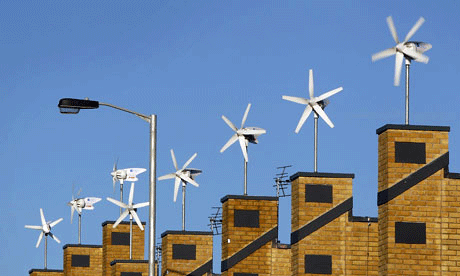 Small-scale wind power facilities could be used in developing countries and in remote areas. In developed countries, small-scale wind power turbines are also gaining in significance with consumers because the electricity generated with them costs less than that offered by many energy providers. Experts see a long-term growth potential in small wind technology.
More than half the wind turbines in Germany are run by private 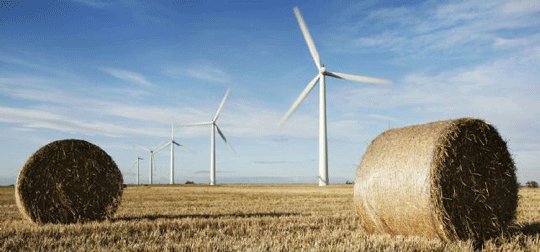 citizens, farmers and local communities.
Wind energy blowing away nuclear power, by Gero Rueter http://www.dw.de/dw/article/0,,15903703,00.html 23 April 12, Wind energy supplies 3 percent of global electricity needs and will soon supply more electricity than nuclear power. In 2011, some 50 billion euros were invested in wind, leading some to say it’s cheap and creates jobs.
Wind energy is booming and it is gaining in significance worldwide. It supplies some 20 percent of electricity in Spain and Denmark as well as about 10 percent in Germany. By 2020, the share of wind energy will have risen to between 20 percent and 25 percent in Germany, according to estimates.
Last year, new wind power plants with a total capacity of some 40 gigawatts (GW) were installed worldwide, according to the World Wind Energy Association (WWEA). This puts wind energy’s global capacity at 237 GW by the end of 2011- the equivalent of what some 280 nuclear power plants generate. Currently, there are some 380 nuclear power
plants producing electricity worldwide.
Four times more wind power by 2020
The harvested wind makes a generator turn inside
Wind energy has expanded at a remarkable speed worldwide, WWEA said.
There has been an annual 20 percent increase in wind turbine
installations. The WWEA said it expects a four-time increase in wind
power capacity by 2020, bringing performance up to more than 1,000 GW.
China is pushing expansion of wind power like no other country in the
world. In 2011, nearly half of all wind turbines produced were set up
in China. Despite covering 3 percent of all energy used in China, the
country is still the world leader in use of wind energy. In per capita
terms, European nations, including Denmark, Spain and Germany, lead in
wind energy use.
Cheapest source of energy
Wind power is environmentally and climate friendly, but the real
reason for its boom lies in the price. Electricity generated from wind
energy is often the cheapest form available.
Stefan Gsänger, CEO of World Wind Energy Association, said the price
for one kilowatt hour of electricity from onshore wind turbines to be
between 5 euro cents and 9 euro cents. That’s the reason, he told DW,
“that wind energy has become one of the most popular sources of
energy.”
Stefan Gsänger (WWEA)
In comparison, electricity generated in new coal power stations costs
some 7 euro cents in Europe. But the real price for electricity from
coal is far higher, according to the EU and the German Ministry for
the Environment. They said that factoring in soot from coal power
stations causes high costs in the health sector that should be
included in calculating the price of energy. Their figures showed that
electricity from other new fossil power plants and new nuclear
reactors also costs more than onshore wind power when secondary costs
are factored in.
Legal conditions are vital
Wind power may already be one of the cheapest sources of energy, but
Gsänger said it still needs political support – not by fixing costs
but by guaranteeing feed-in tariffs. The price paid to producers has
to be fixed by law in order for banks to give out loans.
Gsänger added that Turkey was a good example because “the feed-in
tariff is lower than the market price. And still the feed-in tariff is
necessary in order for banks to finance wind turbines. That would also
be an option for other countries.”
Setting up offshore wind farms is a logistics challenge
Custom-made facilities
Wind energy technology has been advanced further over the last few
years. In areas with less wind energy potential, taller turbines and
turbines with larger blades are used to harness the wind more
efficiently. Meanwhile, gigantic offshore power plants are also being
built. Off-shore installation and maintenance are particularly
difficult, which means prices for electricity are consequently twice
as high as onshore, at between 18 euro cents and 20 euro cents per
kilowatt hour (kWh).
Small wind turbines will gain in significance, say experts
Small wind power plants for houses, small villages or industrial
complexes are also on the rise. More than half a million such plants
have been installed, with most of them in China and the United States.
Small-scale wind power facilities could be used in developing
countries and in remote areas. In developed countries, small-scale
wind power turbines are also gaining in significance with consumers
because the electricity generated with them costs less than that
offered by many energy providers. Experts see a long-term growth
potential in small wind technology.
Citizen participation raises acceptance
More than half the wind turbines in Germany are run by private
citizens, farmers and local communities. This is important for wind
power’s overall acceptance and success, according to Hermann Albers,
president of Germany’s federal association of wind energy. Over the
last 20 years, he has set up several citizen wind farms in the region
where he lives, together with other farmers and citizens.
“There is a high degree of acceptance with the communities,” he told
DW. “In many cases, half the population wants to invest in wind power
there. The people have understood that it represents a big
opportunity.”
Global development with wind energy
Deutsche Welle visited wind power engineers in China, and Indian
villagers who live near a wind farm, DW also paid a visit to Africa’s
biggest wind farm in Morocco and spoke to Hermann Albers, whose
citizen wind farms are a successful concept in Germany.
No comments yet.
1 This month

of the week – Australians for War Powers Reform (AWPR)
To see nuclear-related stories in greater depth and intensity
 Antinuclear
Leave a comment