Navajo tribes going into the solar energy business, with USA government support
 “There’s a strong desire in Indian Country to step out of the role of just a landlord that is collecting rents to being involved in the equity ownership,” MacCourt said.Erny Zah, spokesman for Navajo
The 30-megawatt solar photovoltaic plant planned for the outlying Navajo community of To’Hajiilee would cover more than 200 acres.
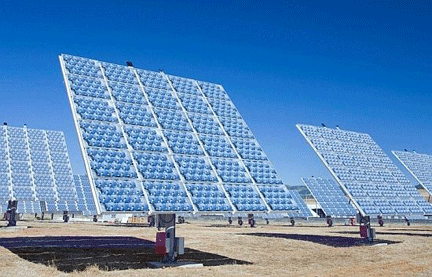
 Navajo community banks on proposed solar array, Bloomberg, By SUSAN MONTOYA BRYAN, 26 April 12, TO’HAJIILEE, N.M. This flat, dusty stretch of prairie in central New Mexico is where the leaders of a remote, sparsely populated American Indian community envision a sea of solar panels capable of producing enough electricity for more than 10,000 homes miles away from the reservation.
The To’Hajiilee solar project is one of 19 energy projects that will share in $6.5 million recently awarded by the U.S. Department of Energy to spur renewable energy development on tribal lands. About
two-thirds of the money is earmarked for tribes in the West, and most of that will be going toward getting projects in New Mexico andArizona off the ground…… At stake is a wealth of untapped potential.
With tens of millions of acres held in trust for tribes, experts say
Indian Country has the potential to supply more than four times the
nation’s electricity needs with solar. Wind resources blowing across
tribal lands could meet another 14 percent of the need.
“Just huge, absolutely huge” is how Michael Utter, chief executive of
the nonprofit consulting corporation Rural Community Innovations,
describes the potential.
Utter and Oregon attorney Doug MacCourt are among the technical,
financial and legal experts helping tribal communities such as
To’Hajiilee become engaged with energy generation and transmission.
Renewable energy development offers some of the same glimmers of
economic salvation and self-determination as the casino boom did
earlier for some tribes. However, the experts say it’s much harder for
sovereign tribes to break into the energy market because of capital
limitations, government regulations and investor perceptions.
“One of the real challenges is how to you get the outside world to
understand these are players just like anybody else in the business,”
MacCourt said. “They’re bringing some very valuable assets to bear,
especially in the western U.S. where most states have statutory
mandates they have to meet for renewable portfolio standards.”
The assets are clear at To’Hajiilee — a wide open, sunbaked expanse
that sits right under buzzing power lines that lead to New Mexico’s
largest metropolitan area…..
In North Dakota, the Standing Rock Sioux Tribe will be embarking on a
feasibility study to support the development of at least 50 megawatts
of wind power. In Arizona, the San Carlos Apaches, Gila River Indians
and Pascua Yaqui Tribe are looking to solar.
A massive wind project is planned by the Penobscot Indian Nation in
Maine, and biomass-fueled power plants are being considered by tribes
in Montana and Minnesota.
The resources might be different, but the thread connecting the
projects involves an effort to craft leases and other agreements with
developers to ensure Native Americans can reap more benefits than
those provided by past coal and uranium deals.
“There’s a strong desire in Indian Country to step out of the role of just a landlord that is collecting rents to being involved in the equity ownership,” MacCourt said.Erny Zah, spokesman for Navajo
President Ben Shelly, said tribal officials are working to revamp an
energy policy that dates back to the 1980s.
“Three decades later, energy production has changed immensely and so
has our view of energy,” Zah said. “We’re looking now to become actual
partners and producers rather than being dependent upon outside
companies giving us lease fees and royalty fees. We’re looking to be a
player rather than being a dependent.”
The 30-megawatt solar photovoltaic plant planned for the outlying
Navajo community of To’Hajiilee would cover more than 200 acres.
Financing options include tax incentives, loan guarantees and bonds
that could be used by utilities to pay for the power for the next 20
years. To’Hajiilee is working with an investment bank to finalize a
financing model……
http://www.businessweek.com/ap/2012-04/D9UCRUB00.htm
No comments yet.
1 This month

of the week – Australians for War Powers Reform (AWPR)
To see nuclear-related stories in greater depth and intensity
 Antinuclear
Leave a comment