Doctors slam uranium miner Toro Energy for promoting junk science on radiation safety:
 We call on Toro Energy to stop promoting fringe scientific views to uranium industry workers and to the public at large.
The Medical Association for Prevention of War has released a statement signed by 45 medical doctors calling on uranium mining company Toro Energy to stop promoting the view that low-level radiation is beneficial to human health. Toro Energy, which plans to mine uranium at Wiluna in WA and has interests in uranium exploration ventures in the NT and SA, has sponsored speaking tours by controversial Canadian scientist Doug Boreham. The joint statement notes that recent research has heightened rather than reduced concern about the adverse health impacts of low-level radiation.
TORO ENERGY PROMOTES RADIATION JUNK SCIENCE , Statement by 45 doctors – (signatures at end ) 1 May 2012
Toro Energy is an Australian company involved in uranium exploration in Western Australia, the Northern Territory, South Australia and in Namibia, Africa. The company’s most advanced project is the proposed Wiluna uranium mine in the WA Goldfields.
Toro Energy has consistently promoted the fringe scientific view that exposure to low-level radiation is harmless. Toro Energy has sponsored at least three speaking visits to Australia by Canadian scientist Dr Doug Boreham, who argues that low-level radiation is actually beneficial to human health.
Those views are at odds with mainstream scientific evidence and expert assessment. For example: Continue reading
Fukushima cancer risk underestimated, especially for young girls
 Nuclear Expert: Fukushima risk underestimated ENE News, — 5% of young girls will get cancer living in 20 milliSv/y for 5 years — “Actually worse than that” — Hot particles NOT included & only counts cancers, not other effects : Cancer Risk To Young Children Near Fukushima Daiichi Underestimated Source: Fairewinds Associates, Inc Author: Arnie Gundersen Transcript Excerpts That gets me to the issue of BIER, Biological Effects of Ionizing Radiation. […]
Now in Japan, the Japanese government is allowing people to go back into these radiation zones, when the radiation exposure is 2 rem. What that means is that they are willing to say that your chances of getting cancer are 1 in 500 if you go back into these areas that are presently off limits, and the exposure levels are 2 rem or 20 milisieverts in a year.
But it is worse than that. The number that we are using in the BIER Report is for the entire population, old people and young. And old people are going to die of something else before a cancer gets to them, whereas young people have rapidly dividing cells and they live a longer time, so they are more likely to get cancer. So if you go into the BIER Report and you look at Table 12-D, you will see that young women have a 5 times that number chance of getting cancer than the population as a whole. So young girls in the Fukushima Prefecture are going to get 5 times the exposure they would get from 2 rem. That means that about one in 100 young girls is going to get cancer as a result of the exposure in Fukushima Prefecture. And that is for every year they are in that radiation zone [at 20 milliSv/y]. If you are in there for 5 years, it is 5 out of 100 young girls will get cancer.
Now the BIER Report only addresses cancer, and of course, there are other effects of radiation that are not included in BIER, so it is actually worse than that.
Two more items: The first is that the BIER Report does not address hot particles. Now we have been over that extensively on the site, and you will see that imbibing it (a kid gets radioactive cesium on their hands and they swallow it, or breathing it in), is not included in the BIER Report.
And the last piece brings us over to Ian Goddard’s video, and that is this assumption by the Japanese and International Atomic Energy Agency, that at some point, this radiation is really so hard to measure that it does not count anymore. Well, the data indicates that just the opposite is happening…… http://enenews.com/gundersen-fukushima-cancer-risk-underestimated-5-of-young-girls-will-get-cancer-living-in-20-millisvy-for-5-years-actually-worse-than-that-hot-particles-not-included-only-counts-cance
Fukushima cancer effects on children, greater for girls
 VIDEO http://vimeo.com/35212151 Cancer Risk To Young Children Near Fukushima Daiichi Underestimated Fairewinds analyzes cancer rates for young children near Fukushima using the National Academy of Science’s BEIR (Biological Effects of Ionizing Radiation) VII Report. Based on BEIR VII, Fairewinds determines that at least one in every 100 young girls will develop cancer for every year they are exposed to 20 millisieverts [millisievert (1 mSv = 0.001 Sv)] of radiation.
The 20-millisievert/ year figure is what the Japanese government is currently calculating as the legal limit of radiological exposure to allow habitation of contaminated areas near the Fukushima Daiichi nuclear power plant.
In this video, Fairewinds introduces additional analysis by Ian Goddard showing that the BEIR VII report underestimates the true cancer rates to young children living near Fukushima Daiichi. Looking at the scientific data presented by Mr. Goddard, Fairewinds has determined that at least one out of every 20 young girls (5%) living in an area where the radiological exposure is 20 millisieverts for five years will develop cancer in their lifetime.
Quack science, anti science, about ionising radiation from Toro Energy’s Dr Doug Boreham
 Doctors take Toro Energy to school on the dangers of radiation , May 1st, 2012 The Australian Greens welcomed today’s call from the Medical Association for Prevention of War for uranium miners Toro Energy to stop promoting the view that low-level radiation is beneficial to human health.
The Greens nuclear policy spokesperson, WA Senator Scott Ludlam, said Toro’s plans to mine uranium at Wiluna, Western Australia, should be abandoned.
“Toro Energy has sponsored a number of speaking tours by Dr Doug Boreham, who promoted radiation as ‘anti-carcinogenic’ at the Paydirt uranium conference in Adelaide. Continue reading
ANSTO radioactive waste application more responsible option then remote dump plan
 1 May 12, The Beyond Nuclear Initiative (BNI) has cautiously welcomed news today that the Australian Nuclear Science and Technology Organisation (ANSTO) will apply to build an interim storage facility at Lucas Heights for radioactive waste due to return from overseas reprocessing.
BNI coordinator Natalie Wasley says the application shows Minister Martin Ferguson’s current push for a remote dump on the Muckaty Land Trust in the NT is losing ground and that interim storage at Lucas Heights is a better option while a comprehensive and long-term management plan is considered. Continue reading
Australia obliged to take back Lucas Heights nuclear waste – it will go to Lucas Heights
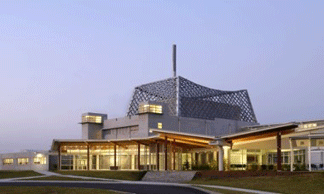 The Australian Greens want to close the Lucas Heights reactor and ban the import and export of nuclear waste …...
Nuclear waste will be stored in Sydney at Lucas Heights BY: IMRE SALUSINSZKY, NSW POLITICAL REPORTER The Australian May 01, 2012 NUCLEAR waste due to boomerang back to Australia in 2015 will be stored in metropolitan Sydney, after decades of political dithering over a national radioactive waste repository in the outback.
The Australian Nuclear Science and Technology Organisation will today launch its application for a licence to build an 800 sq m interim warehouse on the premises of the research reactor at Lucas Heights, which has generated the waste during the 50 years of its operation. Continue reading
Moount Isa Mayor McGrady, on the board of 2 uranium companies – wants Mt Isa to be a “uranium hub”
New Mount Isa Mayor on uranium push,ABC News By Chrissy Arthur May 01, 2012 Mount Isa Mayor Tony McGrady has says he will be talking to the Queensland Government “at every opportunity” about developing a uranium industry in the state’s north-west..
…. The Local Government Association of Queensland (LGAQ) says there is nothing legally wrong with Mr McGrady keeping his role with two uranium companies.
Mayday! Kakadu uranium miner expanding by stealth

 Australian Conservation Foundation 1 May 12 National and Territory environment groups have called on the federal government to stop Energy Resources of Australia from expanding the troubled Ranger uranium mine
in Kakadu under the guise of exploration.
ERA is scheduled to start work today on a mine decline (a one way tunnel) at its Ranger 3 Deeps (R3D) site as part of a move from open cut to underground mining. The company has federal exploration approval for R3D, not approval for mining.
“The company only has exploration approval, yet it is digging a hole big enough to literally drive a truck into,” said Australian Conservation Foundation nuclear campaigner Dave Sweeney.
“The federal government should not allow ERA to expand by stealth, constructing massive mining infrastructure under the guise of exploration activity. There needs to be an urgent and dedicated federal review of the impacts and implications of this plan.”
Ranger has been the scene of more than 150 documented incidents and breaches. Production at the mine remains plagued by water management issues. Continue reading
Multi $billion company BHP and Australian Government out to punish Aboriginal elder who dared to oppose uranium mine
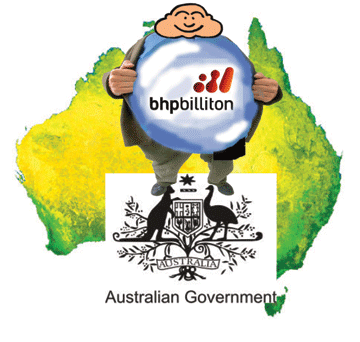 DEMOCRACY AT A PRICE: DECISION BY BHP BILLITON AND FEDERAL GOVERNMENT TO SEEK COSTS FROM ARABUNNA ELDER PUNITIVE AND VINDICTIVE, 1st May 2012 The Australian Nuclear Free Alliance (ANFA) is deeply concerned by the decision of BHP Billiton and the Federal Government to seek costs from Arabunna elder uncle Kevin Buzzacott arising from his challenge of the Federal approval of the Olympic Dam expansion.
“ANFA members fully support Uncle Kevin and admire his stand for country. We know that history will be the fairest judge of this struggle. BHP and the minister who approved the expansion of Olympic Dam will be forever linked to the toxic legacy of this mine, for thousands of years to come,” said Larrakia woman Donna Jackson, co-chair of ANFA.
“The court decided that Kevin Buzzacott had standing to pursue this challenge, as is his right under both the Environment Protection and Biodiversity Act and the Administrative Decisions (Judicial Review) Act,” said ANFA Committe member Nectaria Calan. “Where does this leave the right to judicial review of such projects if those who seek such a review are then punished with costs?”
Dean Della Vale, president of BHP’s Uranium Customer Sector Group which is responsible for the Olympic Dam project, is a founding member of the Australian Uranium Associations Indigenous Dialogue Group, established to facilitate dialogue with traditional owners.
“BHP pursuing costs undermines any claims by the Indigenous Dialogue Group that they are seeking to engage with aboriginal communities in good faith. Aboriginal communities do not have the right to say no to mining on their land, and here we have an elder using one of the few legal options available to them to ensure that at least the impacts of the project were properly considered, and they may be facing a massive bill for doing so,” said Ms Calan.
“The message BHP are sending is that there are repercussions for taking on the mining giant. Last financial year the company recorded a total net profit of US$23. 95 billion – they certainly don’t need the money,” Ms Calan concluded.
Solar energy is still a good financial move for New South Wales homes and small business
 Go solar to cut costs http://www.forbesadvocate.com.au/news/local/news/general/go-solar-to-cut-costs/2539388.aspx MICHAEL BUSHELL 30 Apr, 2012 Forbes residents and business owners looking to cut their electricity costs should still consider solar power, according to Forbes electrical business, Shead and Nicholson.
Shead and Nicholson says while the NSW Government ended the generous Solar Bonus Scheme last year, home and business owners can still take advantage of rebates to offset the cost of solar power installation. Continue reading
Australia’s “intervention” laws promote the grab of Aboriginal land for mining
 Racism the issue, not youth Green Left , April 29, 2012 By Robert Leech & Jacob Ball “….. The government threatens to withhold essential services, housing and health care if Aboriginal communities don’t agree to 40-year leases of their land. The uncertainty and community unrest this causes is set to continue as the government plans to entrench intervention laws for another 10 years.
But billionaire mine owners profit from Aboriginal hardship as more and more new mining exploration and extraction projects are launched across the country on top of existing contracts and projects……
Resistance believes self-determination and a treaty signed by the government to put an end to the theft of resources on Aboriginal land are essential first steps to end the systemic racial discrimination Aboriginal people suffer. To fight racism, we need unity. Full justice must be fought for together with all Australians. http://www.greenleft.org.au/node/50856
Get ready for a media barrage against renewable energy in Australia
 When asked about the $2 billion ‘fuel tax credit scheme’, for which miners are allowed to claim fuel costs as a tax write-off, 91 per cent thought it money that would be better spent on health and education. Nearly eight in 10 respondents wanted the handout scrapped entirely.
No doubt, we will hear further claims about the extraordinary wealth the mining boom is conferring onto Australian working families, and how taxpayer-funded support for investment in clean energy will cruel our economy for decades to come. Far better our tax dollars keep flowing back to the miners.
When that invariably happens we need to remember we’ve heard it all before. We’ll hear it all again. And after the dust settles, they’ll be here until there’s nothing left to dig up and sell.
You’re just jealous: mining and the politics of envy The Drum, Denise Boyd, 1 May 12“.……what is this sovereign risk our big miners are worrying themselves sick over? Basically, it’s another furphy. Our miners aren’t going anywhere. Only a month ago Australia was proclaimed by a 101-year-old mining consultancy to be the best place in the world to be a miner.
The thing is, the vast majority of Australians are not seeing ‘the benefits of the boom’. What they are seeing is an industry with a vested interest in blocking, delaying and holding up efforts to improve our environment, using ever more spurious arguments as to why it deserves special treatment. Continue reading
International Clean Energy Ministerial meeting: but did Australia take part?
 This is about the move for renewable energy in India, and UK. BUT – did anyone know that Australia is a
  member of this forum? Did we have a representative there? Or was Martin Ferguson our Minster For Energy too busy promoting the coal and nuclear industries to attend it?
When the recession-hit coalition [UK] government tried to cut the subsidies – known as Feed In Tariffs – green energy producers and the environmental group Friends of the Earth took it to court. And won
 Montek’s message on clean energy, Hindustan Times, 1 May 12 The Planning Commission Deputy Chairman was in London last week for the Clean Energy Ministerial meeting – leading the Indian delegation in the absence of Dr Farooq Abdullah, the Minister for New and Renewable Energy. It was an important conference to attend, as India is a major partner in this 23-nation initiative. The CEM is a forum of 23 governments: Australia, Brazil, Canada, China, Denmark, the European Commission, Finland, France, Germany, India, Indonesia, Italy, Japan, South Korea, Mexico, Norway, Russia, South Africa, Spain, Sweden, the United Arab Emirates, the United Kingdom, and the United States.
So that’s pretty much most of the G-20, plus a few green worthies such as Sweden and Denmark. India’s importance is underscored by the fact that the summit in 2014 will be held in India. And that’s not a day too soon in a country that Montek Singh Ahluwalia estimates is on course to notching up a long-term economic growth rate of 8 to 9%. With a billion plus population, the environmental implications of India’s energy consumption are enormous…….
the two major clean energy sources India is looking at are solar and wind. There’s good news on both fronts: recent assessments of available resources in India are that they are much larger than previously estimated. And costs are coming down. Continue reading
1 This month
7 April – WEBINAR – Australia and the Doomsday Clock – Preventing nuclear war through NoFirstUse and other policies
Online | Tuesday April 7, 4:00-5:30pm, Australian Eastern Time / 8:00-9:30am Central Europe Time
– Access the registration link
15 April – Zoom –Nuclear Power is Not the Solution
Apr 15, 2026 01:00 AM in Canberra, Melbourne, Sydney

Join the International Physicians for the Prevention of Nuclear War (IPPNW) on Tuesday, April 14th for a timely webinar exploring the risks associated with nuclear power and challenging the myth that it offers a simple, safe, carbon-free solution to the climate crisis

21 April Webinar: No Nuclear Weapons in Australia
Start: 2026-04-21 18:00:00 UTC Canberra, Melbourne, Sydney (GMT+10:00)
End: 2026-04-21 19:30:00 UTC Canberra, Melbourne, Sydney (GMT+10:00)
Event Type: Virtual
A virtual link will be communicated before the event.
Host Contact Info: australia@icanw.org

of the week – Australians for War Powers Reform (AWPR)
To see nuclear-related stories in greater depth and intensity
 Antinuclear