Australia’s State governments fervently slashing renewable energy
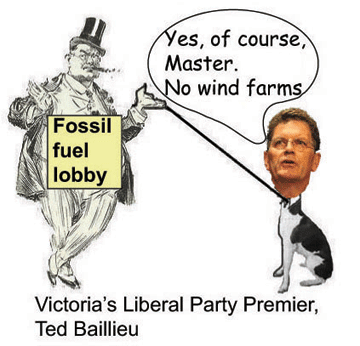 Not so fast to the green scheme graveyard Crikey, by Fergus Green, climate change lawyer and policy analyst, 2 May 12, Federalism of the co-operative and unco-operative variety is back in the news. As the July 1 start date for the federal government’s carbon pricing scheme looms, the uppity conservative state premiers’ league is out in force, crying foul about the “tax” and fervently slashing “redundant” and “costly” state-based climate change schemes. Meanwhile, federal programs such as the Renewable Energy Target are under the microscope, with the Coalition and big business calling for an end to this kind of “green tape”
Victoria’s Baillieu government recently accepted the recommendation 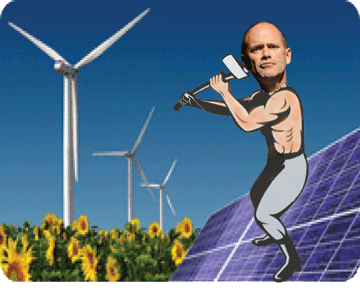 of a review of the Victorian Climate Change Act to scrap the state’s 20% emissions reduction target by 2020 — the latest in a long line of anti-environment, pro-fossil fuels policy developments during its first 16 months in office. Queensland’s newly elected Newman government has opted for a more expeditious approach, axing just about every Queensland government program with a tinge of green — from the $430 million Queensland Climate Change Fund (which provides $30 million a year for climate change initiatives) to the $50 million Smart Energy Savings Program (which helps businesses improve energy efficiency).
Amid this carnage, it is worth considering just what is the appropriate role of complementary state and federal policies in tackling climate change in the context of the new carbon price……
The federal cap only covers a limited number of emissions-producing sectors – notably energy generation, industrial processes, landfill waste and fugitive emissions (for example, methane released from coalmines). Sectors not covered by the scheme include agriculture, forestry and (via changes to the fuel tax and rebate regimes) parts of transport.* Any state or federal government policies that reduce emissions in these sectors will result in abatement beyond that brought about by the federal cap. As the PC points out in its Garnaut Review submission, policies to target these sectors make sense to the extent that they would reduce the costs of achieving an overall national emissions reduction target.
Emissions embodied in the fossil fuels we export, which far exceed our domestic emissions, are not subject to the carbon price either. This gives states (which largely control mining policy) a critical role in influencing global greenhouse gas emissions. http://www.crikey.com.au/2012/05/01/not-so-fast-to-the-green-scheme-graveyard/
No comments yet.
1 This month
7 April – WEBINAR – Australia and the Doomsday Clock – Preventing nuclear war through NoFirstUse and other policies
Online | Tuesday April 7, 4:00-5:30pm, Australian Eastern Time / 8:00-9:30am Central Europe Time
– Access the registration link
15 April – Zoom –Nuclear Power is Not the Solution
Apr 15, 2026 01:00 AM in Canberra, Melbourne, Sydney

Join the International Physicians for the Prevention of Nuclear War (IPPNW) on Tuesday, April 14th for a timely webinar exploring the risks associated with nuclear power and challenging the myth that it offers a simple, safe, carbon-free solution to the climate crisis

21 April Webinar: No Nuclear Weapons in Australia
Start: 2026-04-21 18:00:00 UTC Canberra, Melbourne, Sydney (GMT+10:00)
End: 2026-04-21 19:30:00 UTC Canberra, Melbourne, Sydney (GMT+10:00)
Event Type: Virtual
A virtual link will be communicated before the event.
Host Contact Info: australia@icanw.org

of the week – Australians for War Powers Reform (AWPR)
To see nuclear-related stories in greater depth and intensity
 Antinuclear
Leave a comment