Time to end the silence on Australia’s nuclear reactor and its radioactive wastes
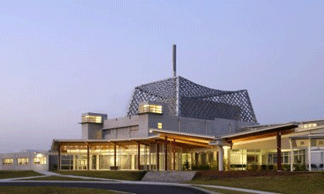 A public inquiry into Australia’s radioactive waste management options would be the long overdue circuit breaker to help restore some sound science, procedural integrity and community confidence
We need to talk about Lucas Heights DAVE SWEENEYABC 3 MAY 2012 If only politicians would face up to the problem of nuclear waste, we might go some way towards solving it. ABC News Online 1 MAY 2012 SUCCESSIVE FEDERAL governments have attempted to manage Australia’s radioactive waste by keeping the issue as low on the political radar and as far from the public eye as possible.
This approach has meant that instead of developing a credible process to identify the range of best management options they have been obsessed with a finding a vulnerable and politically powerless postcode to host the nation’s radioactive waste.
We now have the reality of radioactive waste from spent nuclear fuel from the Australian Nuclear Science and Technology Organisations nuclear reactor at Lucas Heights in southern Sydney set to make the long trip back from European reprocessing plants in the coming years. Continue reading
Should pregnant women and young children be moved away from nuclear facilities?
 the new evidence of an association between increased cancers and proximity to nuclear facilities raises difficult questions. Should pregnant women and young children be advised to move away from them? Should local residents eat vegetables from their gardens? And, crucially, shouldn’t those governments around the world who are planning to build more reactors think again?
Studies in the 1980s revealed increased incidences of childhood leukaemia near nuclear installations at Windscale (now Sellafield), Burghfield and Dounreay in the UK. Later studies near German nuclear facilities found a similar effect. The official response was that the radiation doses from the nearby plants were too low to explain the increased leukaemia. The Committee on Medical Aspects of Radiation in the Environment, which is responsible for advising the UK government, finally concluded that the explanation remained unknown but was not likely to be radiation.
There the issue rested, until a recent flurry of epidemiological studies appeared. Last year, researchers at the Medical University of South Carolina in Charleston carried out a meta-analysis of 17 research papers covering 136 nuclear sites in the UK, Canada, France, the US, Germany, Japan and Spain. The incidence of leukaemia in children under 9 living close to the sites showed an increase of 14 to 21 per cent, while death rates from the disease were raised by 5 to 24 per cent, depending on their proximity to the nuclear facilities (European Journal of Cancer Care, vol 16, p 355).
This was followed by a German study which found 14 cases of leukaemia compared to an expected four cases between 1990 and 2005 in children living within 5 kilometres of the Krummel nuclear plant near Hamburg, making it the largest leukaemia cluster near a nuclear power plant anywhere in the world (Environmental Health Perspectives, vol 115, p 941).
This was upstaged by the yet more surprising KiKK studies (a German acronym for Childhood Cancer in the Vicinity of Nuclear Power Plants), Continue reading
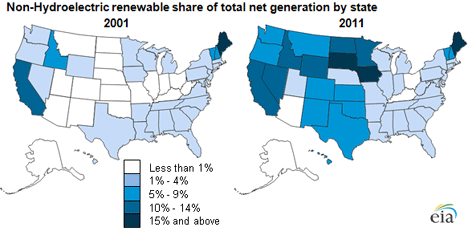
Bega, New South Wales, getting very Smart about Solar Energy
 the stored energy can also be fed back into the network at peak demand times – say, at night when people come home and cook dinner, watch television or play computer games, or use their hot water systems for things like showers and washing up
The battery banks can also be configured to be charged from the network, creating a micro-grid
Bega library’s bright future Eden Magnet, BY BEN SMYTH 03 May, 2012 The roof of the Bega library is sporting a new look this week. On Friday, a network of solar panels was installed as part of a project that will see considerable savings for the Bega Valley Shire Council and, in turn, ratepayers.
In a first for regional NSW, Essential Energy is constructing an “intelligent” solar energy system, which will showcase the benefits of community-based renewable energy solutions and effectively make the library self-sufficient in regards to its electricity consumption. According to Essential’s regional general manager south eastern, Phillip Green, who was on hand to launch the project with Member for Bega Andrew Constance, the library’s system is the third phase of the energy company’s “Intelligent Network”. Continue reading
Greenpeace activist paraglides into French nuclear plant
http://www.reuters.com/article/2012/05/02/france-nuclear-greenpeace-idUSL5E8G2F0C20120502
* Greenpeace enters nuclear site, drops smoke flare
* Intrusion just days before presidential runoff
* France’s high use of nuclear is issue in campaign
* Man entered Civaux plant’s security zone (Adds separate intrusion, details)
PARIS, May 2 (Reuters) – A Greenpeace activist dropped a smoke flare as he flew over a French nuclear reactor on a paraglider on Wednesday, seeking to draw attention to what green activists call gaps in nuclear security four days before a presidential election runoff. The plant’s owner, EDF, confirmed an engine-powered paraglider had landed within its Bugey nuclear site in southeastern France. [ note – there’s a brief video of this flight at : http://usnews.msnbc.msn.com/_news/2012/05/02/11504375-greenpeace-bombs-french-nuclear-reactor-could-it-happen-in-us?lite ]
The pilot flew over the plant and threw a red-smoke flare on the roof of a building before landing, television images showed. Continue reading
Now they’re trying to blame the Australian govt for doubts about Olympic Dam’s future
 You have to sorta scour the news, to realise that the BHP board has not yet decided to go ahead with the new monster Olympic Dam uranium mine. The decision delay is due to the massive cost of the massive project – which won’t make any money for decades.
However – let’s all pounce on the Australian government’s budget plans as the cause of the delay. (Let’s just forget that the project benefits from all sorts og government exemptions, including the new Mining Resources Tax)
Diesel rebate may delay Olympic Dam Sun Herald, by: By Christopher Russell AdelaideNow May 03, 2012 BHP Billiton could be forced to delay expansion of the Olympic Dam mine if the Federal Government scraps its diesel fuel rebate in next week’s Budget, investment analysts say.
The company hinted at an investors’ conference in Sydney yesterday that another major project, at Port Hedland in WA, would be funded before Olympic Dam. Analysts at the conference said a fuel tax change could make the
difference and cause a delay to Olympic Dam….. http://www.heraldsun.com.au/business/diesel-rebate-may-delay-olympic-dam/story-fn7j19iv-1226345385388
Still gloomy news for uranium investors – even China not the great hope
 Finance 9 msn, 1 May 12 “……..In today’s post-Fukushima world speculators are looking a bit twice bitten and three times shy (twice being the bursting of the bubble and then the tsunami). Commodity funds appear less interested in including uranium in their baskets, and China appears about the only source of global growth in longer term uranium demand for the time being. ..
.. Last week in the spot market, only three transactions occurred totalling less than a mere 400,000lbs, TradeTech reports… Until speculators feel more confident in reentering the market, or perhaps Beijing decides to build some quick stockpiles on cheap spot prices, the sellers have no reason to be aggressive….”
Financial analysts recognise the risks of radioactive by-products of rare earths processing
Uranium and thorium present real risk to rare earths developers – Dennis Mineweb 2 May Interview with Carolyn Dennis of Dundee Capital Markets “….. TCMR: Some rare earth deposits include uranium and thorium byproducts and, if a company is not recovering those, it needs to dispose of them. Is that a challenge most REE miners face?
CD: It’s a real risk across the board for rare earth companies. Each deposit, depending on the type of mineralogy, will have varying grades of uranium and thorium. The jurisdiction the deposit is in and how it approaches dealing with the uranium, thorium and radioactivity will dictate how much of an issue it is for the project. It can be a problem in processing as well. In a lot of cases, the thorium should be removed from the concentrate earlier in the process in order to improve processing downstream. Beyond that, radioactive waste material needs to be disposed of….”
Australia’s Defence to get 12 new submarines – they will not be nuclear
Gillard announces submarine design cash Brisbane Times, May 3, 2012 – AAP The federal government has allocated $214 million to the design phase for 12 new submarines. Prime Minister Julia Gillard announced the budget commitment on Thursday.
“In our strategic environment we need strong maritime capabilities and that’s why we need a potent submarine force,” she told reporters in Canberra The 2009 Defence White Paper proposed 12 new advanced submarines to provide Australia with formidable defensive and offensive capabilities. They would replace the six existing Collins class vessels which are set to reach retirement around 2025.
The government previously has said that any new vessels would be built in South Australia and that they would not be nuclear powered…… http://news.brisbanetimes.com.au/breaking-news-national/gillard-announces-submarine-design-cash-20120503-1y07f.html
1 This month
7 April – WEBINAR – Australia and the Doomsday Clock – Preventing nuclear war through NoFirstUse and other policies
Online | Tuesday April 7, 4:00-5:30pm, Australian Eastern Time / 8:00-9:30am Central Europe Time
– Access the registration link
15 April – Zoom –Nuclear Power is Not the Solution
Apr 15, 2026 01:00 AM in Canberra, Melbourne, Sydney

Join the International Physicians for the Prevention of Nuclear War (IPPNW) on Tuesday, April 14th for a timely webinar exploring the risks associated with nuclear power and challenging the myth that it offers a simple, safe, carbon-free solution to the climate crisis

21 April Webinar: No Nuclear Weapons in Australia
Start: 2026-04-21 18:00:00 UTC Canberra, Melbourne, Sydney (GMT+10:00)
End: 2026-04-21 19:30:00 UTC Canberra, Melbourne, Sydney (GMT+10:00)
Event Type: Virtual
A virtual link will be communicated before the event.
Host Contact Info: australia@icanw.org

of the week – Australians for War Powers Reform (AWPR)
To see nuclear-related stories in greater depth and intensity
 Antinuclear