Draconian Aboriginal Intervention laws meeting with powerful community opposition
 From the bush to Bankstown, communities prepare to fight ‘Stronger Futures’ welfare laws Green Left, May 10, 2012 The Stop the Intervention Collective Sydney released the statement below on May 9.
Remote NT communities are joining with the south-western Sydney suburb of Bankstown in a pledge to challenge the implementation of ‘Stronger Futures’ legislation which is set to be debated in the Senate.
“Stronger Futures” will extend draconian NT intervention powers for a further 10 years. The laws also facilitate the national expansion of income management, pioneered under the NT intervention, beginning with Bankstown and four other “trial sites” across Australia.
“Stronger Futures” has faced fierce opposition from Aboriginal communities, churches and peak organisations. More than 36,000 people have signed the online “Stand for Freedom” campaign calling for withdrawal of the legislation.
In a historic statement from Arnhem Land last week, Yolŋu Elders pledged to refuse to negotiate any leases, including mining exploration leases, while the government pushed ahead with “Stronger Futures”.
In Bankstown, the Say No to Government Income Management Campaign Coalition, with strong roots in the community sector, Aboriginal and migrant communities, is organising a major seminar on May 26 to discuss strategies for stopping the implementation of income management…… Paddy Gibson from the Stop the Intervention Collective Sydney has just returned from a research trip to the Northern Territory.
He said: “The NT intervention was designed to deny any control or opportunity to Aboriginal people in remote communities and force a migration into town and larger settlements. Every time I visit these communities the situation has deteriorated further. People are completely disenfranchised, there is next to no employment and in places even basic amenities like sewage are collapsing.
“Scratch the surface of the government’s ‘Stronger Futures’ budget announcements for the NT and you find even less funding for homeland services than the current levels which keep people living in third world conditions.
“The decision not to fund a waged employment program to replace CDEP, once 7500 strong in the NT, is a death sentence for many communities. Meanwhile funding for bureaucracies to punish and control Aboriginal people through the income management and prison systems are spiraling out of control.”…. http://www.greenleft.org.au/node/50971
Australian Senate continues debate on Stronger futures laws
 Senate debates NT intervention Herald Sun May 10, 2012 Debate on the Government’s Stronger Futures laws resumed in the Senate yesterday….. The draft laws have attracted widespread opposition from Aboriginal communities in the NT who claim the measures are racist and they weren’t consulted properly.
Last week, a group of traditional owners, the Yolngu Nations Assembly which represents 8000 people in west, central and east Arnhem Land, threatened to revolt against the legislation.
They could refuse to participate in land-lease negotiations with the federal government and decline approval for any exploration licences.
The Australian Greens have signalled they will oppose the bills. “We have seen significant waste on ineffective measures, when far better outcomes could have been delivered through direct investment in communities and organisations on the ground,” Senator Rachel Siewert said.
Debate on Stronger Futures in the Northern Territory Bill 2012 and related bills has adjourned.
Anxiety about nuclear radiation is “irrational” says India’s Atomic Energy chief

Priority is to remove irrational fears about radiation: Ratan Kumar Sinha Interview with Chairman, Atomic Energy Commission Business Standard, Sanjay Jog / Mumbai May 10, 2012, Ratan Kumar Sinha, who was director of Bhabha Atomic Research Centre, took over as chairman of Atomic Energy Commission and secretary of Department of Atomic Energy (DAE) last week.
His appointment comes at a time when India’s nuclear sector is facing challenges. Sinha, in an interview with Sanjay Jog, speaks on a number of issues. Edited excerpts:
What are your priorities?
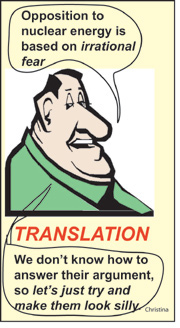
The first is to remove an irrational fear of radiation in the public mind….. We would educate the public and try to remove the unwarranted fear of radiation associated with nuclear plants.
Australian rare earths company Lynas held back by public opposition in Malaysia
the expanding protest movement …… has already delayed the project by eight months and cast a shadow over its future.
The resistance – fed by social networks and Malaysia’s increasingly lively independent online media – also raises broader questions over the global expansion of an industry that has created huge environmental problems in China
Opponents say the Lynas plant doesn’t meet with best practice standards for the industry as it is too close to heavily populated areas and in a place where the ground water level is high. Molycorp’s plant in California, by comparison, is situated far from residential areas in an arid climate.
Citizen backlash keeps Malaysia rare earth plant on hold, The West, Siva Sithraputhran, Reuters May 9, 2012 GEBENG, Malaysia – The expensive machinery lies silent, idling as Malaysia’s government weighs a delicate decision to allow shipments of raw material to arrive from Australia and finally start operations at the world’s largest rare earths plant outside China. Continue reading
Dr Helen Caldicott on global warming, nuclear reactors and nuclear weapons
 Tough Talk From Environmental Activist Dr. Helen Caldicott HUFFINGTON POST, Marianne Schnall , 05/09/2012 Dr. Helen Caldicott has passionately devoted the last 40 years to educating the global community about the inherent risks and dangers of nuclear energy and weapons and the critical changes needed to restore and help save our embattled Earth. The Australian-born medical doctor (a pediatrician) and former Nobel Peace Prize nominee is the author of five books and the founder of several organizations including Physicians for Social Responsibility , Women’s Action for New Directions (WAND) and The Helen Caldicott Foundation/NuclearFreePlanet.org . I recently had the opportunity to talk to the world renowned activist and environmental prophet at Green America’s Green Festival in New York City, where she delivered an urgent and electrifying speech. Dr. Caldicott, who has been outspoken about the health and environmental dangers of nuclear power since before the Three Mile Island and Chernobyl meltdowns, prays that we will take heed from the recent Fukushima nuclear disaster, which resulted in the Japanese government shutting down all 54 of Japan’s nuclear reactors, and spark a global trend to close nuclear power plants. Her frustration and anger at the lack of meaningful progress on this issue is palpable; as is her inspiring hope and belief in the collective power of individual citizens to raise their voices and create the political will to take action. What’s at stake, as she reminds us in this candid interview, is our moral and spiritual imperative to protect our children and our Mother Earth. As she bluntly puts it, ” The planet’s in the intensive care unit, critically, acutely ill, and now we are all physicians to a dying planet.” She urges, “Let the data sink in and then get off your couches to save the planet for your children.”
Marianne Schnall: What is the one message you are most hoping to get out there?
Helen Caldicott: There isn’t one message, there are three. One is that we are in dire danger from global warming ….. Number two: you close down your two Indian Point reactors, because if one of them blows, man – you’re all gone. Three: work with Obama to work with Russia to abolish 97% of the weapons on the planet, between Russia and America. You can do that. The Russians are ready. What’s holding it up is your generals, who are really pathological in the Pentagon and one of them said, ‘If you get rid of our nuclear weapons, man, that’s threatening the family jewels,’ and that says it all, in a nutshell, so to speak, and that’s a bad pun……. http://www.huffingtonpost.com/marianne-schnall/an-interview-with-environ_b_1500898.html
1 This month

of the week – Australians for War Powers Reform (AWPR)
To see nuclear-related stories in greater depth and intensity
 Antinuclear