Australian Council of Trade Unions (ACTU) joins opposition to Muckaty nuclear waste dump plan
 “Today the unions passed this motion in Sydney and next week the community is holding a protest in Tennant Creek to mark five years since Muckaty was nominated as the possible waste dump. It is time that the government listened to all the Traditional Owners because we are not going to stop until they stop”.
Trade union support strengthens NT nuclear waste dump campaign Muckaty Traditional Owners have welcomed news that Australia’s peak trade union body, the Australian Council of Trade Unions, has today committed to actively support the campaign against a proposed radioactive waste dump at Muckaty, 120km north of Tennant Creek in the Northern Territory.
The ACTU National Congress unanimously passed a motion (full text below) expressing ‘disappointment that the highly contested Muckaty Land Trust site will continue to be pursued’ and agreeing to stand ‘in solidarity with Traditional Owners and communities resisting federal government plans for a radioactive waste dump’.
The move comes as a further blow to plans by Federal Resources Minister Martin Ferguson to advance the highly contested waste dump site at Muckaty. Recent legislation, the National Radioactive Waste Management Act (NRWMA), names Muckaty as the only site to be further assessed for a national radioactive dump and allows the Minister to override any state or territory law that would hinder the dump being built, but the plan faces growing political, legal and community challenge. Continue reading
Despite government support, Olympic Dam expansion might not be economic for BHP
 BHP cuts spending on major projects, Adelaide Now, Julian Swallow And Cameron England May 16, 2012 BHP Billiton has backed away from a commitment to spend $80 billion on
  major projects over the next five years, including the
Olympic Dam mine expansion. The miner said yesterday it would make a decision on the $25 billion Olympic Dam expansion by the end of the year but made it clear that its key assets globally would be competing for funds.
BHP had previously announced an $80 billion fund, but chairman Jac Nasser said this figure had been reconsidered.
 “When (CEO Marius Kloppers) talked about that $80 billion … the environment was different,” Mr Nasser said….. BHP has already started spending $1.2 billion earmarked to kick-start the Olympic Dam expansion, which will eventually involve the company digging a 4km-long, 1km-deep, open-cut copper, gold and uranium mine in the state’s Far North. Continue reading
Kazakhstan’s nuclear radiation legacy continues
 Radioactive fallout from nuclear blasts have given Semey and neighboring villages abnormally high rates of cancer and birth defects.
Local oncology centers are screening tens of thousands of patients, trying to detect and treat tumors at early stages. People living in the area are still predisposed to breast and pulmonary cancer.
We are getting more and more disabled infants, each passing day their number increases. Environmental factors work slowly – we can see their effects in 10 or 20 years, in the first, second, third or fourth generation.”
 VIDEO Kazakhstan’s Nuclear Legacy Euro News, 14/04/10 http://www.euronews.com/2010/04/14/kazakhstan-s-nuclear-legacy/ At the elderly care home in Semipalatinsk, we met 85 year old Praskovya. Semipalatinsk, or Semey, is a city 150 kilometers from the main Soviet nuclear weapons test site.
Praskovya is a former warehouse manager who used to work in a small town bordering the restricted area in the 1950s. She witnessed one of the nuclear explosions: “We were curious, so we went outside to watch. When the explosion happened, it looked like a large bowl, with black smoke and flames coming from the bowl. Then it rolled into a ball, and
a smoke column went up, and at the top, the mushroom appeared. And then the soldiers came and made us leave the street, shouting “it’s not allowed, it’s not allowed”. But we already saw everything interesting. And then everyone got health problems. Continue reading
A crushing blow for uranium industry, if Japan manages without nuclear power
 There are certain predictions that seem fairly safe if Japan succeeds in weaning itself off nuclear power so quickly. The switch away from nuclear power should be a major boon to natural gas producers around the world.
Certainly the abandonment of nuclear power would be crushing to uranium miners like  Cameco; there would be demand for uranium to service existing plants, but the growth story would vanish.
Last and not least, abandoning nuclear power should be a major positive for renewable energy companies.
THE END OF NUCLEAR POWER: A BOON FOR INVESTORS? The Bull.com.au By Investopedia.com | 14.05.2012 Investors interested in the electrical utility sector and related industries, like mining and engineering, ought to pay a little extra attention to Japan over the next few months.
With the last operating nuclear plant in Japan going offline for maintenance, Japan will be
operating a nuclear power-free electricity grid this summer. Whether the country gets through the summer without incident or interruption, it seems safe to bet that advocates on either side of the nuclear power debate will be paying close attention…..
This summer will be the real test, as the warm muggy climate of much of Japan puts a strain on the power grid. Last year, the nation made it through by implementing usage limits and asking businesses to shift activity to off-peak hours (weekends and evenings) to reduce peak demand. If similar measures manage to succeed this summer, and residents are not subjected to blackouts or excessive limitations, it may be hard to muster the support to restart those nuclear plants. Activists in other countries could likely point to Japan as proof that nuclear power is not essential. Japan Today, Europe Next? Continue reading
Nationalising TEPCO shows how nuclear risks are socialised while profits remain private
Fukushima nuclear disaster: who profits and who pays? http://www.greenpeace.org/international/en/news/Blogs/makingwaves/fukushima-who-profits-who-pays/blog/40463/ by Jan Haverkamp – May 16, 2012 Last week, the inevitable finally happened. The company responsible for the Fukushima nuclear disaster, Tokyo Electric Power Company, or TEPCO, has been nationalised. Japan’s trade and industry minister Yukio Edano announced a de facto state take-over of the company with a further injection of $12.5bn, bringing the total of state capital in TEPCO to $33.2bn. Edano has said that: “Without the state funds, (TEPCO) cannot provide a stable supply of electricity and pay for compensation and decommissioning costs”.
The total direct costs of the Fukushima Daiichi catastrophe for TEPCO, including compensation and clean up, are estimated at over $100bn. Many Japanese, however, experience in their daily lives that the damages are considerably higher because most of their claims and losses go uncompensated and most of their suffering goes unrecognised. The nationalisation of TEPCO, together with a legal practice called “channelling of liability” in which all liability related to the Fukushima nuclear disaster has to be channelled to TEPCO, means Japanese taxpayers and ratepayers will foot most of the bill.
An infuriating aspect of this story is that in a recent presentation by General Electric (GE) about its “success” over the past 50 years, there was not a word about the Fukushima disaster and nothing approaching an apology. Yet the Fukushima disaster was affected by well-known problems related to GE’s Mark 1 design, which was used at all four troubled reactors. Furthermore, GE was involved in maintenance throughout the four decades of the plant’s operation and had 44 on site at the time of the accident. Continue reading
Adelaide schoolchidren becoming skilled in solar and wind technologies
 Students full of renewable energy Adelaide Now, Clare Peddie May 16, 2012 SCHOOL students are learning about renewable energy through Australia’s first mini wind turbine trial at West Beach. The State Government, with the West Beach Trust, is testing four different turbines for 12 months. The power output is compared to a 6kW solar system nearby, with all the data displayed online.
Yester- day the Royal Institution of Australia launched a Wind Technology Education Package, with funding from the West Beach branch of Bendigo Bank, to help students in Years 7-10 get in on the act. The package covers practical applications, optimal locations and uses of wind turbines. Students from West Beach Primary School and Henley High School were the first to use the package, conducting hands-on activities at the site of the mini wind turbine trial. Students built and tested a model wind turbine and learned what designs worked best….
http://www.adelaidenow.com.au/news/south-australia/students-full-of-renewable-energy/story-e6frea83-1226358260038
In reality, Western Australia’s Solar Feed In Tariff is an economic boon
 Western Australia’s Solar Feed In Tariff Ramifications Exaggerated http://www.energymatters.com.au/index.php?main_page=news_article&article_id=3211, 17 May 12, Professor Ray Wills of the Sustainable Energy Association of Australia (SEA) has challenged the notion that spending more on renewables is somehow a bad thing and brought the situation regarding Western Australia’s solar feed in tariff into perspective.
Professor Wills points out while the media circus has focused on the “blowout” in Western Australia’s scheme; there has been no analysis of the benefits. “Energy Minister Peter Collier rightly points out that 76,000 WA homes now have solar panels on their roofs as “a terrific outcome”,’ says Professor Wills, who says the uptake hasn’t been confined to the wealthy, but spurred on by average households in Western Australia now slashing their electricity bills.
“We are yet to calculate the savings that this program has bought – savings that will amount to fewer upgrades to poles and wires, has in the vast majority of cases delivered improved electricity quality and reliability, and will avoid the need for investment in new fossil-fuel based generation.” Continue reading
In India’s Parliament, a move to scrap nuclear energy programme
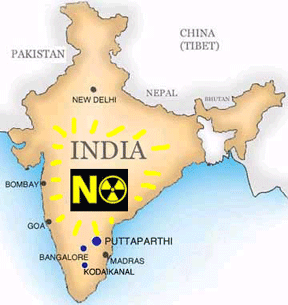 Scrap nuclear power programme, demands Lok Sabha MP Business Standard, Press Trust of India / New Delhi May 17, 2012, An Independent MP today demanded scrapping of the country’s nuclear power programme saying it would have adverse effect on farm production, environment and people.
“I demand that the government should stop the nuclear power programme because it can affect our farm productivity, environment and people,” Tarun Mandal said during Zero Hour. He pointed out that radiation can be spread through water used in the atomic power plants which can badly hit crops, environment and people of the country. Mandal suggested that the government should harness other sources of
energy like hydro-power to meet power demand….. http://www.business-standard.com/generalnews/news/scrap-nuclear-power-programme-demands-lok-sabha-mp/9901/
Uranium mining worries, as across Africa, workers become militant
Conflicts with unions and management may have even larger impacts in the future,
Uranium Miners in Africa Facing Labor Disputes, Business Insider, Resource Investing News | May 16, 2012, Uranium mining companies are operating in difficult environments in many jurisdictions, facing challenges ranging from regulatory compliance, environmental delays, rising costs, and labor relations. Over the last year, the labor challenges seem to have become more accentuated for African uranium mining companies, with several companies having reporting strikes. Continue reading
1 This month

of the week – Australians for War Powers Reform (AWPR)
To see nuclear-related stories in greater depth and intensity
 Antinuclear