Distributed energy – solar and wind, brings economic benefits
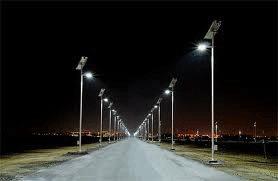 It’s possible to reduce today’s energy consumption for street and road lighting by as much as 60% with new technologies – LED, smart lighting, distributed wind energy and even lights out programs.
The distributed energy market refers to small-scale energy produced primarily for on-site energy consumption meaning street lights, roof tops and ledges anything that requires a direct power source. In 2011, the size of the distributed renewable energy market was estimated around $70 billion dollars globally. It’s expected to top $150 billion by 2015. Because distributed energy is generated at the source of where energy is needed, the inefficient transmission lines are eliminated, creating a more direct source of renewable energy, with the traditional grid being used as a supplemental energy source.
Urban wind solutions from newcomers are also on the rise.
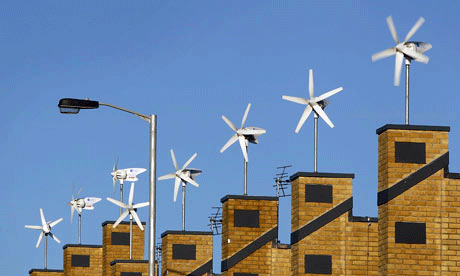
Small Wind Energy Goes Urban In Italy, Korea, Brazil And Texas
http://www.forbes.com/sites/jenniferhicks/2012/05/17/small-wind-energy-goes-urban-in-italy-korea-brazil-and-texas-yes-texas/?ss=innovation-science Streetlights usually operate at electricity rates like the ones we pay in our private homes. About one-third of a municipality’s electrical costs are for street lighting. So having that energy provided by some form of renewable energy, means that every cent is saved and for municipalities, whose budgets are being squeezed, that’s something serious to consider.
Take Trondheim, Germany for example. The city has 21,500 street lights
(1,100 on highways, 2,800 on county roads, 16,600 urban roads, 300 in
parks, 700 on private roads). Their 2006 lighting budget to run and
maintain, including the cost of the energy for those 21,500 lights was
€1,881.250 m euros a year.
It’s possible to reduce today’s energy consumption for street and road
lighting by as much as 60% with new technologies – LED, smart
lighting, distributed wind energy and even lights out programs. By
example, the city of San Jose, California was able to trim down their
$4 million annual electric bill for streetlights just by converting
their street lights to LEDs. The city of Calgary replaced all of their
street lighting with efficient lights which ended up saving the city
about $2 million a year. The City of Oslo in Norway, installed
intelligent street lighting which led to an energy savings of 70%.
And if you could power a street light with a renewable energy like
wind, why wouldn’t you? That is exactly what some cities around the
world are doing, going beyond replacement of street lights with LED
but using small wind – through distributed energy – to power their
city street lights and other small-scale energy needs.
Energy politics aside, the buzz around wind energy is mostly around
reducing dependency on fossil fuels or getting off the grid. But
sometimes those big leaps don’t start that big, they start at a local
level – either from a personal desire to make a change in your own
electric bill or a city choosing to take a stand and install a hybrid
city lighting system.
The distributed energy market refers to small-scale energy produced primarily for on-site energy consumption meaning street lights, roof tops and ledges anything that requires a direct power source. In 2011, the size of the distributed renewable energy market was estimated around $70 billion dollars globally. It’s expected to top $150 billion by 2015. Because distributed energy is generated at the source of where energy is needed, the inefficient transmission lines are
eliminated, creating a more direct source of renewable energy, with the traditional grid being used as a supplemental energy source.
Urban wind solutions from newcomers are also on the rise. Italy’s
Enatek is building micro wind turbine’s for urban roof tops (Forbes,
August 2011) and Southwest Windpower in Arizona (the founders modified
a Ford alternator to create their first wind generator) put a roof top
wind turbine on house in San Francisco’s Mission district.
All around the world, you see cities (and homeowners) turning to small
wind energy solutions to power city lights or control commercial
electricity costs. In fact, the installed capacity for small wind by
country at the end of 2012, and this might surprise you, goes like
this: US, China, UK, Germany, Canada, Spain, Poland, Japan, Italy,
Sweden and South Korea…..
http://www.forbes.com/sites/jenniferhicks/2012/05/17/small-wind-energy-goes-urban-in-italy-korea-brazil-and-texas-yes-texas/?ss=innovation-science
No comments yet.
1 This month

of the week – Australians for War Powers Reform (AWPR)
To see nuclear-related stories in greater depth and intensity
 Antinuclear
Leave a comment