Australia’s politicians ignorant about the economic impact of solar photovoltaic energy
rooftop solar PV was about to play a significant role in the electricity market, so much so that rooftop solar alone could add 12,000 megawatts to 18,000MW to Australia’s electricity capacity by 2031
the economics of solar PV has changed dramatically in recent years.
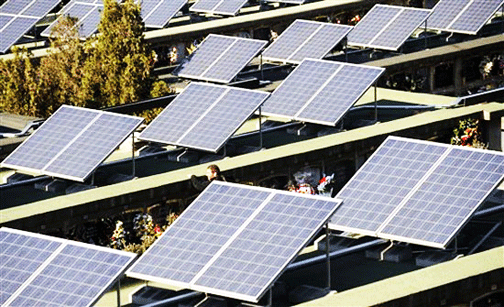
Politics must catch up with solar BY: GILES PARKINSON The Australian June 01, 2012 IT is time politicians in state and federal parliaments had a look at what’s happening in the solar photovoltaic market. There is a revolution going on in the electricity industry and no one in politics seems to have noticed.
This was made clear this week by a report from the Australian Energy Market Operator, which supervises the operation of the electricity grid in the eastern states, and which for the first time has produced a separate report analysis the impact of rooftop solar PV. It came to conclusions that would appear remarkable to those not close to the solar industry.
The first was its admission that rooftop solar PV was about to play a significant role in the electricity market, so much so that rooftop solar alone could add 12,000 megawatts to 18,000MW to Australia’s electricity capacity by 2031.
To put that in context, solar PV provided just 187MW at the end of
2009. At the end of last year, it was 1408MW. But as AEMO noticed, the
economics of solar PV has changed dramatically in recent years. After
a boom in installations from overly generous subsidies that turned
rooftop systems into money spinners, the plunging cost of solar PV,
rising electricity prices and the emergence of financing models such
as “zero down” solar leasing mean rooftop solar is now an inviting
money saver and a hedge against rising grid costs.
And although this is now being understood by the consumer and the
energy industry, it has not yet broken through in the political
rhetoric surrounding clean energy. Indeed, the government’s draft
energy white paper, based on outdated pricing models, forecasts just
10 per cent of the deployment now contemplated by AEMO.
Solar PV brings different benefits and challenges to the energy
industry than utility scale renewables. The first is that it unlocks a
huge amount of capital from householders to invest in clean energy,
reducing the burden on big business and utilities.
If the 18GW prediction holds true, this will produce investment of $30
billion to $35bn from the household sector — an investment, according
to the AEMO, that will generate a return on investment as short as one
to two years by the mid-2020s as solar PV costs continue their fall
and grid-connected retail energy prices continue their rise.
The second is the impact on the industry itself. Almost all of this
development will occur “behind the meter”, meaning it is harder to
control and harder to value.
But as AEMO points out, solar PV has the potential to affect
investments in the network and/or large-scale generation.
This is largely because domestic solar PV will reduce demand from the
grid, and consequently put a dampening effect on wholesale prices.
What’s more, AEMO observes that nearly all of the generation occurs in
periods of peak demand. Even under its “moderate growth” scenario,
which sees 12GW of rooftop solar PV by 2031, this will take 1.3GW out
of peak demand in NSW, 990MW in Queensland and 520MW in South
Australia.
In its high-growth scenarios, rooftop PV will account for nearly 10
per cent of electricity generation, and it should be noted that this
forecast does not include utility scale PV, off-grid PV or even solar
thermal. Nor does it include Western Australia, the Northern Territory
and other regions such as Mount Isa.
The effect on revenues from incumbent generators, and decision-making
about the development of new gas-fired generators, in particular,
could be profound. In SA, the impact is already visible. …….
Investors on board
IN the past week, three separate reports from international accounting
firms KPMG and Ernst & Young, and research house Bloomberg New Energy
Finance, have pointed to a significant change in the clean energy
industry: the emergence of mainstream investors particularly in
renewable energy projects, considered to be the less risky end of the
market…… http://www.theaustralian.com.au/business/opinion/politics-must-catch-up-with-solar/story-e6frg9if-1226377863170
No comments yet.
1 This month

of the week – Australians for War Powers Reform (AWPR)
To see nuclear-related stories in greater depth and intensity
 Antinuclear
Leave a comment