Fukushima No.4 nuclear reactor close to catastrophe
The worries gained new traction in recent days after the operator of the plant, Tokyo Electric Power Co., or TEPCO, said it had found a slight bulge in one of the walls of the reactor building
questions about whether Japan’s all-out effort to convince its citizens that nuclear
power is safe kept the authorities from exploring other – and some say safer – options for storing used fuel rods.
Radioactive waste at Fukushima threatens second nuclear catastrophe
http://www.watoday.com.au/environment/radioactive-waste-at-fukushima-threatens-second-nuclear-catastrophe-20120527 1zcxu.html#ixzz1wgpRdAiv Hiroko Tabuchi, Matthew Wald May 28, 2012 TOKYO:What passes for normal at the Fukushima Daiichi nuclear plant today would have caused shudders among even the most sanguine of experts before an earthquake and tsunami set off the world’s second most serious nuclear crisis after Chernobyl.
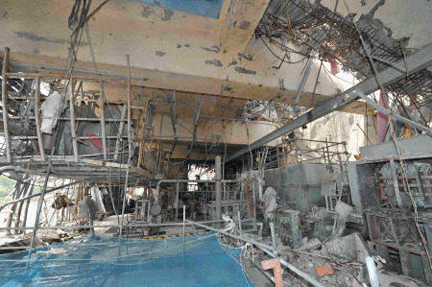
Fourteen months after the accident, a pool brimming with used fuel rods and filled with vast quantities of radioactive caesium still sits on the top floor of a heavily damaged building, covered only with plastic.
The public’s fears about the pool have grown in recent months as some scientists have warned that it has the most potential for setting off a new catastrophe. The three nuclear reactors that suffered meltdowns are in a more stable state, but frequent quakes continue to rattle the region.
The worries gained new traction in recent days after the operator of the plant, Tokyo Electric Power Co., or TEPCO, said it had found a slight bulge in one of the walls of the reactor building, stoking fears over the building’s safety.
To try to quell such worries, the government sent the Environment and
Nuclear Minister to the plant on Saturday, where he climbed a
makeshift staircase in protective garb to look at the structure
supporting the pool, which he said appeared sound. The minister, Goshi
Hosono, added that although the government accepted TEPCO’s assurances
that reinforcement work had shored up the building, it had ordered
further studies because of the bulge.
Some outside experts have also worked to allay fears, saying that the
fuel in the pool is now so old that it cannot generate enough heat to
start the kind of accident that would allow radioactive material to
escape.
But many Japanese have scoffed at those assurances and point out that
even if the building is able to withstand further quakes, a claim that
they question, the jury-rigged cooling system for the pool has already
malfunctioned several times, including a 24-hour failure in April. Had
the failures continued, they would have left the rods at risk of
dangerous overheating.
Government critics are especially concerned, since TEPCO has said the
soonest it could begin emptying the pool is late next year, dashing
hopes for earlier action. ”The No. 4 reactor is visibly damaged and in a fragile state, down to the floor that holds the spent fuel pool,” said Hiroaki Koide, an assistant professor at Kyoto
University’s research reactor institute and one of the experts raising
concerns. ”Any radioactive release could be huge and go directly into
the environment.”
The fears over the pool at reactor No. 4, amplified over the web, are
helping to undermine assurances by TEPCO and the Japanese government
that the Fukushima plant has been brought to a stable condition and
are highlighting how complicated the clean-up of the site, expected to
take decades, will be. The concerns are also raising questions about
whether Japan’s all-out effort to convince its citizens that nuclear
power is safe kept the authorities from exploring other – and some say
safer – options for storing used fuel rods.
”It was taboo to raise questions about the spent fuel that was piling
up,” said Hideo Kimura, who worked as a nuclear fuel engineer at the
Fukushima Daiichi plant in the 1990s. ”But it was clear that there
was nowhere for the spent fuel to go.”
The worst-case situations for reactor No. 4 would be for the pool to
run dry if there is another problem with the cooling system and the
rods catch fire, releasing enormous amounts of radioactive material,
or that fission restarts if the metal panels that separate the rods
are knocked over in a quake. That would be especially bad because the
pools, unlike reactors, lack containment vessels to hold in
radioactive material.
Attention has focused on No. 4′s spent fuel pool because of the large
number of assemblies filled with rods that are stored at the reactor
building.
According to TEPCO, the pool at the No. 4 reactor, which was not
operating at the time of the accident, holds 1331 spent fuel
assemblies, which each contain dozens of rods.
Professor Koide and others warn that TEPCO must move more quickly to
transfer the fuel rods to a safer location. But such transfers have
been greatly complicated by the accident. Ordinarily the rods are
lifted by cranes, but at Fukushima those cranes collapsed during the
series of disasters that started with the earthquake and included
explosions that destroyed portions of several reactor buildings.
TEPCO has said it will build a separate structure next to reactor No.
4 to support a new crane. But under the plan, released last month, the
fuel removal will begin late next year.
No comments yet.
1 This month
To see nuclear-related stories in greater depth and intensity
– go to https://nuclearinformation.wordpress.com/


 Antinuclear
Leave a comment