Deflating Barry Brook’s pro nuclear bubble
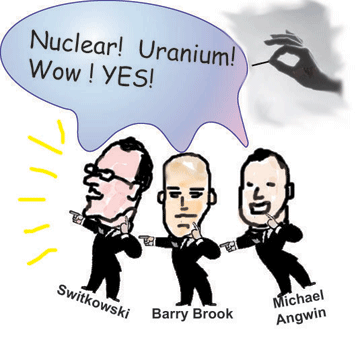 Solar and wind energy projects are going apace in the world right now. And that’s where private investment is going, too, not into nuclear power. I would say that hurdle No 1 would be in persuading people to invest in nuclear power – and that’s a big hurdle. Hurdle 1a would be in getting the government to subsidise nuclear power.
I suspect that even in Australia, solar and wind power systems, both centralised and small, will be well established by 2050, and nuclear power will be a forgotten dream.
Answering Barry Brook on Australia’s nuclear power future, Online Opinion, Noel Wauchope, 13 June 2012 Australia’s nuclear propagandists are at it again, although Ziggy Switkowski, the usual leader of the pack, has been very quiet lately. However, Professor Barry Brook, and his acolyte, Terry Krieg of Australian Nuclear Forum, seem to be taking up the torch now….
Costs Barry Brook claims that there would be “cost benefits” for Australia to adopt these generation 1V nuclear reactors. This is a bald statement. As far as I can tell, nobody at present is able to estimate the costs. Particularly when it comes to the small reactors. One thing is accepted: the only way that these could ever be commercially viable would be if they were to be manufactured and sold in large numbers. The likelihood of this happening, of a mass production and sale of small reactors is dubious.
For fast neutron reactors, large or small, Barry Brook himself admits that there are currently none in commercial operation.
David Biello comments: Fast-neutron reactors would not improve the economics of nuclear power
based on past experience, …. As far back as 1956, Adm. Hyman Rickover, who oversaw both the Navy’s nuclear-propulsion efforts as well as the dawn of the civilian nuclear power industry, cited such sodium-cooled fast-neutron reactors as
“expensive to build, complex to operate, susceptible to prolonged shutdown as a result of even minor malfunctions, and difficult and time-consuming to repair.” That judgment remains despite six decades and $100 billion of global effort, according to physicist Michael
Dittmar of the Swiss Federal Institute of Technology in Zurich who
wrote, “ideas about near-future commercial fission breeder reactors
are nothing but wishful thinking.
Investment
When trying to get a grip on the nuclear issue, a memorable quote from
All The President’s Men applies here provides a helpful tip “Follow
the money”. The nuclear industry has a world-wide problem in that it
can get private investment only where the government subsidises it,
and also takes on the costs of nuclear disasters and permanent
radioactive waste disposal. This is made even more difficult now by
the strong swing towards investment in renewable energy. Total
investment in renewable energy, from both private and public sources,
reached $211 billion in 2010, and continues to climb.
Time
Just as we learn that a new solar farm at Broken Hill will be
operational in 2015, we might ponder on the hurdles that Barry Brook’s
nuclear reactors will be needing to overcome, before a bunch of them
might be operational by 2050.
Solar and wind energy projects are going apace in the world right now. And that’s where private investment is going, too, not into nuclear power. I would say that hurdle No 1 would be in persuading people to invest in nuclear power – and that’s a big hurdle. Hurdle 1a would be in getting the government to subsidise nuclear power, as is happening to some degree, but not very successfully, in democracies such as Britain and USA.
India is a whole different story – with repression of anti nuclear
activists there, India’s status as a democracy is looking wobbly.
Even assuming that, somehow or other, Australia does decide for these
nuclear reactors, then there are a series of hurdles. New federal and
state legislation would be needed. Local acceptance would need to be
gained. Detailed designs would have to be submitted to government,
covering all sorts of aspects – Site characteristics: population,
meteorology, geology, hydrology, plant accident scenarios,
qualifications to operate the plant, radiological discharges to air,
water, safety analysis.emergency response plans. All that sort of
stuff before any work is begun on the proposed sites.
As far as the new Integral Fast Reactors are concerned – at present
there are none in operation. So, who knows how long it would take to
get even one built in Australia? Generation 1V reactors (Gen IV) are a
set of theoretical nuclear reactor designs currently being researched.
Most of these designs are generally not expected to be available for
commercial construction before 2030. Small modular reactors are also
still in the design stage.
I suspect that even in Australia, solar and wind power systems, both centralised and small, will be well established by 2050, and nuclear power will be a forgotten dream…
http://www.onlineopinion.com.au/view.asp?article=13726&page=2
No comments yet.
1 This month

of the week – Australians for War Powers Reform (AWPR)
To see nuclear-related stories in greater depth and intensity
 Antinuclear
Leave a comment