Mainstream media distortion of the Olympic Damn uranium mine issue
 Christina Macpherson 18 July 12, Today is the officially final day of the anti uranium protest – the Lizard’s Revenge, at Olympic Dam. The mainstream media has given scant coverage to this large well-organised, and peaceful festival of the movement for clean energy, and for closing down BHP Billiton’s planned behemoth – the largest uranium mine in the world. But no doubt the media will be able to highlight the arrests of 13 protestors – (6 of them for the dangerous activity of playing cricket!)
I saw some coverage on SBS televison, and was fascinated to see the time given to the BHP spokesman, who stated the “authentic” Aboriginal landowners’ agreement about the mine expansion. Just who were these Aboriginal spokespeople? BHP will claim that they are the true traditional owners – the Kokatha people.
But – when you look back to the and not very far past – you find that the Kokatha people rejected uranium mining. There was never a genuine consultation with either the Kokatha or Arabunna peoples, the real traditional owners. Then a new, never before known group, appeared – the Kokatha Mula. and they formed Kokatha Mula Land Nations Council Inc and the Kokatha Olympic Dam Agreement Association Inc. This group emanated from the West Coast of South Australia, and simply – did a deal with BHP.
It’s not hard to realise that for many Aboriginals – it’s a very desirable thing to get the same living standards as the rest of Australians. Just a pity that they have to kow tow to an unethical company like BHP to get what the rest of Australians already have, without us having to see our land poisoned by uranium mining.
Video – police arrest Olympic Damn anti uranium activists at breakfast
Too often we ignore the effects of this industry because it happens away from our direct doorstep, uranium is mined here in the desert, and dumped on the homes of Aboriginal communities in the desert within Australia. But as we have been reminded again from Fukushima, radiation doesn’t discriminate, and this is a threat to the health of us all, now and into the future.
 VIDEO Breakfast not Bombs http://lizardsrevenge.net/breakfast-not-bombs-media-release-17-7-2012/ Lizards Revenge 18 July 12 Activists call for “Breakfast not Bombs” as police defend what BHPBilliton aims to make the largest uranium mine in the world. At the road blockade set up to control access to the Olympic Dam mine demonstrators set up a breakfast and blockade. Their message, that the uranium from this mine and others like it contributes to the nuclear weapons industry and any expansion to this mine is an increased contribution to the industry.
Here are statements from the picnickers that have blocked the road near the Bypass rd and Olympic way from7am til 9am. 6 people were arrested with what the police describe as various offense “Breakfast not Bombs” crew reported seeing many trucks being turned around during the picnic road block. Continue reading
Dangers of transporting uranium from Olympic Dam through Australia’s Northern Territory
NT ENVIRONMENT GROUPS RED LIGHT OLYMPIC DAM TRANSPORT OPTION , Lauren Mellor 18 July 12 Members of the Arid Lands Environment Centre and the Environment Centre NT have joined a week long protest outside Olympic Dam uranium mine to highlight the risks of transporting uranium on NT rail and port networks.
More than 500 protestors have camped at the gates of Olympic Dam to protest BHP Biliton’s plans for expansion, a move that would make it the largest open cut uranium mine in the world. The expansion was granted approval last year by the Federal and SA State Governments, but relies on access to NT rail networks and access to the Port of Darwin.
Lauren Mellor from the Arid Lands Environment Centre said “Under the proposed expansion BHP Biliton plans to send another two trains a day, containing an unprecedented 1.6 million tonnes of toxic copper concentrate and 17,000 tonnes of yellowcake, on the Adelaide to Darwin rail line for the next 80 years. Every train puts the environment and communities along the transport route at risk of radiation and contamination. Northern Territory residents have a lot to lose if this project goes ahead. In Alice Springs, these dangerous and unnecessary shipments will cut our town in half for 16 minutes every day.”
Cat Beaton, Nuclear Free NT Campaigner at the Environment Centre NT said “The Adelaide to Darwin railway is notorious for train derailments, with three occurring in the last 19 months alone. In December last year a train carrying 1200 tonnes of copper concentrate was given permission to cross the Edith River during flooding and derailed, spilling its toxic contents into pristine waterways.”
“The Northern Territory is already under threat of hosting Australia’s first national radioactive waste dump if Federal Government plans to build the facility at Muckaty, 120kms north of Tennant Creek, are advanced. The increased pressures of a growing uranium mine at Olympic Dam on our transport networks is a radioactive disaster waiting to happen.”
“We are calling on Federal Environment Minister Tony Burke to urgently reconsider his approval for the Olympic Dam expansion project in light of these concerns and the project’s reliance on NT rail and port networks” concluded Ms Mellor.
“We will fight this expansion project every step of the way – in solidarity with the Arabunna and Kokatha people and the South Australian community who continue to fight this dangerous and dirty project, and with all those working to build a nuclear free future for Australia” concluded Ms Beaton. For more information contact: Cat Beaton (Olympic Dam) Environment Centre of the NT 0434 257 359 Lauren Mellor (Alice Springs) Arid Lands Environment Centre 0413 534 125
Review confirms bullying and coverup at Australian Nuclear Science and Technology Organisation
 N-plant spill probe ‘seriously flawed’ BY: LEIGH DAYTON, SCIENCE WRITER The Australian July 18, 2012 A DAMNING review by global consultant KPMG has again highlighted safety and bullying concerns at Australia’s nuclear facility.
The review by KPMG’s forensic unit was conducted for the national regulator, the Australian Radiation Protection & Nuclear Safety Agency, and obtained by The Australian yesterday.
It found an ARPANSA investigation into a September 2007 contamination incident at the Australian Nuclear Science and Technology Organisation involving radioactive Yttrium-90 was seriously flawed. Continue reading
Small doses of radiation cause cancer in children – research from France
 “Thanks to recent studies, we are now certain that small doses of radiation can seriously affect the thyroids of young children, causing cancers or other illnesses,”
Victims of French nuclear tests see hope in cancer link finding http://www.france24.com/en/20120717-france-nuclear-tests-polynesia-algeria-radiation-cancer-victims-compensation-health Victims of French nuclear tests say a report establishing a link between exposure to radiation and cases of cancer may prove decisive in their lengthy battle for compensation. By Andrea Davoust
Thanks to a landmark medical expert’s report, a new link has been established between France’s nuclear testing in the Pacific and North Africa and cases of cancer among civilians and former military personnel.
The findings, revealed by daily Le Parisien on Tuesday, could help speed up the lengthy legal process to compensate potential victims of these tests. Continue reading
Solar photovoltaic and energy storage – large scale project to commence in New South Wales
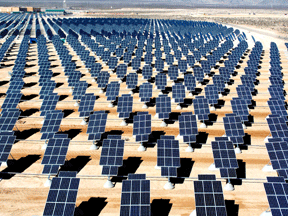 All Systems Go For Capital East Solar Farm, by Energy Matters, 18 July 12 Australia’s first solar photovoltaic (PV) and energy storage demonstration facility will be constructed at Bungendore in New South Wales.
Infigen received approval earlier this month for the development of the facility. The first stage of the development will consist of a 200kW solar PV array and energy storage system, with view to expanding it to 1MW.
While 200kW isn’t exactly of gargantuan proportions (enough to power around 40 homes), the company says the facility will “support Infigen’s entry into large scale solar PV generation and implementation of energy storage technologies.”
The project will address one of the final hurdles facing large scale solar PV – how to continue supplying electricity when the sun doesn’t shine. This challenge has already been overcome using solar thermal technologies incorporating molten salt “batteries”.
“Infigen recognises that energy storage will be a key enabling technology in the future of renewable energy in Australia,” said David Griffin, General Manager of Development.
“Distributed renewable energy facilities that are also capable of providing network support are expected to become increasingly competitive with traditional supply solutions requiring continuing large investments in outdated network infrastructure”…. http://www.energymatters.com.au/index.php?main_page=news_article&article_id=3301
1 This month

of the week – Australians for War Powers Reform (AWPR)
To see nuclear-related stories in greater depth and intensity
 Antinuclear