BHP delays for 2 years decision on whether or not to go ahead with new Olympic Dam uranium mine

 Olympic Dam threat as BHP puts brakes on
BY: SARAH MARTIN, SA POLITICAL REPORTER The Australian July 28, 2012 “,,,,,,Documents obtained by The Weekend Australian show the company has informed outsiders that a decision to proceed with the project – spruiked by federal and state Labor governments as key to South Australia’s economic future – will be delayed by two years……The expansion would make Olympic Dam the world’s largest uranium mine,,,,,the strongest indication yet that the project will not receive board approval before the end of the year, meaning the company will fail to meet the government’s December 8 deadline and its indenture agreement will lapse…… The potential delay for the project comes as the South Australian government has recently softened its commentary on the importance of the mine expansion to the state’s economy. Treasurer Jack Snelling last week told The Australian that the mine expansion was never going to be a “cash cow” for government coffers….” http://www.theaustralian.com.au/national-affairs/olympic-dam-threat-as-bhp-puts-brakes-on/story-fn59niix-1226437208652
Northern Territory’s only uranium mine doubles last year’s crippling loss of money!
 Ranger loses $51.5m http://www.ntnews.com.au/article/2012/07/27/312091_nt-business.html NIGEL ADLAM | July 27th, 2012 Ranger uranium mine. THE Territory’s only
 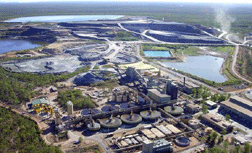 uranium mine has lost more money. Energy Resources of Australia said yesterday that Ranger suffered a loss of $51.5 million in the first six months of this year.
The operation lost $22.3 million in the same period last year. ERA said lower sales, lower prices and a strong Australian dollar were behind the result despite production doubling in the period.
Lower income suburbs in Victoria taking to solar energy in a big way
 Tarneit and neighbouring suburbs Hoppers Crossing and Truganina have more solar power installed than any other postcode in the state – 2564 systems, with a capacity of 5.1 megawatts.
Werribee, just a little further down the Princes Freeway, is second on the list of Victorian solar postcodes. The top five are rounded out by other lower-income, outer-suburban areas: Cranbourne, Caroline Springs and Grovedale in Geelong.
”I don’t think the government or public have appreciated just how profound or rapid the change will be in the solar market over the next couple of years.”
Out on the fringe, solar comes of age, The Age, July 28, 2012,  Adam Morton UNTIL recently, Tarneit, about 25 kilometres west of the Melbourne CBD, was mostly grazing paddocks, a place without a post
office. Now there is barely a cow left. Between the 2006 and 2011 censuses, the population of the outer suburb boomed, tripling to more than 20,000 as the city sprawled and first home buyers snapped up new affordable housing.
The residents of Tarneit are much like those in other developing areas on the city’s fringe. As you might expect, they earn less than the average Victorian. Perhaps less predictably, they are also much more likely to have solar panels on their roofs.
While the myth of solar panels as a purely upper-middle-class luxury persists, new data released by the Clean Energy Regulator suggests it is misplaced. Continue reading
Secrets and lies: Japan’s nuclear-medical Establishment and the “radiation hormesis” fallacy

 What Really Happened in Fukushima : A Report From a Medical Care Provider http://fukushimavoice-eng.blogspot.com.au/2012/07/what-really-happened-in-fukushima.html?spref=tw December 21, 2011
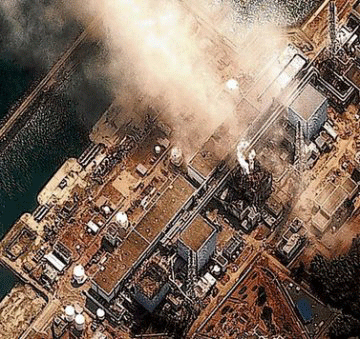

The president of the hospital where I am employed says people live longer when irradiated and Fukushima people now will be healthier because of radiation hormesis. There is no argument allowed. Since this statement comes from a physician, many people believe this in Fukushima. Continue reading
Dick Smith promoting CSIRO’s electric car
 the CSIRO test car is designed in such a way that it can be used as a household power source, feeding electricity back into the 240-volt grid, and being charged up again at night when power demand is low.
Dick Smith visits Newcastle CSIRO centre http://www.theherald.com.au/news/local/news/general/dick-smith-visits-newcastle-csiro-centre/2637702.aspx BY IAN KIRKWOOD 28 Jul, 2012 AS an avowed skeptic, entrepeneur and philanthropist Dick Smith says renewable energy is a good thing whether climate change is real or not.
“While I think we could be altering our climate, I think most business people like me are climate change deniers and I think we could be affecting the climate but coal and oil are going to run out one day,” Mr Smith said in Newcastle yesterday. Continue reading
1 This month

of the week – Australians for War Powers Reform (AWPR)
To see nuclear-related stories in greater depth and intensity
 Antinuclear