AUSTRALIA’S NUCLEAR HISTORY – theme for August 2012
In some ways, Australia’s uranium/nuclear history is a sorry story.
Australia’s very earliest involvement (up to 1915) was in mining and processing radium whichwas used for medical research. But from 1944 onwards, Australia was involved in nuclear weapons – through both providing the fuel for USA and UK weapons, and in the 1950s, hosting Britain’s nuclear weapons testing.
Australia has continued to sell uranium, under cloak of pretense that it does not end up in nuclear weapons. To our shame, the government now agrees to sell to India, which has not signed the Nuclear Non Proliferation Treaty, and which is rapidly militarising with nuclear weapons.
Australia still, by the secret facilities at Pine Gap, participates in the USA’s nuclear military system. Our greatest disgrace is the shameful way in which the Aboriginal people have been exploited, and have suffered, through the uranium/nuclear industry.

In some other ways, it is a history to be proud of.
Australia has a proud history of anti nuclear activity, going right back to the 1960s. Anti nuclear activism in Australia put the brakes on the uranium industry for along time. Among Australia’s anti nuclear activists, Dr Helen Caldicott stands out as the world’s best known and most articulate and respected speaker on the nuclear danger. Our anti nuclear movement also led to the end of France’s nuclear bomb testing in the Pacific. It has saved Australia from having nuclear power plants, and getting an international nuclear waste dump.
More recently, Australian anti nuclear activism in South Australia and Western Australia, is contributing to the slowdown, and hopefully the decline and fall of uranium mining – an industry which, by any measure, never contributed more than an insignificant amount to the economy, anyway.
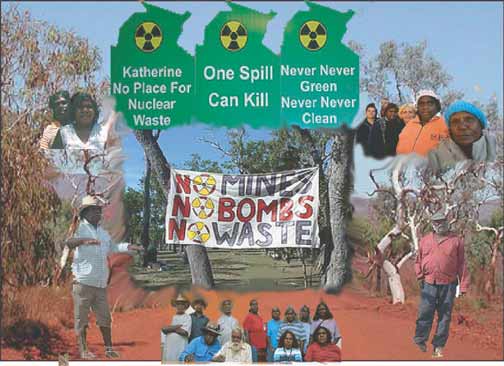
The battle continues, to save this country, and especially its Aboriginal lands, from this toxic industry – now in the fight against the government’s plan for a nuclear waste dump at Muckaty, Northern Territory.
Australian uranium projects not economically viable – Kintyre, Yeelirrie, Olympic Dam
 Uranium prices halt Sandy Desert project, BY: BARRY FITZGERALD The Australian July 29, THE most likely of Australia’s next big uranium mine developments – the Kintyre project in Western Australia’s Great Sandy desert – has fallen victim to sluggish demand and prices for the nuclear fuel, and WA’s “hot” construction market for resource projects.
Project operator and 70 per cent owner, Canada’s Cameco, has revealed that the economics of the project are “challenging” in that a development would not be profitable at current uranium prices. Prices are 34 per cent below where they need to be for a viable project.
The sluggish demand backdrop has implications for BHP Billiton which must find a home for the additional uranium it will produce with the planned $30 billion expansion of its Olympic Dam copper/uranium/gold mine in South Australia’s outback.
The expansion would see uranium output at Olympic Dam grow massively from 9.6 million pounds a year to 40.6 million pounds a year – 17 per cent of forecast global mine output in 2020.
But the Weekend Australian revealed that BHP plans to defer a decision on the project for two years.
Sluggish uranium demand has already reported to have led to BHP becoming disinterested in moving towards developing its Yeelirrie uranium deposit in WA.
Cameco chief executive Tim Gitzel told analysts that Cameco was “not going to develop Kintyre at any cost Continue reading
BHP’s technology problems with its dubious Olympic Dam uranium mine plan
 BHP Billiton’s desperate Olympic race Business Spectator Robert Gottliebsen, 30 Jul
  2012 “……there is another problem that is causing some to speculate that BHP needs a technical as well as a customer partner at Olympic Dam. BHP was once a global mining technology giant. That is no longer so and it relies on outsiders for much if its technical expertise.
The company has a history of failure in high technology mining ventures including Hartley Platinum, hot iron briquettes, mineral sands and Ravensthorpe…..
Any non-smelter solution to Olympic Dam will again thrust BHP into high technology mining treatment where it has a track record of failure.
BHP is not the only global miner to run down its technology in favour of highly profitable digging and shipping. If BHP steps back from Olympic Dam in December it should also reveal any wider long-term treatment problems and canvass new partners.
Footnote: BHP’s environmental statement revealed it planned to spend six years removing the overburden to access the ore body. In all, it planned to remove a 350 metre thick layer of overburden and the rock taken out will be transported to a rock storage facility that covers 6,720 hectares and will eventually be 150 metres high. By 2050, when the mine has not even completed half its life, the pit would be 4.1 kilometres long, 3.5 kilometres wide and one kilometre deep …..”
http://www.businessspectator.com.au/bs.nsf/Article/BHP-Billiton-Olympic-Dam-China-ore-prices-pd20120730-WNSYX?OpenDocument&emcontent_Gottliebsen
200,000anti nuclear protestors surround Japanese Parliament

 PHOTOS and VIDEOS Sunday Protest 200,000 Surround Diet Building http://www.simplyinfo.org/?p=6962 July 29th, 2012Protests started at 3pm JST and went on into the night with marches to TEPCO, METI and a candlelight protest back at the Diet. Two were arrested for obstructing the police and there were periodic scuffles with police. Organizers estimate about 200,000 attended.
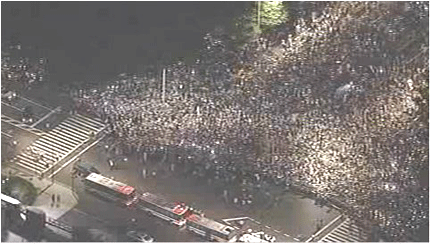 People who showed up were spread around the diet building crowded on sidewalks making it hard to obtain a visual of everyone. News media did sent out a helicopter, a few aerial shots can be seen in various videos. Protests as many previous ones included a broad cross section of people participating in the protests. PM Noda is still hinting that he wants 15% nuclear power in Japan, something that would require restarting most of the reactors and would be highly unpopular with the public.
Most media outlets in Japan did cover this protest unlike other large ones that went without media attention. Embedded videos can be found at these links.
Queensland’s Liberal-National Party policy on Climate Change- an international embarassment
 Queensland and the weird alternate reality of climate change denialists Independent Australia, Graham Readfearn, 25 July, 2012 “….. we come to the latest episode, where Queensland’s currently in-power Liberal-National Party has accepted a motion that climate science shouldn’t be taught in schools. The proposer of the motion, which was accepted unanimously (but may not be taken up by the parliamentary wing of the party), is a Dr Richard Pearson, from Noosa.
It now appears that Dr Pearson has been conducting his own climate science experiments — at home, in his kitchen, armed only with thermometers, two fish cooler boxes and a roll of cling film. Some may find the results remarkable; you see, Dr Pearson believes he may have disproved the greenhouse effect (you may now pinch yourself).
We know this because he wrote about his experiment on the website of the climate sceptic group the Galileo Movement — whose patron is the noted climate expert (and radio presenter) Alan Jones. Dr Pearson’s conclusion?
‘That the Greenhouse Effect theory is not confirmed by this experiment and may be disproved by it.’
Now, even though the notion that a guy in his kitchen in Noosa armed with two eskies and a roll of cling film could single-handedly disprove the greenhouse theory may seem just a tad fanciful….
plausible to non-experts, such as the vast majority of the general public. At the end of his experiment, Dr Pearson recounts how his daughter had questioned how a man with cling film could “disprove a theory that hundreds of climate scientists around the world say is true”. “That my darling is science”, was Dr Pearson’s response. Is it really?…
Professor Matthew England, of the University of New South Wales Climate Change Research Centre and also chairman of the Australian Climate Commission’s science advisory panel, says the motion which Dr Pearson managed to get passed at the LNP’s state conference could have broad ramifications, if only for the state’s reputation.
If the proposal to remove greenhouse science from the school curriculum is enacted, Queensland’s education system will become an international joke overnight. Basic greenhouse gas physics has been established with around 200 years of scientific progress — any move to muzzle climate science facts from being taught at schools will be condemned as world’s worst practice in scientific education.
So if the Queensland Education Minister John Paul Langbroek does act on the motion from his party, then Prof England says the State will be a laughing stock. Until then, we’ll just have to settle for the majority of the members of the LNP. http://www.independentaustralia.net/2012/politics/queensland-and-the-weird-alternate-reality-of-climate-change-denialists/
Low sales, low prices cause Cameco uranium company’s profit loss
 Cameco profit hit by lower sales, prices Mining Peter Koven Jul 27, 2012 Second quarter profit dropped sharply at Cameco Corp. as the uranium giant’s sales volumes declined and it faced lower realized prices and higher costs.
Adjusted net income came in at $34-million, or 9 cents a share, down from 18 cents a year ago. The numbers fell short of analyst expectations.
Uranium sales volumes in the quarter were 5.3 million pounds, well down from 5.8 million pounds in the second quarter of 2011. Saskatoon-based Cameco’s realized price also dropped 8% year-over-year to US$42.08 a pound because of lower U.S.-dollar prices under
fixed-price contracts. Uranium production dropped 7%….
Solar energy leasing recommended at Sydney’s Clean Energy Week
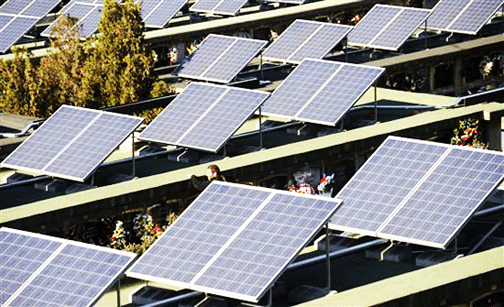 Clean Energy Week 2012 underway in Sydney, Ecogeneration, 27 July 2012 At the Clean Energy Week Conference in Sydney, Clean Energy Council Chief Executive David Green has told clean energy industry stakeholders “We need policy measures that are long, loud and legal”, while Federal Climate Change and Energy Efficiency Minister Greg Combet has outlined why Australia has to transform its emissions-intensive electricity system to cut carbon.
Taking place from Wednesday 25–Friday 27 July at the Sydney Convention and Exhibition Centre, Clean Energy Week 2012 has played host to key political and industry leaders…
Today, conference participants heard from Australian Greens Leader Federal Senator Christine Milne and Sungevity President Danny Kennedy, who congratulated the Australian solar industry on the exponential growth it has made over the last five years.
“If there was a gold medal out there for residential solar – you won!” said Mr Kennedy. “You’re truly pioneers in what I call the rooftop revolution.”
Mr Kennedy recommended the process of solar leasing, such as in the United States where 75 per cent of the residential market is leased or under power purchase agreements, as a process that democratises solar…… http://ecogeneration.com.au/news/clean_energy_week_2012_underway_in_sydney/076602/
1 This month
7 April – WEBINAR – Australia and the Doomsday Clock – Preventing nuclear war through NoFirstUse and other policies
Online | Tuesday April 7, 4:00-5:30pm, Australian Eastern Time / 8:00-9:30am Central Europe Time
– Access the registration link
15 April – Zoom –Nuclear Power is Not the Solution
Apr 15, 2026 01:00 AM in Canberra, Melbourne, Sydney

Join the International Physicians for the Prevention of Nuclear War (IPPNW) on Tuesday, April 14th for a timely webinar exploring the risks associated with nuclear power and challenging the myth that it offers a simple, safe, carbon-free solution to the climate crisis

of the week – Australians for War Powers Reform (AWPR)
To see nuclear-related stories in greater depth and intensity
 Antinuclear