Investment funds applaud BHP’s decision to shelve Olympic Dam uranium mine expansion
factors hampering BHP’s ability to build massive expansion projects like Olympic Dam.
 Shelving projects ‘a wise move for miners’ THE AUSTRALIAN, BY: MATT CHAMBERS AND BARRY FITZGERALD July 30, 2012 THE nation’s biggest listed investment fund and one of BHP Billiton’s top shareholders has applauded moves by big miners to shelve Australian projects because of high costs and sliding commodity prices.
Over the weekend, the most likely of Australia’s next big uranium developments, the Kintyre project in the Great Sandy desert, became the latest victim after being hit by sluggish prices for the nuclear fuel and Western Australia’s heated construction market.
The shelving of Kintyre, by Canada’s Cameco, came as The Weekend Australian revealed BHP had told outsiders of a two-year delay on a $30 billion decision due this year on expanding the Olympic Dam copper and uranium mine in South Australia’s outback.
Australian Foundation Investment Co managing director Ross Barker said the time of huge profits from very high commodities prices appeared to be coming to an end, Continue reading
Outback Aboriginal company joins forces with solar power company
 Aboriginal people to install solar systems in remote WA communities http://www.abc.net.au/rural news/content/201207/s3556353.htm ABC rural news By Babs McHugh , 30/07/2012 An Indigenous mining company has joined forces with a solar power company to build renewable energy systems in remote Western Australia.
Carey Power plans to train and employ local Aboriginal people to install and maintain the power systems, which will also be rolled out to mine sites.
Minnie King is a Torres Strait Islander who’ll run the company, which has already signed a memorandum of understanding (MOU) with an Aboriginal Corporation in the Northern Territory to look at power solutions there.
She says Carey Power will be initially focused on solar energy projects, using panels bought in China.
“We’re interested in looking at perhaps doing hybrids, where there are existing diesel generation systems in communities, looking at installing solar there, perhaps solar farms,” she said. “But in saying that, there are other technologies that we would be interested in exploring down the track.”
General Electric chief sees little future for nuclear power
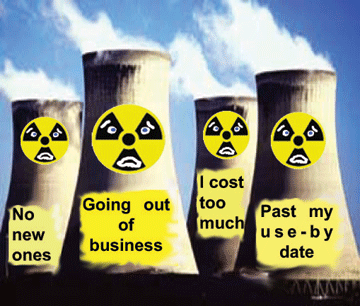 Nuclear ‘hard to justify’, says GE chief FT.com By Pilita Clark, 31 July 12, Nuclear power is so expensive compared with other forms of energy that it has become “really hard” to justify, according to the chief executive of General Electric, one of the world’s largest suppliers of atomic equipment.
“It’s really a gas and wind world today,” said Jeff Immelt, referring to two sources of electricity he said most countries are shifting towards as natural gas becomes “permanently cheap”…. It’s just hard to justify
nuclear, really hard. Gas is so cheap and at some point, really, economics rule,” Mr Immelt told the Financial Times in an interview in London at the weekend. “So I think some combination of gas, and either wind or solar … that’s where we see most countries around the world going.”
Mr Immelt’s comments underline the impact on the global energy landscape of the US shale gas revolution, Japan’s 2011 Fukushima nuclear meltdown and falling prices for some types of renewable power…..
a 75 per cent fall in solar panel market prices in the past three years has made solar power competitive with daytime retail electricity prices in some countries, according to a recent report by Bloomberg New Energy Finance, while offshore wind turbine prices have steadily declined.
Such factors pose dilemmas for countries such as the UK, which is trying to build new nuclear plants without public subsidy……
Analysts estimate GE’s nuclear revenues, from a joint venture with Japan’s Hitachi, at an estimated $1bn, or less than 1 per cent of annual global sales. …. http://www.ft.com/intl/cms/s/0/60189878-d982-11e1-8529-00144feab49a.html#axzz22EdFcsHr
The plot to frame Julian Assange

 Australian TV Program Exposes Julian Assange Frame-up http://www.democraticunderground.com/101636930 http://www.wsws.org/articles/2012/jul2012/assa-j28.shtml “Four Corners”, an Australian Broadcasting Corporation current affairs program, this week broadcast what amounted to an exposé of the frame-up of WikiLeaks editor Julian Assange on allegations of sexual misconduct in Sweden. Assange remains inside the Ecuadorian embassy in London, seeking political asylum from the threat of being removed to Sweden, which would in turn facilitate extradition to the US.
By tracing the chronology, the program also clarified the connection between the Swedish witchhunt and the Grand Jury operation underway in the United States to charge Assange with espionage for WikiLeaks’ exposures of US war crimes (see: “Sex, Lies and Julian Assange”).
The program provided substantial evidence that the allegations against him were false and politically motivated. The unproven accusations were used to blacken his name in Sweden and around the world, and counter the widespread public support that he and WikiLeaks had won for courageously exposing the crimes and machinations of the US and other powers.
Assange has still not been charged with any crime.
Julian Assange’s mother claims to have documentary evidence of USA’s intentions to prosecute him
Assange’s mother says U.S. bent on extraditing WikiLeaks founder The Star, By Eduardo Garcia QUITO (Reuters) 31 July 12, – Julian Assange’s mother said she handed evidence to Ecuador’s government on Monday indicating Washington is bent on extraditing her son to the United States, where she fears the WikiLeaks founder could face execution….. Neither U.S.
nor Swedish authorities have charged Assange with anything. Swedish prosecutors want to question him about allegations of rape and sexual assault made by two WikiLeaks supporters in 2010…
.. Christine Assange is due to meet with Ecuador’s President Rafael Correa later this week. She described the socialist leader as “very brave” and said she trusts that Correa will not allow his country’s sovereignty to be manipulated by foreign interests.
Both Correa and Julian Assange have alienated Washington. Correa is an ardent critic of what he calls U.S. “imperialism,” and U.S. authorities accuse Assange of damaging its foreign relations with his leaks http://thestar.com.my/news/story.asp?file=/2012/7/31/worldupdates/2012-07-30T220338Z_3_BRE86T0R9_RTROPTT_0_UK-ECUADOR-ASSANGE&sec=Worldupdates
Fast breeder nuclear reactors – the PRISM is not the answer to UK’s nuclear waste pile
Adrian Simper, the strategy director of the UK’s Nuclear Decommissioning Authority, warned last November in an internal memorandum that fast reactors were “not credible” as a solution to Britain’s plutonium problem because they had “still to be demonstrated commercially” and could not be deployed within 25 years.
the plutonium metal, once prepared for the reactor, would be even more vulnerable to theft for making bombs than the powdered oxide.
Are fast-breeder reactors the answer to our nuclear waste nightmare? The Guardian 30 July 12 The battle is intensifying on a decision over a major fast-breeder reactor to deal with the plutonium waste at Sellafield. Fred Pearce “…….Britain has a history of embarrassing failures with MOX, including the closure last year of a $2 billion blending plant that spent 10 years producing a scant amount of fuel. And critics say that, even if it works properly, MOX fuel is an expensive way of generating not much energy, while leaving most of the plutonium intact, albeit in a less dangerous form.

Only fast reactors can consume the plutonium. Many think that will ultimately be the UK choice. If so, the PRISM plant would take five years to license, five years to build, and could destroy probably the world’s most dangerous stockpile of plutonium by the end of the 2020s. GEH has not publicly put a cost on building the plant, but it says it will foot the bill, with the British government only paying by results, as the plutonium is destroyed.
The idea of fast breeders as the ultimate goal of nuclear power engineering goes back to the 1950s, when experts predicted that fast-breeders would generate all Britain’s electricity by the 1970s. But the Clinton administration eventually shut down the U.S.’s research program in 1994. Britain followed soon after, shutting its Dounreay fast-breeder reactor on the north coast of Scotland in 1995. Continue reading
Ecuador asked Sweden to question Julian Assange in London
Assange suffering, mother says THE AUSTRALIAN, AP July 31, 2012 THE mother of WikiLeaks founder Julian Assange says her son’s health is suffering after more than a month confined to Ecuador’s embassy in London. Christine Assange is in Ecuador to meet with officials about her son’s political asylum request.
Ecuadorian officials have said they will not announce a decision until after the London Olympics end in mid-August.
Christine Assange told an Ecuadorian TV station on Monday that her son, owing to his cramped living conditions and inability to exercise, has extreme psychological stress. The activist who published secret US documents took refuge in the
embassy on June 19 to avoid extradition to Sweden, where he is wanted for questioning about allegations of sexual misconduct.
Assange says he fears Sweden will extradite him to the United States. Meanwhile, Ecuador says it has asked Sweden to question Mr Assange in London…… The WikiLeaks founder fears that from Sweden, he could subsequently be re-extradited to the United States to stand trial for espionage, on account of the trove of leaked US diplomatic cables and military logs that were published on his website…..
http://www.theaustralian.com.au/in-depth/wikileaks/assange-suffering-mother-says/story-fn775xjq-1226439239285
1 This month

of the week – Australians for War Powers Reform (AWPR)
To see nuclear-related stories in greater depth and intensity
 Antinuclear