Investors warn – forecast for Olympic Dam mega uranium mine just gets gloomier
 Argo worries BHP’s $3b write-downs a warning sign, The Age, Michael Evans August 7, 2012 JASON BEDDOW, the boss of listed investment company Argo Investments, has expressed concern over the $3 billion in write-downs at BHP Billiton, saying he fears there may be more to come.
After announcing a 3 per cent fall in Argo’s net profit to $167.3 million for 2012, Mr Beddow, who estimates his firm’s BHP  stake at about $260 million, told BusinessDay that he would like BHP management, led by the chief executive, Marius Kloppers, to know that ”you need to be a bit prudent”….
Mr Beddow said that there was ”every chance they will have to take [further] write-downs’….. if you really wanted to point the [finger] that’s what you’re paid for in a CEO. You’re paid for responsibility.”…
The market was concerned at the uncertainty around some of its major projects such as Olympic Dam, he said.
Radiation will be a killer for human travellers to Mars
 How a long mission to Mars could kill you NBC News, By Eric Niiler 7/18/2011 We’ve already “done” the moon, but Mars still beckons like some interplanetary Brigadoon ; visible through the eyes of clever little rovers and orbiters, but just beyond the reach of human footsteps…..
Radiation The combined effects of background cosmic rays from extragalactic sources and extreme radiation events from the sun make space travel too hazardous for an estimated six months there and six months return. “The estimate now is you would exceed acceptable levels of fatal cancer,” said Francis Cucinotta, chief scientist for NASA’s space radiation program at the Johnson Space Center in Houston. “That’s just cancer. We also worry about effects of radiation on the heart and the central nervous system.”
Cucinotta says these estimates do take into account protective shielding around a crew vehicle, probably some form of polyethylene plastic. Lead shields actually create secondary radiation when struck by cosmic rays, while water, perhaps the best form of protection, would have to be several meters thick to get enough protection. (“Houston calling Water Balloon 1, do you copy?”)
Lead and water, in any case, are very heavy for the quantities that would be required, making them an expensive shielding to launch….. studies show that radiation can damage the vitamins in food supplies, and the loss of even one vitamin in the food chain could cause serious health effects over a long trip. Little is known about the long-term effects of radiation on food supplies, since International Space Station (ISS) crews have been partially sheltered by Earth’s magnetosphere.
It’s expected that the crew will have to grow its own food in some kind of greenhouse,… http://www.msnbc.msn.com/id/43796117/ns/technology_and_science-science/t/how-long-mission-mars-could-kill-you/?__utma=14933801.1192036095.1344035709.1344126652.1344387760.3&__utmb=14933801.1.10.1344387760&__utmc=14933801&__utmx=-&__utmz=14933801.1344387760.3.3.utmcsr=google|utmccn=(organic)|utmcmd=organic|utmctr=(not%20provided)&__utmv=14933801.|8=Earned%20By=msnbc%7Ctechnology%20%26%20science%7Cscience%7Ccosmic%20log=1^12=Landing%20Content=Original=1^1
Australia’s Prime Minister, and politicians just don’t “get” the solar photovoltaic energy revolution
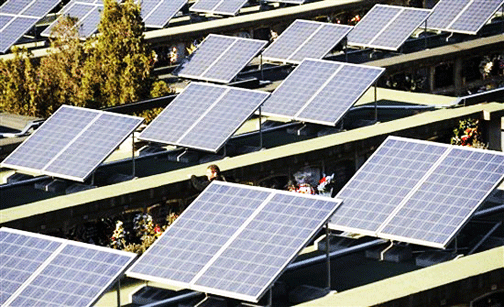 Solar PV industry has a fight on its hands, REneweconomy, By Giles Parkinson 7 August 2012 Prime Minister Julia Gillard’s speech about the need for electricity market reform is hugely welcome, but it highlights some of the challenges that the solar PV industry will face in the near and medium term future.
Gillard today outlined her plan to gain COAG agreement on changes to energy pricing regulation, moving energy towards a service than a commodity, and recognising the value of demand management and energy efficiency.
But like the rest of Labor, she and her advisors do not yet get solar. As Energy Minister Martin Ferguson and Climate Change Minister Greg Combet have said in recent weeks, Gillard trotted out the old canard: solar PV is the plaything of the rich. And who should we blame for such nonsense? Well, let’s start with AGL Energy…..Solar PV is on the cusp of becoming a game changer in Australia because it is able to deliver electricity to households cheaper than via the grid. Some say it could be the the firstmass-market for solar PV in the world. Its availability will increase massively as new financing models are introduced that offer zero cost upfront. That message is understood by some, but not by many. It has the potential to change the nature of the electricity debate and the political debate too.
AGL Energy is happy – via its highly influential series of economic papers – to demonise solar PV as a rich person’s indulgence that penalises the poor, because having great swathes of panels installed across the roofs of Australia, as envisaged by recent AEMO forecasts, does not fit easily into its business model. Nor does it fit easily with other generators and network operators, which is why many are trying to push back against its deployment with tariff changes and other regulation as we highlighted in this story How utilities propose to kill solar PV.
Yet, solar is having a demonstrable impact. According to the REC Agents Association, an industry body, the combination of energy efficiency and solar PV will reduce demand on the network by around 10,66gGWy, or 5 per cent, by 2015. Around one fifth of Australian households already have solar power or a solar hot water system.
The challenge for the solar industry is to make sure that their message is understood – not just by the public, but by the politicians too. http://reneweconomy.com.au/2012/solar-pv-industry-has-a-fight-on-its-hands-35969
In USA cashed up fossil fuel front “think tanks” wage war on renewable energy
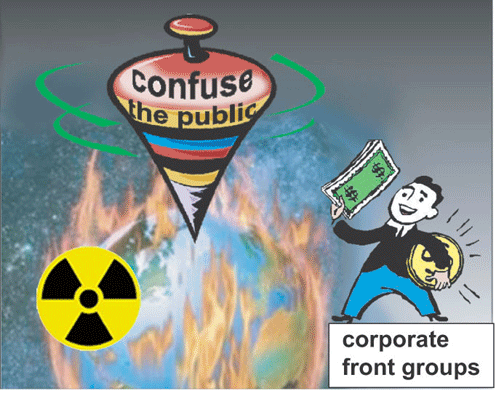 Renewable Energy Under Siege In The USA http://www.energymatters.com.au/index.php?main_page=news_article&article_id=3326 by Energy Matters, 7 Aug 12, Renewable energy faces opposition from cashed-up fossil fuel supporters in Australia; but it’s nothing compared to what is going on in the USA at the moment. While solar energy, wind power and other clean energy sources have always hit opposition in the USA, the smearing has hit new levels as the nation prepares to vote and crucial renewable energy support mechanisms are under review.
The Sierra Club has released a report revealing how the fossil fuel industry is using tactics such as financial contributions to political campaigns, fake think tanks and faux intellectuals to attack renewable energy in order to alter public opinion and the views of lawmakers. “From California to Pennsylvania, clean energy jobs are under attack by fossil fuel interest groups – yet many in Congress are sitting on their hands while tens of thousands of American jobs hang in the balance,” said Michael Brune, executive director of the Sierra Club.
The Sierra Club’s report claims the oil and gas industry spent more than $146 million on lobbying alone in 2011 and organizations such as the Manhattan Institute and the Heartland Institute that defend oil subsidies while attacking renewable energy have received in excess of $600,000 each since 1998 from the oil company Exxon. The report states the oil and gas industry contributed to 88 percent of all members of the U.S. House of Representatives and 89% of Senators in the 2010 election cycle.
Quoting data from Open Secrets; ConocoPhillips spent $20.5 million on lobbying last year and Royal Dutch Shell, $14.79 million. Add to those figures spending by ExxonMobil, Chevron, the American Petroleum Institute, and Koch Industries and the grand total comes to more than $74 million in 2011.
The report comes at a crucial time as a crucial element of support for wind energy – the Production Tax Credit (PTC) – may be lost at the end of this year. The PTC helps support the more than 75,000 jobs in the wind industry and many as half those jobs could be lost if it is not renewed.
The report, titled “Clean Energy Under Siege – Following the Money Trail Behind the Attack on Renewable Energy”, can be viewed in full here (PDF).
1 This month

of the week – Australians for War Powers Reform (AWPR)
To see nuclear-related stories in greater depth and intensity
 Antinuclear