Solar photovoltaic energy is here to stay, and to grow, in Australia
 The inevitability of Solar PV in Australia, The Energy Collective, Nigel Morris, August 8, 2012 Is 40 gigawatts by 2030 conceivable in Australia?We argue for the inevitable surprise PV has in store for us. Over the last few months, I have had the pleasure of presenting to hundreds of solar industry delegates at the EcoGeneration Master Classes held around Australia.
Inevitably, the most interesting part for me was the conversations with so many who are at the ‘coal face’; working day in, day out to sell the virtues of solar photovoltaic (PV) against rising coal-fired energy prices.
I met installers who told me that they could feel the attitude of the mass market changing, describing how the economic proposition was so compelling that conversion rates were rising, despite the declining levels of government support.
I met wholesalers who were astounded at the rate of demand from dealers, at the pull-through from the market, and that it is flowing well beyond 30 June – when the Small-scale Technology Certificate (STC) multiplier will be reduced. They are talking about short-term supply shortages, would you believe.
…….One of the most popular slides in my presentation was one that showed a snapshot of where the local market could be by 2030. This slide stems from analysis I helped produce for the Australian Energy Market Operator (AEMO) who – as a result – effectively lifted the expectations for solar PV from less than 2 gigawatts (GW) in 2030 to a potential of 18 GW. And that’s only the rooftop installations; the ‘behind-the-meter’ demand. But since the last Master Class, several fascinating events have occurred that got me thinking about how this revised projection fits into the wider context of predicting solar uptake. Continue reading
MOX plutonium fuel, and Fukushima Daiichi Nuclear Power Plant
United States Circumvented Laws To Help Japan Accumulate Tons of Plutonium, DC Bureau By Joseph Trento, on April 9th, 2012 “…….In September 2010, France’s Areva loaded the first plutonium-based mixed-oxide (MOX) fuel into Reactor Number 3 at the Fukushima Daiichi Nuclear Power Plant. As the years passed more and more Japanese leaders have become bolder in their pro-military and pro-nuclear pronouncements. In the weeks leading up to the March 2011 tsunami and nuclear disaster, the issue of a nuclear-armed Japan became very public after a Chinese captain was arrested after he rammed Japanese coast guard vessels with his ship. In an interview with the British newspaper, The Independent, Tokyo Governor Shintaro Ishihara asserted that Japan could develop nuclear weapons within a year and send a strong message to the world. “All our enemies: China, North Korea and Russia – all close neighbors – have nuclear weapons. Is there another country in the world in a similar situation?
People talk about the cost and other things but the fact is that diplomatic bargaining power means nuclear weapons. All the [permanent] members of the [United Nations] Security Council have them.” Ishihara told The Independent the clash, which ended when police released the captain of the Chinese ship accused of ramming the Japanese coast guard vessel, had exposed his country’s weakness in Asia. “China wouldn’t have dared lay a hand on the Senkakus [if Japan had nuclear weapons].”
The week before the governor made his comments, Beijing announced that its 2011 defense budget would be increased by 13 percent. Further adding to the tension with Japan is that China officially surpassed Japan as the world’s second largest economy in January 2011.
The governor said that a nuclear-armed Japan would also win more respect from Russia, which seized four Japanese-owned islands during the Second World War. And he advised his nation to rid itself of all restrictions in its constitution on the manufacture and sale of weapons. “We should develop sophisticated weapons and sell them abroad. Japan made the best fighters in the world before America crushed the industry. We could get that back.” Japanese nationalists have urged Japan’s postwar constitution, written by the United States during the American occupation, be abandoned. It makes Japan initiating war illegal.
A month after the governor made these comments, three reactors at the Fukushima nuclear power plant melted down including Reactor Number 3 with the plutonium-based MOX fuel. For the first time the larger Japanese public began to ask serious questions about the relationship between their government and the powerful Japanese utility companies and their plutonium stockpile.
A year later, more questions than answers remain. http://www.dcbureau.org/201204097128/national-security-news-service/united-states-circumvented-laws-to-help-japan-accumulate-tons-of-plutonium.html
“Violent” 82 year old anti nuclear nun could get 5 years’ gaol
 Prosecutor Kirby – “their action was a “crime of violence.” Kirby got worked up enough to hiss, “Their description of nonviolence is not right. They are willing to die for what they believe. That’s violence.”
Unarmed Octogenarian Nun Called ‘Danger to Community’ by Prosecutors Nuclear Security Unmasked
by JOHN LaFORGE, AUGUST 08, 2012 “……. something our nuclear war mafia hates as much as vampires hate daylight — is that the gravity of the Y-12 shut-down, along with the government’s wish to keep the interveners behind bars, moved prosecutors to up the charges. The three were at first charged only with federal trespass.
On Aug. 3, prosecutors added a felony count — “willful and malicious destruction or injury to a structure, conveyance, personal or real property” or its attempt — which carries a max of 5 years in prison, 3 years’ probation, and/or a $250,000 fine. Continue reading
Giant cuttlefish – a unique species under threat – especially relating to Olympic Dam uranium mine
 Let us not forget that the giant cuttlefish has only one breeding ground in the whole world. And that is in Upper Spencer Gulf – where BHP Billiton would put its desalination plant -as part of its project for the world’s biggest uranium mine at Olympic Dam. The breeding ground depends on a very special, and delicate, balance of fresh and salt water.– CM
Green group demands cuttlefish study’s release http://www.abc.net.au/news/2012-08-08/green-group-demands-better-giant-cuttlefish/4185184 August 08, 2012 The Conservation Council of South Australia is calling on the State Government to release the results of a recent study on the population of giant Australian cuttlefish near Point Lowly.
Conservation Council CEO Tim Kelly says the Government needs to announce a plan of action and immediately put the cuttlefish on a protected species list. Continue reading
Demand for power falls http://www.theage.com.au/business/demand-for-power-falls-20120808-23uk9.html#ixzz235uEjIIk August 9, 2012 Brian Robins New power stations will not be needed until 2018: forecast WEAK electricity demand will delay for several years the need to build new power stations and, when building resumes, renewable power and peaking power plants using gas will be the main new sources of energy. Continue reading
Figures show inflation effect of carbon tax mostly hot air ,
 The Courier, By Peter Martin Aug. 7, 2012, Promising signs … initial research suggests Mr Abbott’s negative comments regarding the carbon tax may have been premature.
TONY ABBOTT said its impact on the cost of living would be “almost unimaginable”. Joe Hockey said it would “drive up the price of everything”. The Senate leader of the Nationals, Barnaby Joyce, said it would force working mothers to pay “over $100 for a roast”.
Yet the first figures in on the price impact of the carbon tax show its effect contained and inflation surprisingly low. Continue reading
Nuclear reprocessing’s danger in hastening the arms race
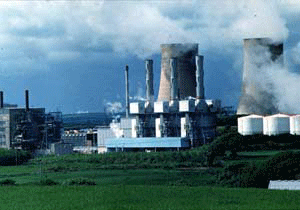
The most dangerous result of Sellafield’s reprocessing industry is the arms race it may cause on the other side of the world.
United States Circumvented Laws To Help Japan Accumulate Tons of Plutonium, DC Bureau By Joseph Trento, on April 9th, 2012“…….Besides Japan, only France, Russia and Great Britain still regard plutonium as an asset. These countries have invested tens of billions of dollars in their commercial reprocessing industry. The United States abandoned its only reprocessing facility in Barnwell, S.C., just outside the gates of the Savannah River Site without ever operating the facility.
Only huge government-owned plants in La Hague, France, and Sellafield, England, separate tons of plutonium from spent nuclear fuel for foreign customers. The biggest of these customers is Japan, which, despite its confidence in its ability to build a breeder reactor, had turned to purchasing plutonium from the British and French.
The plutonium that the French and British reprocessors return to Japan is pure enough to use in nuclear weapons, Continue reading
Solar panel popularity cuts demand
Adelaide Now, Julian Swallow August 09, 2012 REDUCED electricity consumption and growing use of renewable energy will cause a five-year delay in the need for extra generation investment in SA, a new report says. Continue reading
1 This month
To see nuclear-related stories in greater depth and intensity
– go to https://nuclearinformation.wordpress.com/


 Antinuclear