The Dirty History of Nuclear Power – theme for August 2012
 ‘The child is father to the man’ – a saying that applies so well to the nuclear industry. It was born in lies and deception, as early research into ionising radiation ( as a palliative treatment for advanced cancer) was perverted into research towards a radioactive killer. The Manhattan Project first set out to devise a weapon that would kill people, while leaving buildings etc intact – a release of radiological material.
In 1995, the US Department of Energy produced the Final Report of the Advisory Committee on Human Radiation Experiments. It states: “The first proposed military application of atomic energy was not nuclear weaponry but radiological warfare (RW) – the use of radioactive materials to produce injury“ (http://noelwauchope.wordpress.com/2012/07/15/before-the-bomb/)
Later, this aim was changed, to both devastate a city by explosive blast, (still releasing toxic radioactive materials)
After atomic bombs were dropped on Hiroshima and Nagasaki in 1945 most nuclear scientists followed the idea of the “peaceful atom” – nuclear technology would somehow be redeemed through ‘cheap’, ‘clean’ nuclear energy.
No so. Following the USA, other countries adopted nuclear reactors, in order to make nuclear bombs. This process continues today – nuclear power remains a fig leaf on nuclear weaponry – it could never have developed without the weapons industry, accompanied by government subsidies.
The nuclear lies and the nuclear killing machines have continued to this day. Nuclear power was never cheap – especially as the costs paid by indigenous peoples have never been included in estimates. Nor have the costs of the virtually endless disposal and security of nuclear wastes.
The Hibakusha of Japan, and of indigenous peoples, victims of nuclear testing
the world is still full of hibakusha who can testify to the rippling consequences of radiation exposure on health, family and community.
Nuclear testing hibakusha who have been removed from their home communities have suffered the social breakdowns
They often define themselves in relation to the colonial power that irradiated them, i.e., they are victims of French nuclear testing, of Soviet nuclear testing, of American nuclear testing
The late Mrs Milpuddie and her [Aborignal] family were found sleeping in a bomb crater. The people were taken, stripped and scrubbed. Their dogs were shot. Another family were ordered to walk to Western Australia, and ordered not to leave the track. Obeying those orders, the adults died of thirst. Only two children arrived alive.
 Hibakusha: Hiroshima, Nagasaki and Beyond . Dr Bo Jacobs 11 Aug 12, http://www.dianuke.org/hibakusha-hiroshima-nagasaki-robert-jacobs/ Hundreds of hibakusha gather in Hiroshima today, and in Nagasaki on 9 August. Many more will stay away from such commemorations, preferring to spend these anniversaries in private. Almost all of these hibakusha were children when their families were attacked with nuclear weapons: and it is these grown children who remain to bear witness.
While over 70,000 people were killed in Hiroshima on the day that the US dropped an atomic bomb on the city center in August 1945, even more people became survivors of that attack. Many tens of thousands would die in the coming weeks, months and years, but some would live long and full lives. Their lives would forever be marked by this experience. Many have never shaken the trauma of expecting that they would die, having watched their family and their friends die, having
seen an endless horizon full of the dead and dying and the corpses of people and animals burned beyond recognition, and of seeing their homes and city disappear into fire and rubble.
Beyond the epidemiological and psychological affects on the hibakusha, the social impacts were often as devastating. Experiencing discrimination in marriage and employment, many were also plagued by their own worries about whether to have children, and by anxieties that every subsequent cold or flu that they or their children experienced might be the first signs of an impending fatal illness. In a sense the nuclear attacks on Hiroshima and Nagasaki never ended. Continue reading
Australian uranium miner Paladin lost $39 billion in 9 months
 Uranium mine lost K39 billion in 2011 , The Maravi Post, 10 Aug 12 BLANTYRE–The Kayekelera uranium mine in Karonga, which is operated by Paladin Energy Limited of Australia, lost K39 billion in nine months of operation ending March 2012 due to fluctuating prices of the commodity on the international market, the company’s top official has said.
Greg Walker, general manager for international affairs, told the Daily Times Business that the loss was a result of the historic earthquake in Japan that produced a Tsunami in March last year. Spot price for uranium oxide dropped from $75 (some K21, 000) to $47.50 (K13, 000) after the closure of Fukushima nuclear plant in Japan.
Walker said now the price is at $49.50 -K14,000 – saying this was below the direct cost of production at Kayelekera, the country’s biggest investment. Walket told the daily that Paladin have bankrolled $145 million–K41 billion- to keep the mine afloat… http://www.maravipost.com/malawi-news/society/1486-uranium-mine-lost-k39-billion-in-2011.html#.UCbaJ6FlT4Y
Rare Earths Reprocessing in Australia
Note – I am not opposed to the mining and reprocessing of rare earths. I recognise that they are a necessary “lesser evil” in the development of modern and renewable technologies. BUT – rare earths reprocessing does produce toxic radioactive wastes, and the disposal of these wastes is an important issue that must be adressed, and clearly shown [ rather than spun] to the public. – Christina Macpherson
 Whilst working with Alkane on a pilot rare earths processing plant, ANSTO has previously partnered with BHP Billiton at the Olympic Dam mine, Energy Resources Australia at the Ranger uranium mine, and a number of other Australian-based miners.
Chalmers marked final government approvals as other major hurdles beyond the research with ANSTO.
And while so far steering clear of local opposition, the company remains mindful of the importance of keeping those outside the industry on side.
All eyes on ANSTO, Australian Mining, 10 August, 2012 Andrew Duffy “….. On a tour of its ANSTO pilot plant Alkane managing director Ian Chalmers told Australian Mining the company [ Alkane Resources ] was aiming to be producing rare earths by 2015…..
The company also runs tours for schools and interested community members to ensure everyone’s well informed.
Chalmers told Australian Mining Alkane’s close relationship with the community had been part of the reason why the company had avoided the difficulties faced by Lynas. Lynas has faced significant community opposition to its rare earth
processing plant in Malaysia, and protestors have been the source of ongoing delays, cost blowouts, and multiple court battles. ….
while the company’s community and environmental relations are a focus, the research at its ANSTO plant is all about the science behind rare earths processing. Continue reading
Lynas rare earths project in trouble: investment advice to dump Lynas
 Analysts recommend investors dump Lynas Australian Mining, 10 August, 2012 Andrew Duffy Foster Stockbroking has recommended investors sell shares in Lynas because the company’s rare earths processing plant in Malaysia is likely to face further delays. In an investor note today Foster said approval of the Lynas Advanced Materials Plant had been “a drawn out saga” and the upcoming Malaysian election would force further delays.
“Appeals by local groups and the opposition party regarding the environmental impacts of the plant have resulted in the LAMP becoming a politically sensitive issue and delayed a final decision on issuing the licence,” Foster analysts said…..
http://www.miningaustralia.com.au/news/analysts-recommend-investors-dump-lynas?fb_ref=.UCX0ch5fn6U.like&fb_source=home_oneline
Who will rid the nuclear industry of this troublesome nun?
The actions of Sister Rice, a New York native who grew up on a prosperous block in Morningside Heights, and her companions, ages 57 and 63, are a huge embarrassment for President Obama
“It’s the criminality of this 70-year industry,” she said. “We spend more on nuclear arms than on the departments of education, health, transportation, disaster relief and a number of other government agencies that I can’t remember.”

The Nun Who Broke Into the Nuclear Sanctum. NYT, By WILLIAM J. BROAD August 10, 2012 She has been arrested 40 or 50 times for acts of civil disobedience and once served six months in prison. In the Nevada desert, she and other peace activists knelt down to block a truck rumbling across the government’s nuclear test site, prompting the authorities to take her into custody.
She gained so much attention that the Energy Department, which maintains the nation’s nuclear arsenal, helped pay for an oral history in which she described her upbringing and the development of her antinuclear views.
Now, Sister Megan Rice, 82, a Roman Catholic nun of the Society of the Holy Child Jesus, and two male accomplices have carried out what nuclear experts call the biggest security breach in the history of the nation’s atomic complex, making their way to the inner sanctum of the site where the United States keeps crucial nuclear bomb parts and fuel.
“Deadly force is authorized,” signs there read. “Halt!” Images of skulls emphasize the lethal danger. Continue reading
Cree Nation enacts permanent ban on uranium mining in James Bay territory
 James Bay Cree Nation enacts permanent uranium moratorium in James Bay territory, The First Perspective (Canada) Crees “determined to protect our way of life against the unique and grave threat posed by uranium mining and waste, today and for thousands of years to come”. Waskaganish, QC, Aug. 9, 2012 – The James Bay Cree Nation has declared a Permanent Moratorium on uranium exploration, uranium mining and uranium waste emplacement in Eeyou Istchee, the James Bay Cree territory. The permanent moratorium was enacted unanimously by the Annual Cree Nation General Assembly in Waskaganish.
“The risks inherent in uranium exploration, mining, milling, refining and transport, and in radioactive and toxic uranium mining waste, are incompatible with our stewardship responsibilities in Eeyou Istchee,” the Resolution declares.
“The Cree Nation is determined to protect our economies and way of life against the unique and grave threat posed by uranium mining and uranium waste, today and for thousands of years to come,” said Grand Chief Dr. Matthew Coon Come. “We are not opposed to sustainable and equitable mining and other industrial and resource development activities in Eeyou Istchee – but the toxic and radiation risks created by uranium mining and uranium waste are unique in scale and duration.” Continue reading
Leaked report: threat of Mururoa nuclear test site collapsing
the report doesn’t properly emphasise the serious threat posed by the buried radioactive material. “In this report that we got not too long ago, they’re not even talking about radioactivity,” “The way they present it it’s like it’s not very dangerous.”
Nuclear fears over French Polynesia atoll collapse http://www.radioaustralia.net.au/international/2012-08-10/nuclear-fears-over-french-polynesia-atoll-collapse/996942 10 August 2012, A leaked report has raised new fears that Murorua Atoll, the site of French nuclear testing in the Pacific, is in danger of collapsing. Murorua e Tatou says the issue was detailed in a leaked report from the Ministry of Defence to the French government dated March 2010.
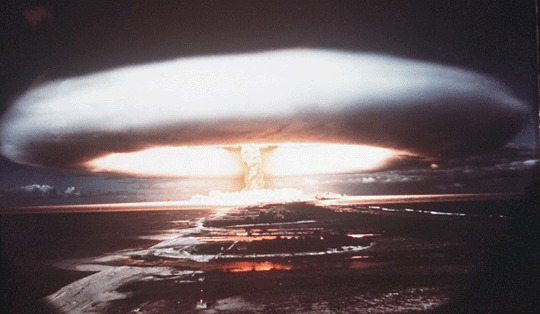
The Nuclear Association’s president, Roland Oldham, told Radio Australia’s Pacific Beat program that radioactive material could be released into the Pacific Ocean if the atoll were to collapse.
“Just in that little area there is over maybe twelve underground tests in that area and we have to remember that France have done altogether 193 nuclear test explosions in Murorua,” he said. “In the soil of Muroroa, if something happens there are about 150 holes containing very dangerous radioactivity.”
The association says if the atoll were to collapse it could also trigger a 15 metre tsunami. ‘Hidden information’
Mr Oldham is concerned the government didn’t make the report available to the public earlier. Continue reading
Any new bulk electricity generation in Australia will be sourced only from renewables
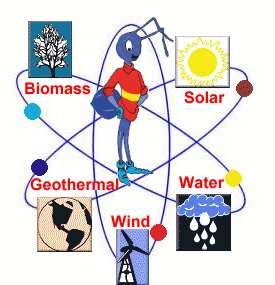 The only new generation that will be built in any great quantity in the next decade will be renewables THE AUSTRALIAN BY: GILES PARKINSON August 10, 2012 LAST year was a notable one for the global green energy industry: for the first time, the value of new generation exceeded that of fossil fuels. According to Bloomberg New Energy Finance, $US187 billion ($176bn) was invested across the globe in new plants generating electricity from the wind, sun, waves and biomass, while $US157bn was invested for natural gas, oil and coal. It is not a trend that is expected to be reversed.
This figure is rarely mentioned at home. Yet Australia seems destined for an even more dramatic turnaround in energy investment.
As the annual Electricity Statement of Opportunities published by the Australian Energy Market Operator concluded this week, there was no need for any new coal or gas baseload generation in the country for the next decade.
The only new generation that will be built in any great quantity will be renewables. Most of this will come from wind, which accounts for more than 90 per cent of the green energy plans, although solar may play a more prominent role in years to come. Continue reading
Australian breakthrough in solar energy storage
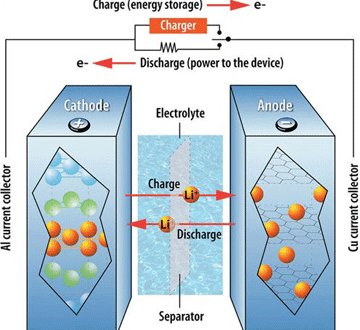
The picture at left is of a typical Lithium ion battery, not the sodium ion one. But I do my best! – CM
Australian scientists make renewable energy storage breakthrough, Home Heating Guide By Katie Anderson August 10, 2012 Although renewable energy technologies have come on leaps and bounds in the last couple of decades, a solution to economical energy storage remains a big stumbling block in the quest to generate more energy with sustainable technologies and to make renewable energies more affordable. However a team of scientists in Australia are one step closer to finding a viable solution in terms of storing solar and wind energy for use in non-generation times – at night and during windless days. And it comes in the form of a water-based sodium-ion battery , developed by researchers from the School of Chemical and Mathematical Sciences at Murdoch University in Perth, Western Australia. Continue reading
Australia’s Prime Minister aware of the importance of distributed solar energy
 Julia Gillard made two key points – apart from drawing attention to the massive overspend on
  poles and wires – about the energy systems of the future in her speech on Tuesday. One was about the introduction of smart technologies, and the other was about the power of choice. “People should be able to use what they want when they want it, and cut out expensive services they don’t need,”
new technologies are now offering alternatives and distributed generation has become cost-competitive and reliable
Do energy consumers want a smart grid, or no grid at all? REneweconomy, By Giles Parkinson on 8 August 2012 Robin Gudgel, the founder of Californian energy firm Midnite Solar, has been helping people provide their own electricity – mostly with renewable energy sources and batteries – for their homes and small businesses for several decades. …. now it’s more of a mainstream trend – people living where the grid doesn’t reach, and some who want to look after themselves because they want to make a statement about their green credentials, or their independence.
“Very seldom do you get people who get mad as hell about electricity prices and go off grid. It simply costs too much,” Gudgel told RenewEconomy during a recent visit to Australia. That may well be the case in mainland USA, where electricity prices are relatively benign.
But in Hawaii, where electricity prices are three times higher, customers are getting as mad as hell and are reportedly leaving the grid in droves. So is the US military…… Energy independence is the big new strategic play of the US military brass. And it’s on the wish list of consumers.
Why does this matter to Australians? Well, it turns out that Hawaii and Australia have a lot in common. Both are islands, both have plenty of sun, and both have really high retail electricity prices – Hawaii because it relies on imported fuel and Australia because of its massive network infrastructure, much of which may be surplus to requirements – and both have falling energy demand. Continue reading
Olympic Dam anti uranium protestors facing court
 Olympic Dam protest has court sequel http://www.abc.net.au/news/2012-08-09/olympic-dam-protest-charges-heard/4188096?section=sa August 09, 2012 Some of the protesters arrested near the Olympic Dam mine recently have faced the Magistrates Court at Port Augusta. Those who pleaded guilty were fined $150 and had no conviction recorded. Others who did not attend or pleaded not guilty will face a pre-trial conference in mid-September.
One man who was charged with interfering with a motor vehicle for allegedly chaining himself to a semi-trailer refused to enter a plea. He argued the court had no jurisdiction over him as he observed the laws of the Arabunna nation.
He also refused to stand in the dock, claiming it was where criminals stood and he was not a criminal.
Hundreds of people protested near the BHP Billiton mine, urging it be closed down rather than expanded.
Australia’s newest uranium customer moving big time into the nuclear weapons race
India test-fires nuclear capable Agni-II missile, Hindustan Times, Balasore, Odisha, August 09, 2012 Sharpening its missile teeth, India on Thursday successfully test-fired its medium range nuclear capable Agni-II missile with a strike range of 2000km as part of a user trial by the Army from the Wheeler Island off Odisha coast. …..
http://www.hindustantimes.com/India-news/Odisha/India-successfully-test-fires-Agni-II-missile/Article1-910715.aspx

India to launch nuclear submarine in arms race, The Age, 11 Aug 12. INDIA will soon launch its first home-built nuclear submarine, capable of firing ballistic missiles, as the country escalates an arms race with China and Pakistan.
INS Arihant, planned to be the first of five of its class, would soon be ready to begin sea trials, said Admiral Nirmal Verma, the Indian navy’s chief of staff. When the vessel is operational, India will be able to launch nuclear missiles from the sea, land and air, joining a handful of countries possessing the ”nuclear triad”. …. http://www.theage.com.au/world/india-to-launch-nuclear-submarine-in-arms-race-20120810-23zxh.html#ixzz23Hk1Y1bg
1 This month

of the week – Australians for War Powers Reform (AWPR)
To see nuclear-related stories in greater depth and intensity
 Antinuclear